

On this page
Most students sit mocks whenever there is a free slot. That builds knowledge, but it does not test the exam day itself, with its own clock, rules and small things that go wrong. A rehearsal mock is one full paper sat exactly as the real one will be, so the surprises happen at home, weeks early, instead of in the hall.
Why does the time of day matter for a mock test?
Hans Henrik Sievertsen, Francesca Gino and Marco Piovesan analysed the national test scores of all children in Danish public schools from 2009/10 to 2012/13 (PNAS, 2016). For every hour later in the day a test was taken, performance fell by 0.9% of a standard deviation. A 20- to 30-minute break before the test raised average performance by 1.7% of a standard deviation. The effects are small but real.
The NTA information bulletin for NEET (UG)-2026 set NEET-UG 2026 as a single-shift, three-hour pen-and-paper exam from 2:00 pm to 5:00 pm IST. If every mock you sat started at 8 am, you have never tested how you think at 3:30 pm, after lunch and a journey. Take the exact reporting and start times from your admit card and the latest official notices.
What counts as real exam conditions at home?
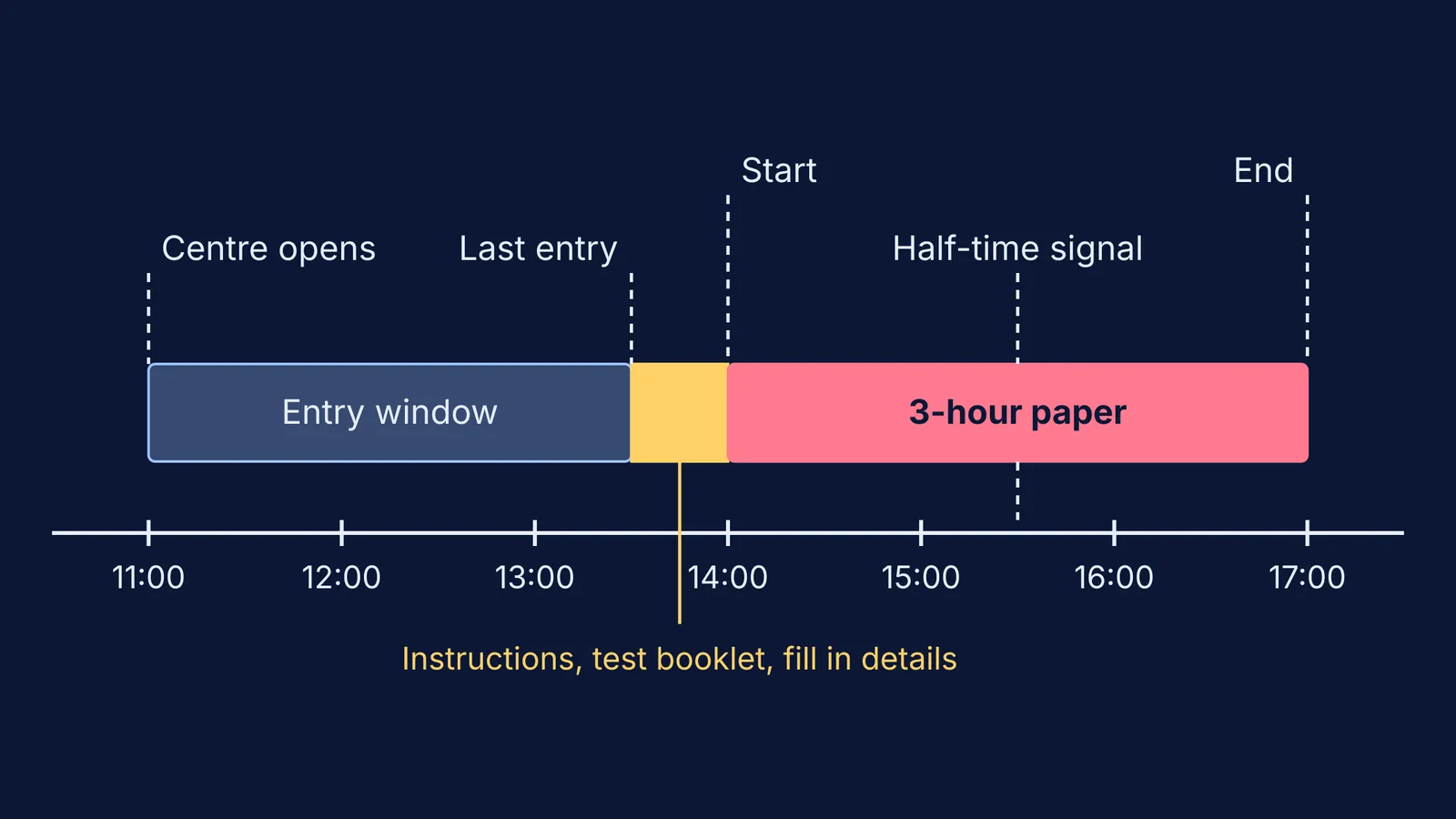
Copy the rules, not just the paper. Chapter 13 of the 2026 NEET-UG bulletin set out the day:
The centre opened at 11:00 am and last entry was 1:30 pm.
Instructions and admit-card checks ran from 1:30 to 1:45 pm, the test booklet came at 1:45 and candidates wrote their details at 1:50.
A signal was given at the start and at half-time.
No candidate could leave their seat or the hall until the test ended.
Water bottles, tea, coffee, cold drinks and snacks were barred. Candidates with diabetes could bring sugar tablets, fruit and transparent water bottles, but not packed foods.
Rules shift within a year: the bulletin barred water bottles, but an NTA advisory dated 30 April 2026 allowed transparent water bottles and said light clothing and slippers or low heels were preferred.
The hall will still feel new. A meta-analysis by Steven Smith and Edward Vela found that the surrounding environment has a reliable effect on memory, and that mentally reinstating the original setting at test reduced that effect (Psychonomic Bulletin & Review, 2001). If you blank in the hall, try picturing where you studied that topic.
How to run a full mock rehearsal: a plan for a 2 pm paper
Pick one day two to three weeks before the exam.
Wake at your exam-day time, eat your planned meals and wear what you will wear to the centre.
At 1:30 pm, sit at a cleared table with only what is permitted: pen, admit-card printout, water if allowed. Phone in another room.
At 1:45, someone hands you a paper you have not seen. At 1:50, fill your details on a printed answer sheet.
Start at 2:00 sharp. Do not get up until 5:00. At 3:30, note which question you have reached.
At 5:00, pens down. Write your failure log before you check a single answer.
If your exam is on screen, rehearse at your shift time on a computer-based mock instead of paper; our guide to using NTA's official mock tests explains how.
What usually fails, and how do you fix it before exam day?
Write one line per problem, with a fix beside it:
Sleepy around 3 pm: change the lunch and test it again.
Too cold or too warm: plan layers within the dress rules.
Bubbling took longer than expected: practise filling the sheet, and read our guide to NEET OMR sheet mistakes.
Behind at half-time: set a question number you must reach by the half-time signal.
Careless errors in the last hour: plan a short checking pass for the end.
Then mark the paper with a 60-minute mock review routine. If the log shows you used the wrong method on a question type, the Fermi Problem Library has worked problems with a step-by-step solver that explains the reasoning rather than printing an answer. If it shows a concept you never quite understood, look it up in the Fermi Concept Library.
How can parents help with a rehearsal mock?
Be the calm invigilator. A short script: "It's 1:45, here is your booklet. Write your details." Then "Half-time" at 3:30, and "Pens down" at 5:00. Afterwards, ask "What went wrong with the day?" before asking about marks.
Pressure in a rehearsal is not wasted. In a study by Amy Smith, Victoria Floerke and Ayanna Thomas, people who learned material by taking practice tests showed no stress-related drop in recall, while those who learned by restudying did (Science, 2016).
The Press Information Bureau describes Tele MANAS, the government's toll-free helpline on 14416, as a 24x7 service across India.
Pick your rehearsal date today and block the exam hours on the family calendar.


