On this page
Sequence-and-series questions in JEE Main can give you two of the three classical means of a pair of numbers and ask for the numbers. The NTA's JEE (Main) 2026 syllabus lists "Relation between A.M and G.M." under Mathematics Unit 6, Sequence and Series. The harmonic mean comes in through one identity. Once you can prove it yourself, these questions turn into a quadratic you can solve in a few lines.
What are the AM, GM and HM of two numbers?
Take two positive numbers a and b. Their three means are below; the harmonic mean formula is the two-number form given in the harmonic mean entry on Wolfram MathWorld and on Wikipedia:
Arithmetic mean: A = (a + b)/2
Geometric mean: G = √(ab)
Harmonic mean: H = 2ab/(a + b)
The harmonic mean is the reciprocal of the average of the reciprocals: 1/H = (1/a + 1/b)/2. That is why harmonic progressions turn into arithmetic progressions when you flip every term, a trick covered in our guide to solving harmonic progression problems by flipping to an AP.
Why is G² = AH for two numbers?
Multiply A by H:
A × H = [(a + b)/2] × [2ab/(a + b)]
The 2s cancel, and so does (a + b), leaving A × H = ab
But ab = G², so G² = AH
For two numbers, G² = AH, which means G is itself the geometric mean of A and H. MathWorld writes the same fact as H = G²/A. In other words, A, G and H are three consecutive terms of a geometric progression.
Why is A ≥ G ≥ H?
First show A ≥ G. Write A − G = (a + b)/2 − √(ab) = (√a − √b)²/2. A square is never negative, so A − G ≥ 0. It equals zero only when √a = √b, that is, when a = b.
Now use G² = AH to get G ≥ H for free. Dividing by A gives H = G × (G/A). Since G/A ≤ 1, H ≤ G. Wikipedia's harmonic mean article uses the same argument for the two-number case. Putting the two halves together gives A ≥ G ≥ H, with equality throughout only when a = b.
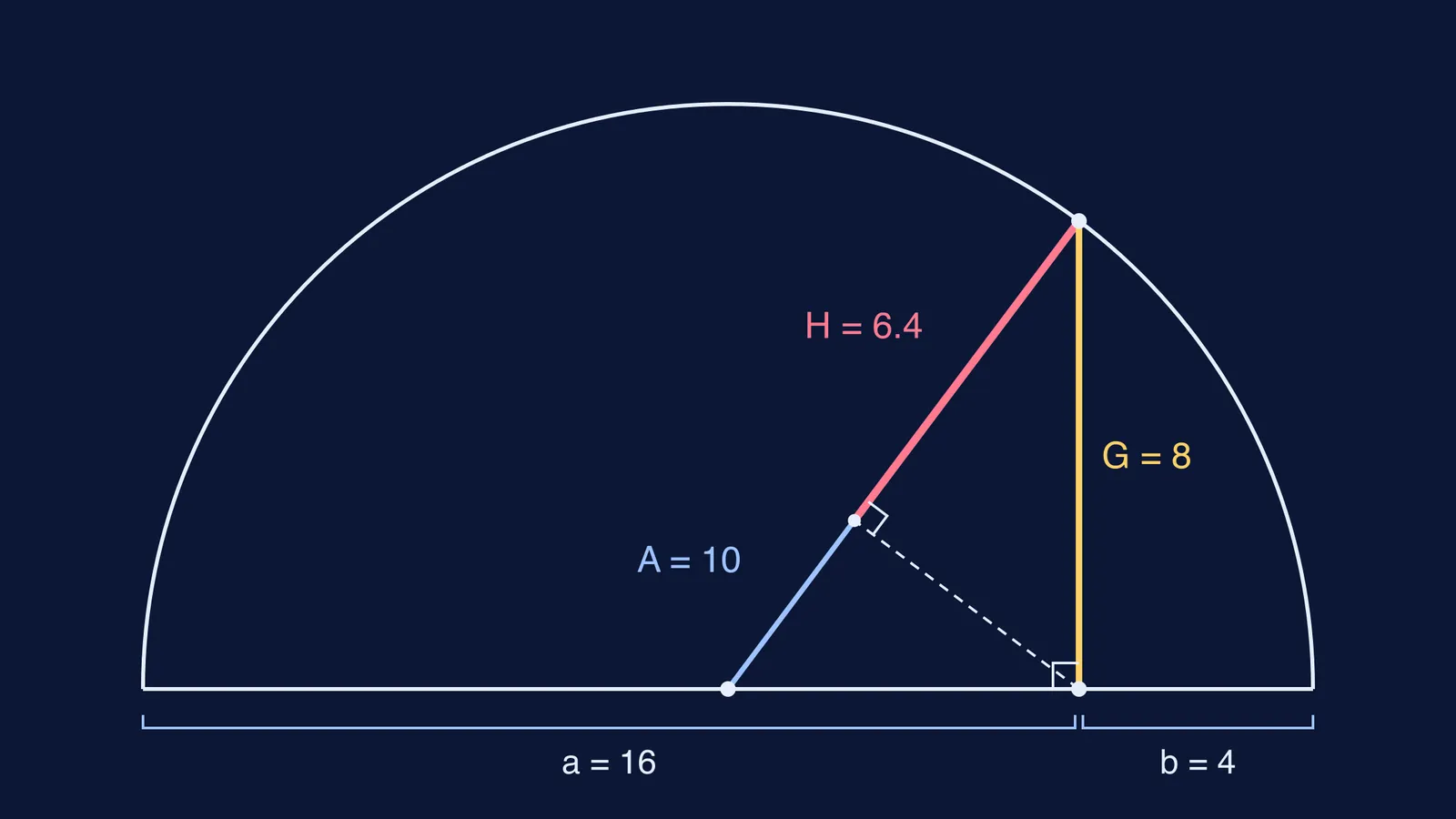
If you would like to see A ≥ G as a picture first, the hero diagram above draws all three means in one semicircle. Our post on the visual proof of AM-GM with a semicircle walks through a similar picture.
How do you find two numbers from their AM and HM?
Here is a typical JEE-style question: the arithmetic mean of two numbers is 10 and their harmonic mean is 6.4. Find the numbers.
Sum: a + b = 2A = 20.
Product: ab = G² = AH = 10 × 6.4 = 64.
The numbers are the roots of x² − (sum)x + (product) = 0, that is, x² − 20x + 64 = 0.
Factorise: (x − 4)(x − 16) = 0, so the numbers are 4 and 16.
Check: A = (4 + 16)/2 = 10, G = √64 = 8, H = 2 × 64/20 = 6.4. Also, 8² = 10 × 6.4, so G² = AH holds.
The method works because the AM gives you the sum and G² = AH gives you the product. Those are exactly the two numbers a quadratic needs.
Try one yourself: A = 5 and H = 3.2. The sum is 10 and the product is 16, so the numbers are 2 and 8, and G = 4.
What mistakes cost marks on AM, GM and HM questions?
Run through this checklist before you mark an answer:
Did you use the HM formula 2ab/(a + b), not (a + b)/2ab? The second one is the reciprocal of the HM.
Are both numbers positive? The geometric mean √(ab) and the ordering A ≥ G ≥ H assume they are.
Did you use G² = AH for exactly two numbers, not three?
Does your answer satisfy A ≥ G ≥ H? If your G comes out bigger than your A, an arithmetic slip is hiding somewhere.
Did you substitute your answer back into all the given means?
The same inequality is also a tool for maximum and minimum questions. Our guide to using the AM-GM inequality in JEE maths covers when to use it there.
If you get the method wrong partway through a problem like this, the Fermi Problem Library has worked problems with a step-by-step solver that explains the reasoning rather than printing an answer. If what's missing is the idea itself, the Fermi Concept Library covers every concept in mathematics, each with its own lesson.