

On this page
Johan Jensen, a Danish mathematician, published the inequality that carries his name in 1906 in the journal Acta Mathematica (Jensen, Sur les fonctions convexes et les inégalités entre les valeurs moyennes, Acta Mathematica 30, pages 175-193). It turns many inequalities from school and olympiad maths, including AM-GM, into one check: is the function curving up or curving down?
What does convex mean, and how do you check it?
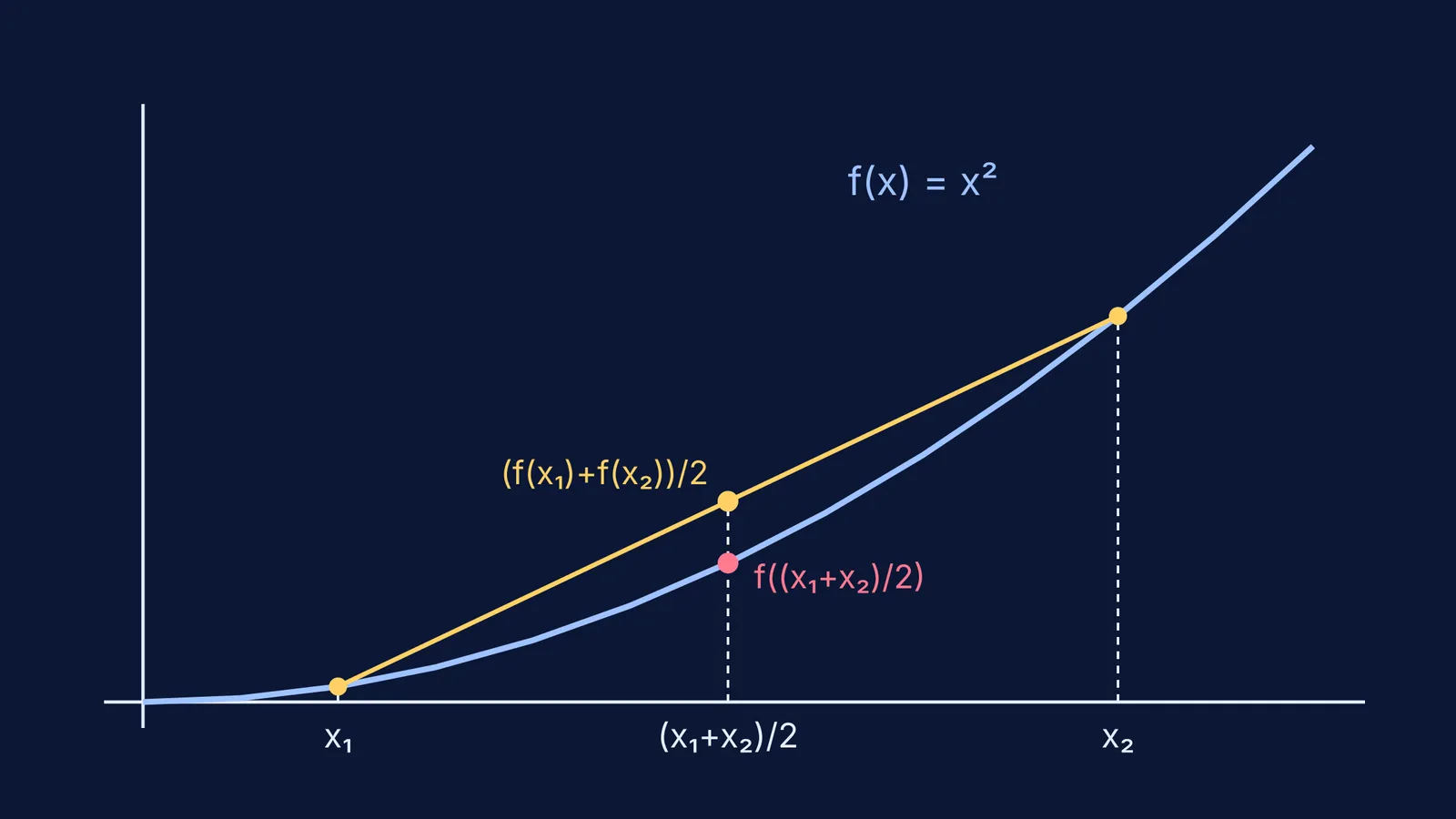
A function is convex on an interval if the chord joining any two points of its graph lies on or above the graph. A twice-differentiable function of one variable is convex on an interval exactly when its second derivative is non-negative there (Wikipedia: Convex function). If f'' ≤ 0 instead, the function is concave and every chord lies on or below the graph.
Three functions you will meet again and again:
f(x) = xⁿ for x > 0 and n ≥ 1: f''(x) = n(n − 1)xⁿ⁻² ≥ 0, so convex.
f(x) = ln x for x > 0: f''(x) = −1/x², so concave.
f(x) = sin x on [0, π]: f''(x) = −sin x ≤ 0, so concave there, though convex on (π, 2π).
If the second derivative test feels shaky, our explainer on why f'' < 0 means a maximum draws the picture.
What does Jensen's inequality say?
Take weights w₁, …, wₙ that are non-negative and add to 1. If f is convex on an interval containing x₁, …, xₙ, then
f(w₁x₁ + … + wₙxₙ) ≤ w₁f(x₁) + … + wₙf(xₙ).
In words: for a convex function, the value at an average is at most the average of the values; for a concave function the inequality flips (Wikipedia: Jensen's inequality). If f is strictly convex (f'' > 0), equality holds only when all the xᵢ with positive weight are equal, which gives you the equality case in a proof.
How do you get AM-GM from Jensen's inequality?
Use the concavity of ln. For positive x₁, …, xₙ and weights that add to 1, Jensen for a concave function gives
ln(w₁x₁ + … + wₙxₙ) ≥ w₁ ln x₁ + … + wₙ ln xₙ = ln(x₁^w₁ ⋯ xₙ^wₙ).
Since eˣ is increasing, take exponentials of both sides:
w₁x₁ + … + wₙxₙ ≥ x₁^w₁ x₂^w₂ ⋯ xₙ^wₙ.
That is the weighted AM-GM inequality. Put every wᵢ = 1/n and you get the familiar one: (x₁ + … + xₙ)/n ≥ (x₁x₂⋯xₙ)^(1/n), with equality only when all the xᵢ are equal, because ln is strictly concave. Our post on the relation between AM, GM and HM of two numbers proves the two-number case by algebra; Jensen gives every n at once.
How do you use Jensen's inequality on a problem?
A four-step routine handles most problems:
Spot the function: the expression is a sum of the same f applied to different variables.
Check the sign of f'' on the interval where the variables actually live, not on all real numbers.
Choose weights that add to 1, usually equal, so that the average inside f is a quantity the problem fixes (a sum, a perimeter, A + B + C = π).
Write the equality case and check that it can happen. If it cannot, Jensen alone will not give the sharp bound.
Example 1: sines in a triangle. Prove sin A + sin B + sin C ≤ 3√3/2 for the angles of any triangle. Each angle lies in (0, π), where sin is concave. With weights 1/3 each,
(sin A + sin B + sin C)/3 ≤ sin((A + B + C)/3) = sin(π/3) = √3/2.
Multiply by 3. Equality holds for the equilateral triangle.
Example 2: powers. If a, b, c > 0 and a + b + c = 3, prove a⁴ + b⁴ + c⁴ ≥ 3. Here f(x) = x⁴ has f''(x) = 12x² ≥ 0, so it is convex. Jensen gives
(a⁴ + b⁴ + c⁴)/3 ≥ ((a + b + c)/3)⁴ = 1,
so the sum is at least 3, with equality at a = b = c = 1.
Where does Jensen's inequality go wrong?
Mixed concavity. tan x is convex on (0, π/2), so tan A + tan B + tan C ≥ 3√3 holds in an acute triangle. In an obtuse triangle one angle leaves that interval, and since tan A + tan B + tan C = tan A tan B tan C with one negative factor, the sum is actually negative.
Flipped direction. Convex means the value at the average is at most the average of the values. Sketch the chord over the curve to remember which way it goes.
An equality case you cannot reach. If equal variables break a constraint, the true bound needs another method, such as the rearrangement inequality or a tangent-line argument.
To revise convexity, AM-GM and inequalities one idea at a time, the Fermi Concept Library covers every concept in mathematics, physics, chemistry, biology and computing. When a proof stalls, the Fermi Problem Library has a step-by-step solver that explains the reasoning, so you can see which step broke.


