On this page
Most students learn the second derivative test as a rule: negative means maximum, positive means minimum. Then the exam twists the question and the rule falls apart. The fix is to picture the tangent line and the way it turns as you slide along the curve.
What does the second derivative test say?
The test is stated in OpenStax Calculus Volume 1, section 4.5. Suppose f′(c) = 0 and f″ is continuous near c. Then:
If f″(c) > 0, f has a local minimum at c.
If f″(c) < 0, f has a local maximum at c.
If f″(c) = 0, the test is inconclusive.
The same book defines concavity through the slope itself: f is concave up where f′ is increasing and concave down where f′ is decreasing (OpenStax, section 4.5). The test is all about the slope, not the height.
Why does f″ < 0 mean a maximum?
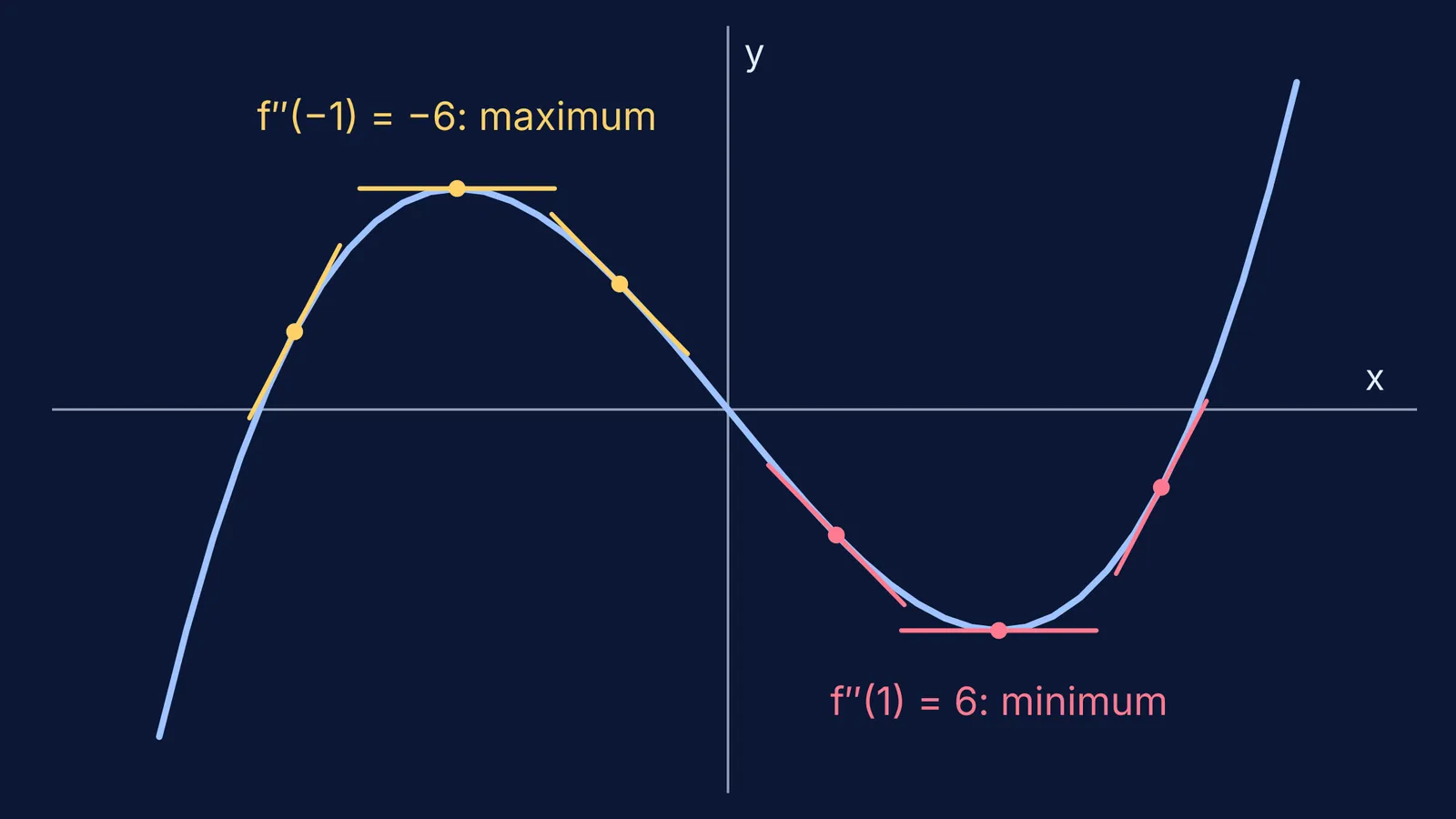
Imagine laying a ruler flat against the curve and sliding it towards the top of a hill. On the way up the ruler tilts upwards, so the slope f′ is positive. At the very top it lies flat, so f′ = 0. On the way down it tilts downwards, so f′ is negative.
Watch what the ruler did: it turned steadily clockwise. The slope went from positive, through zero, to negative. A falling slope is a decreasing f′, and the rate of change of f′ is f″. So f″ < 0 means "the tangent is turning clockwise here". If it is turning clockwise at the moment it lies flat, it was rising just before and is falling just after. That is a peak.
For a valley, run the film the other way. The ruler tilts down, flattens, then tilts up. It turns anticlockwise, f′ is increasing, f″ > 0, and the flat point is a minimum.
This idea is easier to see than to read, which is what the interactive simulations in the Fermi Simulation Lab are for.
A worked example: f(x) = x³ − 3x
This is the curve in the diagram above, set out as you would in a JEE Main or board exam answer.
Differentiate: f′(x) = 3x² − 3.
Find the flat points: 3x² − 3 = 0 gives x = 1 or x = −1.
Differentiate again: f″(x) = 6x.
Test x = −1: f″(−1) = −6, which is negative, so the tangent is turning clockwise. Local maximum, with f(−1) = 2.
Test x = 1: f″(1) = 6, which is positive, so the tangent is turning anticlockwise. Local minimum, with f(1) = −2.
Sanity check: f″(x) = 6x changes sign at x = 0, so the curve switches from concave down to concave up there. So (0, 0) is an inflection point, which OpenStax defines as a point where the function changes concavity.
When does the second derivative test fail?
The test only gives an answer when f″(c) is not zero. Paul's Online Math Notes describes it as a method for identifying "some critical points (but not all)". The standard examples, all from OpenStax, share the same flat point at x = 0 with f″(0) = 0:
f(x) = x⁴ has a local minimum at 0.
f(x) = −x⁴ has a local maximum at 0.
f(x) = x³ has neither. The tangent is flat for an instant but the curve keeps rising.
In picture terms, f″(c) = 0 means the tangent is not obviously turning at that instant, so you cannot tell from that moment alone what happens next. The test also needs f to be twice differentiable at the point (Wikipedia, second derivative test), so a sharp corner such as |x| at 0 is outside its reach.
When it fails, you have two good options:
First derivative test. Check the sign of f′ just left and just right of c. Plus to minus means a maximum, minus to plus means a minimum, and no change means neither. For x³, f′ = 3x² is positive on both sides, so there is no extremum.
Higher derivatives. Keep differentiating until one is non-zero at c. If its order is even, you have a maximum (negative) or minimum (positive). If its order is odd, there is no extremum (Wikipedia). For x⁴ the fourth derivative is 24, which is even order and positive, so it is a minimum.
How do you use the test in an exam question?
Set f′ = 0 and list every flat point.
Find f″ at each one. Negative: maximum. Positive: minimum.
If f″ is zero, do not guess. Switch to the sign of f′ on either side.
Sketch three tiny tangents (before, at, after) to check your answer by eye.
If the slope-versus-turning idea still feels slippery, the Fermi Concept Library gives each concept in mathematics its own lesson. Try sketching the three tangents for −x⁴ before you look anything up.