On this page
A zero-sum game is one where the advantage to one side is matched by an equivalent loss to the other (Wikipedia: Zero-sum game). Here is how to solve one by hand: first with a saddle point, then, when there is none, with a mixed strategy.
What is a payoff matrix in a zero-sum game?
Write player A's choices as rows and player B's as columns. Each entry is what B pays A, so one number per cell is enough: A wants it large, B wants it small. Unlike the prisoner's dilemma, the players can never both do better together.
How do you find a saddle point?
A saddle point of a matrix is an entry that is both the smallest in its row and the largest in its column (Wikipedia: Saddle point). To find one:
Take the minimum of each row. The largest is the maximin, the most A can guarantee.
Take the maximum of each column. The smallest is the minimax, the least B can hold A to.
If they are equal, that entry is a saddle point and the value of the game.
Try this matrix, rows for A and columns for B:
Row 1: 4, 2, 5
Row 2: 1, −1, 3
Row 3: 6, 0, −2
The row minima are 2, −1 and −2, so the maximin is 2. The column maxima are 6, 2 and 5, so the minimax is 2. They match at row 1, column 2: the value is 2, and neither player gains by switching alone.
How do you solve a 2×2 game with no saddle point?
In matching pennies, two players each show heads or tails; if the coins match, Even wins the other's penny, and if they differ, Odd wins (Wikipedia: Matching pennies). Even's matrix is +1, −1 in the first row and −1, +1 in the second. The maximin is −1 and the minimax is +1: no saddle point, and any fixed choice can be read and punished.
The answer is a mixed strategy: randomise, with probabilities that make the opponent's choices pay off equally. If Even plays heads with probability p, Even expects 2p − 1 when Odd shows heads and 1 − 2p when Odd shows tails. Setting them equal gives p = 1/2 and value 0, the equilibrium that page describes.
Here is a worked example with a penalty kick. These practice numbers are made up; entries are the chance of a goal:
Kick left: 0.60 if the keeper dives left, 0.95 if right
Kick right: 0.90 if the keeper dives left, 0.70 if right
Saddle point? Row minima 0.60 and 0.70 give a maximin of 0.70. Column maxima 0.90 and 0.95 give a minimax of 0.90. No saddle point.
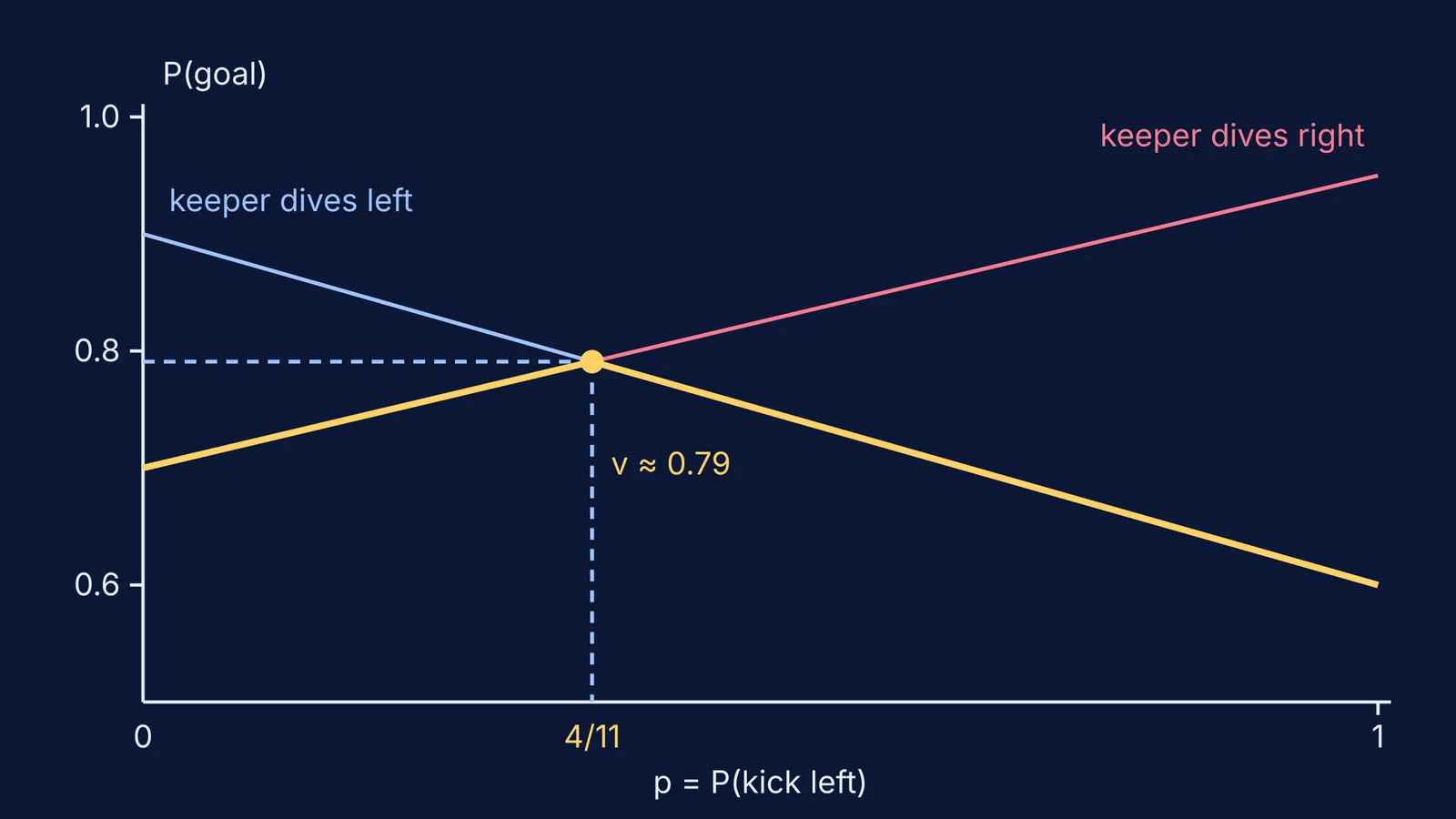
Kicker kicks left with probability p. Against a left dive: 0.60p + 0.90(1 − p) = 0.90 − 0.30p. Against a right dive: 0.95p + 0.70(1 − p) = 0.70 + 0.25p.
Equalise: 0.90 − 0.30p = 0.70 + 0.25p, so p = 0.20 / 0.55 = 4/11, about 36%.
Keeper dives left with probability q. Equalising the kicker's two options gives 0.95 − 0.35q = 0.70 + 0.20q, so q = 5/11, about 45%.
Value: 0.90 − 0.30 × 4/11 = 8.7/11, about 0.79. Check that it sits between the maximin 0.70 and the minimax 0.90.
Each player picks a mix that leaves the other with nothing to exploit, not one aimed at their own best cell. Expected value does the work, as in checking whether a dice game is fair and linearity of expectation.
Do real players actually play minimax?
Ignacio Palacios-Huerta tested this with penalty kicks in professional football in Professionals Play Minimax, published in the Review of Economic Studies in 2003. His abstract reports that winning probabilities were statistically identical across strategies and that players' choices were serially independent, the two things minimax predicts (RePEc record).
What does von Neumann's minimax theorem say?
John von Neumann published his minimax theorem for two-player zero-sum games in 1928, in the paper Zur Theorie der Gesellschaftsspiele in Mathematische Annalen (Wikipedia: Minimax theorem). Once mixed strategies are allowed, max-min equals min-max, so every finite zero-sum game has a single value, even matching pennies. Game theory in the form economists use was given its first general mathematical formulation by von Neumann and Oskar Morgenstern in 1944 (Stanford Encyclopedia of Philosophy).
A checklist for any zero-sum game question
Check for a saddle point first.
Delete any row whose every entry is no larger than another row's, and any column whose every entry is no smaller than another column's (B wants small numbers).
If a 2×2 game remains, equalise: choose p so B's two replies pay the same.
Find B's mix the same way.
Confirm the value lies between the maximin and the minimax.
If expected value feels shaky, the Fermi Concept Library has a lesson for every concept in mathematics. To practise, the Fermi Problem Library has worked problems with a step-by-step solver that explains the reasoning rather than printing an answer. Then change 0.60 to 0.50 in the penalty example and see which way the kicker's mix moves.