

On this page
A stall at a school mela offers a deal: pay ₹10, roll two dice, and win ₹30 for a doublet or ₹12 for a sum of 7. It sounds generous, because there are two ways to win. Is it fair? The method below settles it, and it answers the "is this game fair?" and "find the fair stake" questions you meet in school and JEE probability.
What does a fair game mean in probability?
One textbook definition, from LibreTexts' risk management text: a fair game is one in which the cost of playing equals the expected winnings, so the net value of the game is zero.
The expected value of a discrete random variable X is E(X) = Σ x·P(x), the sum of each value times its probability, as defined in Shafer and Zhang's Introductory Statistics/04%3A_Discrete_Random_Variables/4.02%3A_Probability_Distributions_for_Discrete_Random_Variables).
OpenStax Introductory Statistics calls the expected value the "long-term" average: the average you would expect if you repeated the experiment over and over.
So "fair" is about the payouts, not the dice: over many plays, neither you nor the stall owner comes out ahead.
How do you build the probability distribution of winnings?
Work with net winnings: what you take home minus what you paid. List the rolls that pay out, count them out of the 36 equally likely rolls of two dice, and check the winning events do not overlap. A doublet always has an even sum, so it can never total 7.
For the mela game:
Doublets: (1,1), (2,2), (3,3), (4,4), (5,5), (6,6). That is 6 rolls out of 36, so the probability is 1/6.
Sum 7: (1,6), (2,5), (3,4), (4,3), (5,2), (6,1). Also 6 out of 36, so 1/6.
Neither: 36 − 12 = 24 rolls, so 4/6.
With a ₹10 stake, your net winnings X are:
X = 30 − 10 = +₹20, with probability 1/6
X = 12 − 10 = +₹2, with probability 1/6
X = 0 − 10 = −₹10, with probability 4/6
Check: 1/6 + 1/6 + 4/6 = 1. If your probabilities do not add to 1, you have missed or double-counted an outcome. For a refresher, see our guide to probability distributions and their mean and variance.
How do you calculate the expected value of the game?
Multiply each value by its probability and add:
E(X) = 20 × 1/6 + 2 × 1/6 + (−10) × 4/6 = (20 + 2 − 40)/6 = −18/6 = −₹3.
The game is not fair. On average you lose ₹3 every time you play. Play 50 times and you should expect to be about ₹150 down, though your actual total will wobble around that figure.
OpenStax applies the same reasoning to a lottery: in their example, a $2 ticket has an expected value of about −$1, an average loss of roughly $1 per game (OpenStax Introductory Statistics).
What stake makes the game fair?
Call the stake s. Every net result is "prize minus s", and the probabilities add to 1, so E(X) = E(prize) − s. Set that to zero and you get the shortcut:
Fair stake = expected prize.
Here, E(prize) = 30 × 1/6 + 12 × 1/6 + 0 × 4/6 = 5 + 2 = ₹7. So a ₹7 stake makes the game fair.
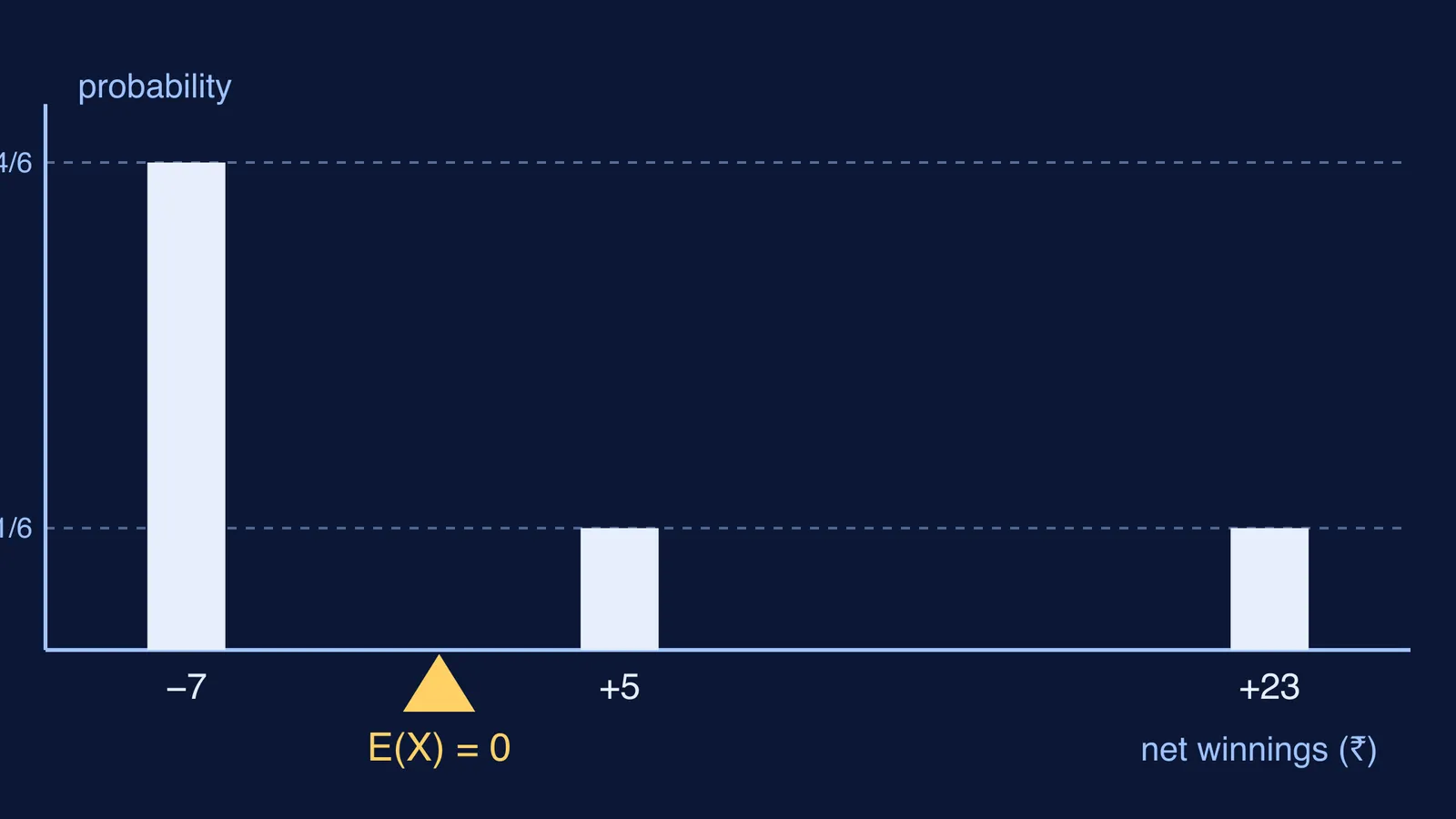
Check it with the full distribution. At s = ₹7 the net winnings are +₹23 (1/6), +₹5 (1/6) and −₹7 (4/6):
E(X) = (23 + 5 − 28)/6 = 0.
The diagram at the top shows the three bars balancing on zero. Charging ₹10 instead lets the stall keep ₹3 per game on average.
A five-line check for any game
Use this on any game:
Define X as net winnings (prize minus stake), not the prize alone.
List every outcome, its count and its probability. Make sure they add to 1.
Compute E(X) = Σ x·P(x).
E(X) = 0 means fair; negative means the game favours the organiser; positive means it favours you.
For the fair stake, compute the expected prize and set the stake equal to it.
Exam questions often hide one twist: "you get your stake back if you win". Then the net result on a win is the prize alone, not prize minus stake. Read the wording before writing your table.
To watch the average settle over hundreds of rounds, see our walkthrough on testing the expected value of a game with a simulation, and see why short runs matter in our gambler's ruin simulation.
If your expected value comes out wrong, the slip is usually in step 1 or 2. The Fermi Problem Library has worked problems with a step-by-step solver that explains the reasoning rather than printing an answer, so you can see exactly where your table went wrong. If the idea of a random variable itself feels shaky, its lesson is in the Fermi Concept Library.


