On this page
A mela stall offers a dice game: bet ₹10 on a number from 1 to 6 and roll three dice. If your number shows on one die, you keep your ₹10 and win ₹10 more; on two dice you win ₹20; on all three, ₹30. It sounds like an even bet. It is not, and you can prove it twice: with expected-value arithmetic, and by playing 10,000 times in a spreadsheet. The game is chuck-a-luck, with its usual payouts of 1, 2 or 3 to 1.
How do you calculate the expected value of a game?
The expected value of a random variable is its mean: multiply each outcome by its probability and add the products, as OpenStax Introductory Statistics defines it. For a game, the outcome is your net win, the prize minus what you paid, with losses written as negative numbers.
List every way the game can end.
Write your net win for each one.
Find each probability, and check that they add up to 1.
Multiply each net win by its probability and add.
This is the same table you build for probability distributions and their mean in JEE maths.
Now the worked example, per ₹1 bet on the number 6. Three dice give 6 × 6 × 6 = 216 equally likely rolls.
No six on any die: 5 × 5 × 5 = 125 rolls, net win −1.
Exactly one six: 3 × 5 × 5 = 75 rolls, net win +1.
Exactly two sixes: 3 × 5 = 15 rolls, net win +2.
Three sixes: 1 roll, net win +3.
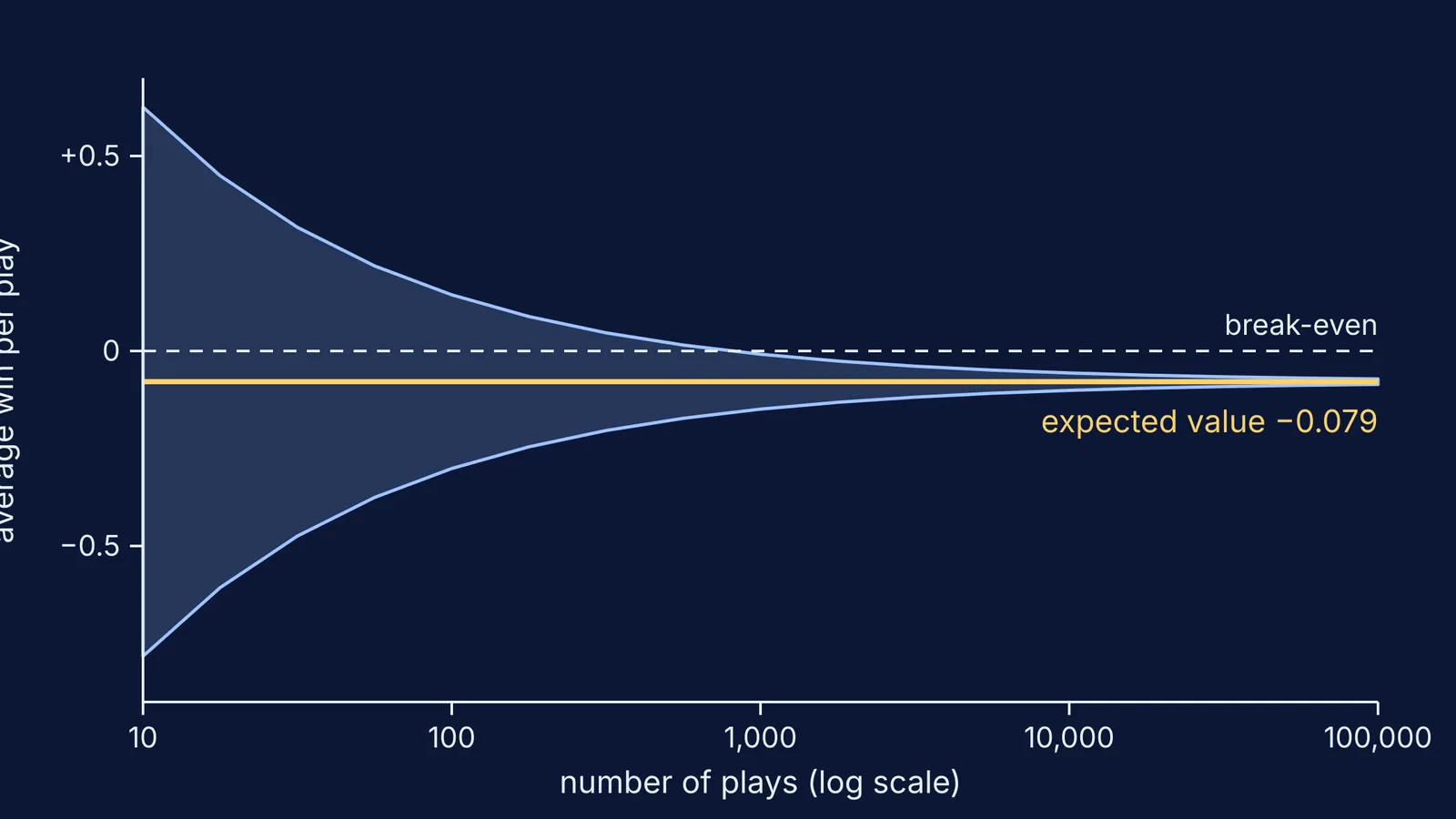
The counts add to 216. The expected value is (−125 + 75 + 30 + 3) ÷ 216 = −17/216, about −0.079. You lose about 7.9 paise per rupee on average, which matches the 7.9% house edge the chuck-a-luck entry gives for these payouts. On a ₹10 bet, that is about 79 paise lost per play.
Why does a fair-looking dice game lose money?
The trap is adding probabilities that overlap. The quick sum 1/6 + 1/6 + 1/6 = 1/2 counts every roll with two or three sixes more than once. The true chance of at least one six is 1 − 125/216 = 91/216, about 42%. Bigger payouts for doubles and triples close only part of the gap; the same chuck-a-luck entry notes that payouts of 1, 3 and 5 to 1 would make the game break even.
Spinners hide the same thing. Say a spin costs ₹10 and the wheel has eight equal sectors: one pays ₹50, two pay ₹10, five pay nothing. The top prize is five times your entry, but the average prize is (50 + 10 + 10) ÷ 8 = ₹8.75, so the expected value is ₹8.75 − ₹10 = −₹1.25 per spin.
What happens when you simulate the game 10,000 times?
Expected value is a long-run average. The law of large numbers says that as the number of trials grows, the gap between theoretical probability and observed frequency shrinks towards zero (OpenStax); Jacob Bernoulli's coin-toss maths shows where the idea came from. You can watch it happen in Google Sheets or Excel:
In A2, B2 and C2, type =RANDBETWEEN(1,6) for the three dice.
In D2, count the sixes: =COUNTIF(A2:C2,6)
In E2, the net win: =IF(D2=0,-1,D2)
In F2, the running average: =AVERAGE($E$2:E2)
Fill rows 2 to 10001 down and draw a line chart of column F.
Write down your prediction first: −0.079. From the same table, a single play has a standard deviation of about 1.11 rupees, so the average of n plays usually wobbles within about 1.11 ÷ √n of the expected value. After 100 plays the wobble is about ±0.11, more than the 0.079 edge, so finishing an evening ahead is common. After 10,000 plays it shrinks to about ±0.011, and the average lands between −0.10 and −0.06 about nine times in ten. That is how a losing game looks fair to anyone who plays it only a few times.
For the spinner, put =INDEX({50,10,10,0,0,0,0,0},RANDBETWEEN(1,8))-10 in E2 instead and predict −1.25.
For other ideas that are easier to see than to read, the Fermi Simulation Lab has interactive simulations.
How can you check any game before you play?
Use net wins, not prizes: subtract the entry fee first.
Count outcomes; do not add probabilities that overlap.
Check that your probabilities add up to 1.
Read the sign: below zero, the organiser wins on average.
Ignore short streaks: 100 plays cannot tell −0.08 apart from 0.
The chuck-a-luck entry lists the house edge for both schemes below.
If counting trips you up, see Class 10 probability with cards, dice and coins.
When a method keeps going wrong, the Fermi Problem Library has worked problems with a step-by-step solver that explains the reasoning rather than printing an answer.
Next time a game looks fair, build the four-line table before you pay.