On this page
Cutting a cake for two children is a solved problem: one cuts, the other chooses. Add a third child and the old trick stops working. The fix comes from a branch of mathematics called fair division.
Why is divide and choose fair for two people?
In divide and choose, one person cuts the cake into two pieces and the other picks one. The cutter keeps whatever is left.
The cutter's best plan is to cut two pieces that look equal to them, because they will get whichever piece the chooser leaves. The chooser simply takes the piece they prefer. Each person ends up with a piece they value at least as much as the other piece, so neither wants to swap. The same idea appears in the Book of Genesis, where Abraham divides the land and Lot chooses.
What is the difference between proportional and envy-free?
Mathematicians use two tests of fairness (envy-free cake-cutting).
Proportional: with n people, everyone gets at least 1/n of the cake by their own measure.
Envy-free: everyone thinks their own share is at least as good as anyone else's.
An envy-free division of the whole cake is always proportional, but a proportional division need not be envy-free. With three people, you might get exactly a third while believing someone else got half: proportional, but not envy-free.
How do you divide a cake fairly among three or more people?
During the Second World War, Hugo Steinhaus asked his students Stefan Banach and Bronisław Knaster for a method that works for any number of people. Steinhaus published their answer in 1948. It is now called the last diminisher procedure.
The first person cuts off a slice they think is worth 1/n.
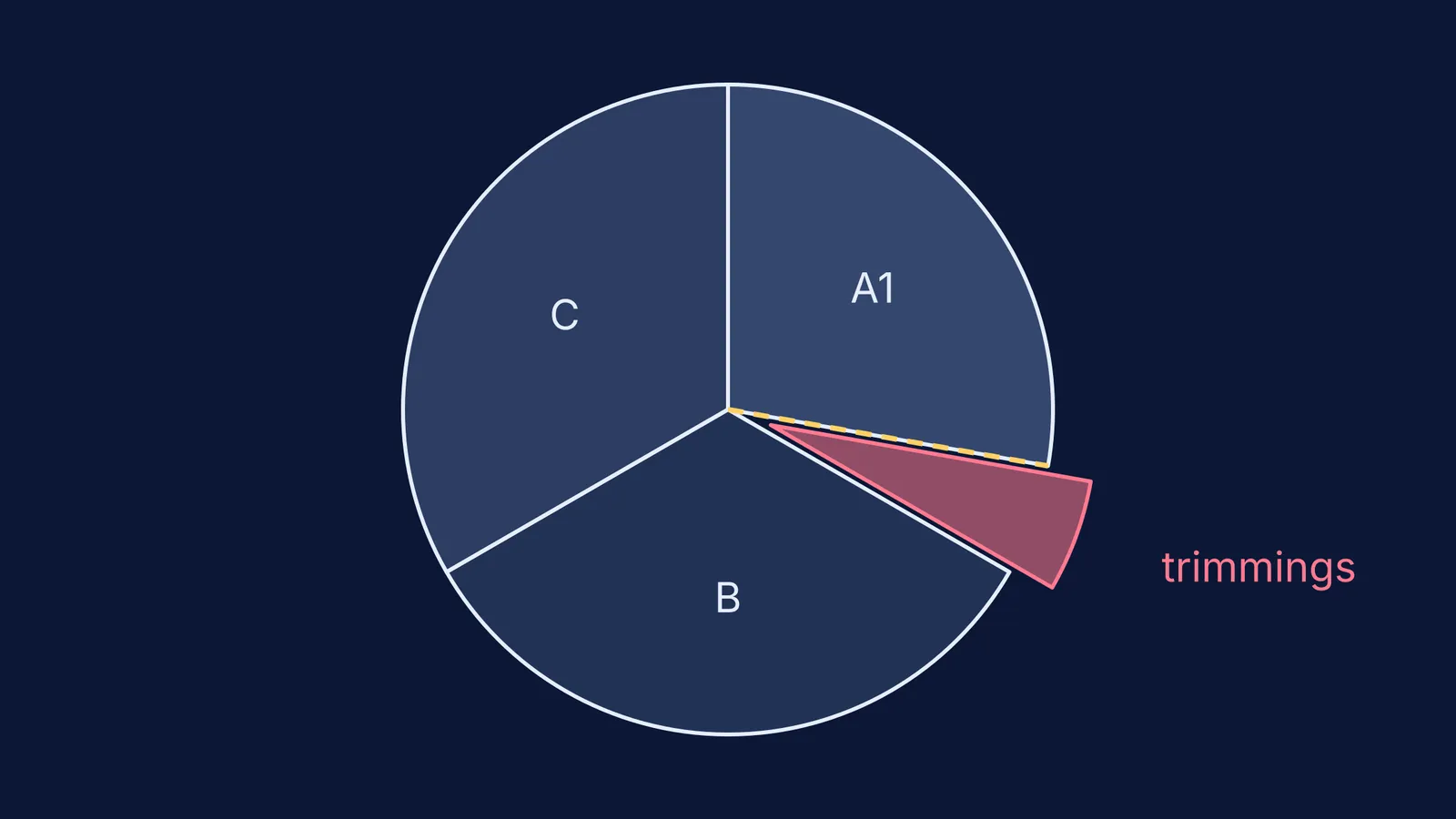
Each person in turn may trim the slice if they think it is too big. Trimmings go back to the main cake.
The last person to trim takes the slice and leaves. If nobody trims, the cutter takes it.
The rest repeat with the remaining cake until two are left, and they use divide and choose.
Everyone can make sure of at least 1/n by their own measure, so the method is proportional. It is not always envy-free: with three or more people, someone can feel that a person who left earlier got more.
How does the Selfridge–Conway procedure work?
The first step-by-step envy-free method for three people was found by John Selfridge in 1960 and later found again on its own by John Conway. Neither of them published it. It needs at most five cuts, though a share may end up in more than one piece (Selfridge–Conway procedure).
Take Asha, Ravi and Meera.
Asha cuts the cake into three pieces she thinks are equal.
Ravi finds the piece he likes most. If it beats his second favourite, he trims off just enough to make them equal in his eyes. The trimmings go aside.
Meera picks first, from all three pieces.
Ravi picks next, but if Meera left the trimmed piece, he must take it.
Asha takes the last piece. It is untrimmed, and she thought all three were equal at the start.
Nobody envies anyone yet: Meera chose first, Ravi got one of his two equal favourites, and Asha has a full third. Now share the trimmings. Suppose Ravi took the trimmed piece. Meera cuts the trimmings into three parts she thinks are equal. Ravi chooses first, then Asha, and Meera takes the last. Asha does not mind Ravi's share, because his trimmed piece plus all the trimmings only add up to one of her original thirds.
What about four or more people?
Steven Brams and Alan Taylor published an envy-free protocol for any number of people in 1995 (Brams and Taylor, American Mathematical Monthly). It always ends, but nobody can say in advance how many cuts it needs (envy-free cake-cutting). In 2016, Haris Aziz and Simon Mackenzie gave the first envy-free method for any number of people with a fixed upper limit on its steps (Aziz and Mackenzie, FOCS 2016).
A quick guide to choosing a method
Two people: divide and choose.
Three people who only need everyone to get a third: last diminisher.
Three people where nobody should envy anyone: Selfridge–Conway.
Four or more: last diminisher for proportional shares; envy-free methods exist but get long fast.
The same "think about each player's best move" reasoning drives the XOR strategy for winning at Nim and the prisoner's dilemma and Nash equilibrium. To check fairness with numbers, see how to test whether a dice game is fair using expected value.
The Fermi Concept Library gives each mathematics concept its own lesson and its place in the map. When you try a proof of your own, the Fermi Problem Library has a step-by-step solver that explains the reasoning rather than printing an answer.