

On this page
Two friends are caught copying in an exam and questioned separately. If both stay quiet, both get a light penalty. If one blames the other, the talker walks free and the other takes the full blame. If both blame each other, both are punished. What should you do? Working through this puzzle teaches you to read a payoff table, find a Nash equilibrium and see why being nice can still be clever.
What is the prisoner's dilemma?
The prisoner's dilemma is a two-player game in which each player does better by defecting (betraying the other) whatever the other does, yet both do worse when both defect than when both cooperate, as the Stanford Encyclopedia of Philosophy entry on the prisoner's dilemma sets out.
According to that entry, the game is usually credited to Merrill Flood and Melvin Dresher at the RAND Corporation, who had colleagues play it one hundred times in a row in early 1950. The prison story came from the mathematician Albert Tucker, who used it to explain their game to psychologists at Stanford.
The same tension sits underneath the tragedy of the commons, from Hardin to Ostrom.
How do you read the payoff table?
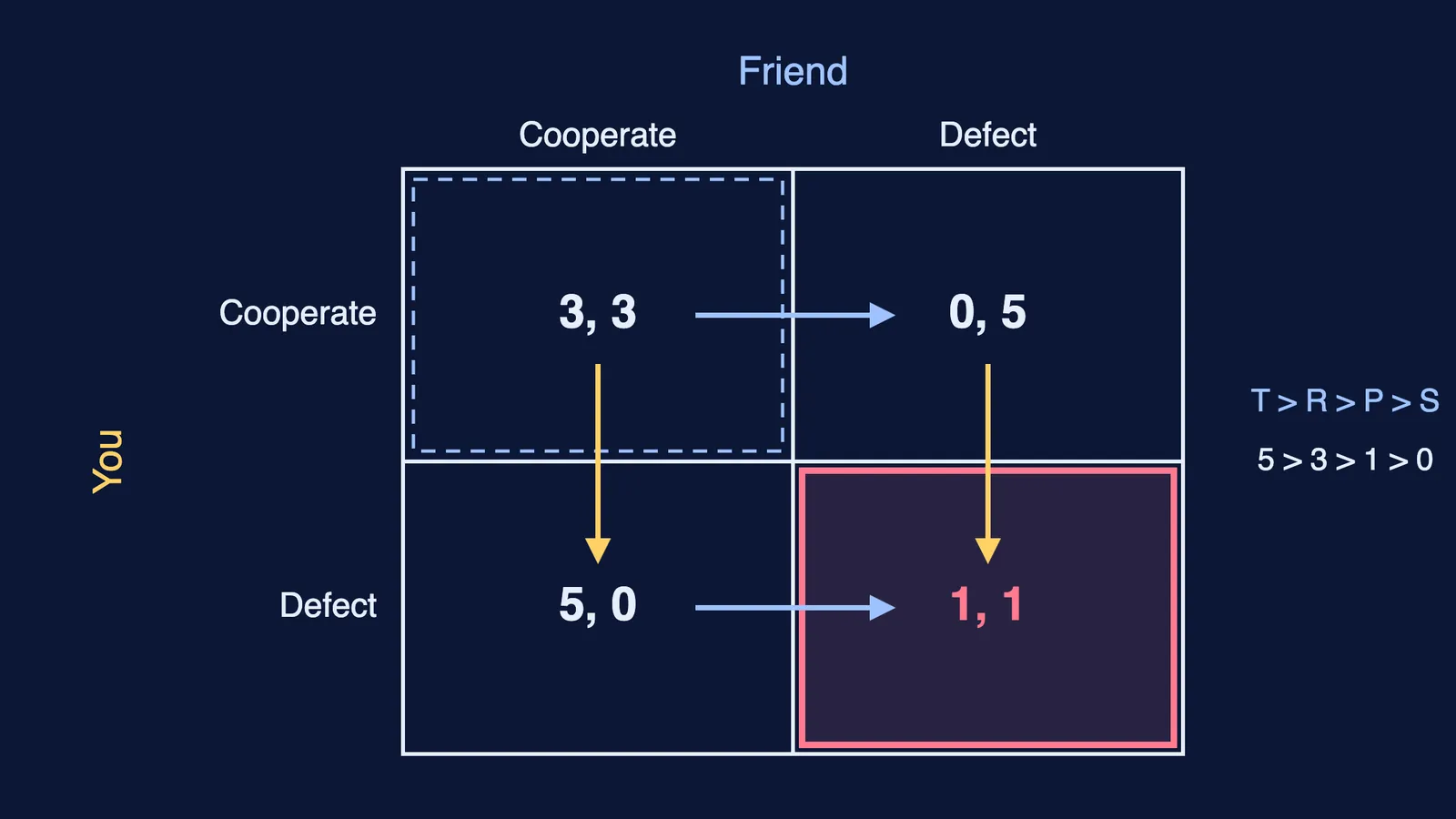
The Stanford entry uses four payoffs: T (temptation, for defecting while the other cooperates), R (reward, for both cooperating), P (punishment, for both defecting) and S (the sucker's payoff, for cooperating alone). A game is a prisoner's dilemma when T > R > P > S (Stanford Encyclopedia of Philosophy).
Here is a worked example with points we chose to fit that rule: T = 5, R = 3, P = 1, S = 0. Each line gives (your points, friend's points):
You cooperate, friend cooperates: (3, 3)
You cooperate, friend defects: (0, 5)
You defect, friend cooperates: (5, 0)
You defect, friend defects: (1, 1)
Check: 5 > 3 > 1 > 0. For repeated play the same entry adds a condition, that R is at least half of T + S, so taking turns to exploit each other cannot beat steady cooperation. Here 3 is more than 2.5.
What is a Nash equilibrium, in plain words?
A Nash equilibrium is a set of moves in which no player can do better by changing only their own move. John Nash proved such equilibrium points exist in a wide class of games in Equilibrium points in n-person games (PNAS, 1950).
Now find it. If your friend cooperates, you get 3 by cooperating and 5 by defecting, so defect. If your friend defects, you get 0 by cooperating and 1 by defecting, so defect again. Defecting is better whatever your friend does, which is called a strictly dominant move, and your friend reasons the same way.
Mutual defection is the game's only strict Nash equilibrium, according to the Stanford Encyclopedia of Philosophy. Two careful thinkers land on (1, 1) when (3, 3) was on the table.
What did Axelrod's tournaments show?
Classmates and neighbours meet again and again, so the political scientist Robert Axelrod asked what wins when the game repeats. He ran a computer tournament with decision rules sent in mainly by game-theory experts from psychology, political science, economics, sociology and mathematics (Axelrod, Journal of Conflict Resolution, 1980).
In the second round, 62 entrants designed their rules knowing the first round's results, and the winner was again Tit for Tat, which cooperates on the first move and then copies the other player's previous move (Axelrod, Journal of Conflict Resolution, 1980). His analysis pointed to three habits: do not be the first to defect, be somewhat forgiving, and be provocable.
With the biologist W. D. Hamilton, he then showed in Science (1981) how cooperation based on reciprocity can get started, thrive among other strategies and resist invasion. For another mathematician of strategy, read about David Blackwell's work on game theory and duels.
How can you play it in class or at home?
You need two players, a pen and the points above:
Each player writes C or D in secret, then both reveal and score.
Play 10 to 20 rounds without announcing the last one, so nobody can plan a final betrayal.
Each player picks a strategy first: always defect, always cooperate, Tit for Tat, or their own.
Swap partners and total the scores.
Discuss: who defected first, did anyone forgive, and do the totals match Axelrod's lessons?
Then set R = 2, so T + S is more than 2R, and see whether taking turns to defect now pays. For more practice turning a game's rules into numbers, try checking whether a dice game is fair with expected value.
If the dominance step or the inequalities feel slippery, the Fermi Concept Library gives every concept in mathematics its own lesson. Not sure where to start? Fermi's AI tutor works out what you already know and builds a plan for the session.


