On this page
David Blackwell asked when a duellist should fire, helped build the mathematics of decisions, and wrote an early textbook that taught statistics the Bayesian way. Here is what he did, and a rule from his duel work you can try on paper.
Who was David Blackwell?
Blackwell was born on 24 April 1919 in Centralia, Illinois, and earned his PhD at the University of Illinois in 1941 under Joseph Doob, according to the MacTutor History of Mathematics biography. He joined Howard University in Washington in 1944 and led its mathematics department, then moved to the University of California, Berkeley, where he became chair of statistics in 1956.
The path was not open to him everywhere. The same MacTutor biography records that when the Institute for Advanced Study gave him an honorary appointment, the president of Princeton University objected.
In 1965 Blackwell became the first Black man elected to the US National Academy of Sciences, and in 2012 he was posthumously awarded the National Medal of Science, as the Simons Institute at Berkeley notes. He died in 2010. In a 1983 interview quoted by the Simons Institute, he said: "I'm not interested in doing research, and I never have been. I'm interested in understanding, which is quite a different thing."
What was Blackwell's duel problem?
Blackwell spent three summers between 1948 and 1950 at the RAND Corporation working on game theory, says MacTutor. One problem: two duellists walk towards each other, each with one loaded pistol. The closer they get, the likelier a hit. Fire too early and you probably miss, letting your opponent walk up and fire at close range. Wait too long and they may fire first.
A game of timing is one where the question is not what to do but when to do it. Blackwell also studied a harder version with silent guns, where you cannot tell whether your opponent has already fired and missed.
He later wrote Theory of Games and Statistical Decisions (1954) with Abe Girshick, whose 1945 lecture on sequential analysis had first drawn him to statistics, MacTutor says.
How do you solve a duel with game theory?
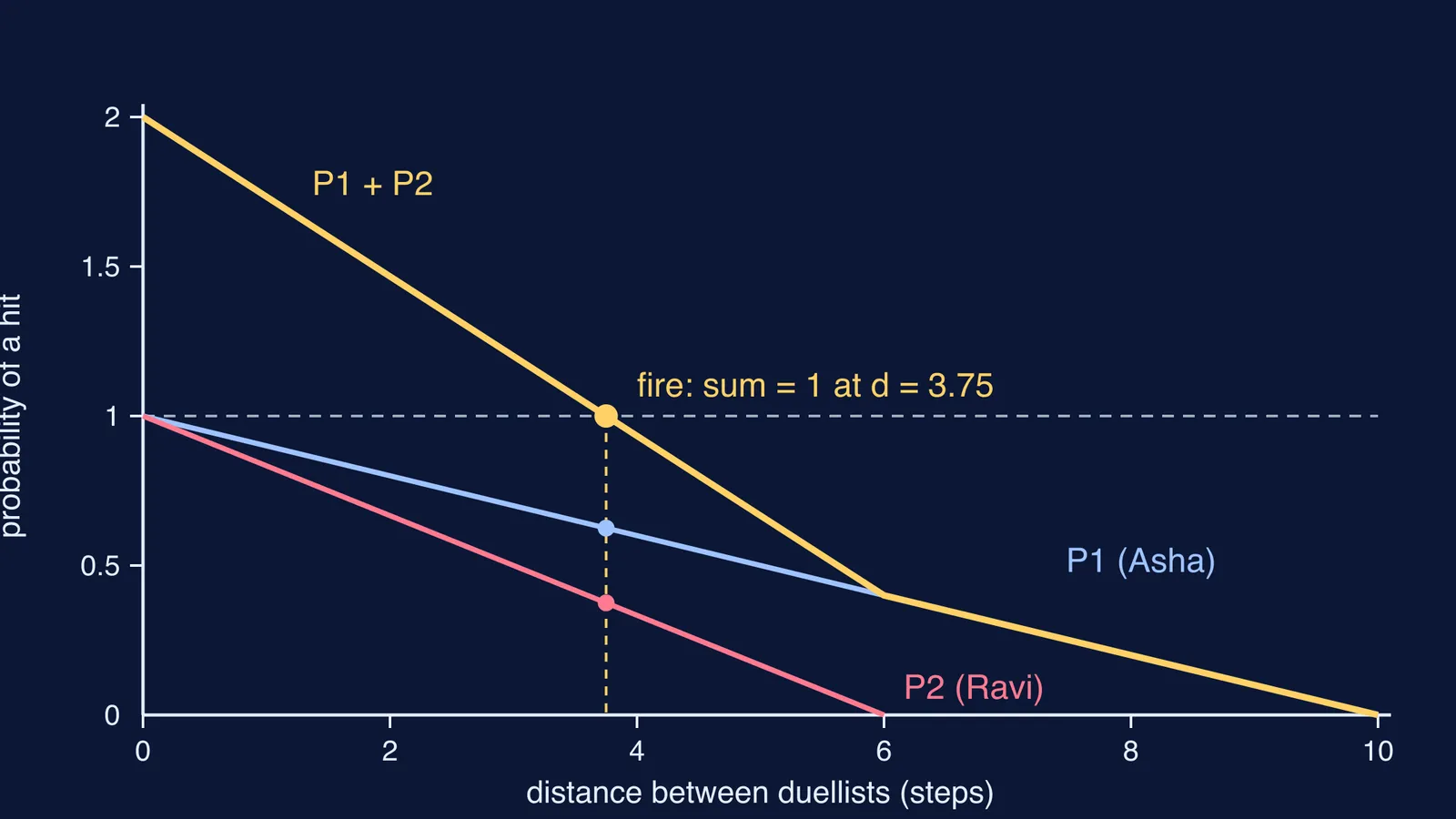
Yale economist Ben Polak's lecture notes on the duel solve a simple version by backward induction: start at point-blank range, where whoever's turn it is must fire, and reason backwards step by step. The answer is short: roughly, shoot as soon as the two players' hit probabilities add up to one. It does not matter who is the better shot, only the sum.
Here is a worked example with made-up skills. Asha's chance of hitting at a distance of d steps is 1 - d/10. Ravi is a weaker shot: his chance is 1 - d/6, and zero beyond 6 steps.
At 6 steps: 0.4 + 0 = 0.4. Wait.
At 5 steps: 0.5 + 0.17 = 0.67. Wait.
At 4 steps: 0.6 + 0.33 = 0.93. Wait.
At 3.75 steps: 0.625 + 0.375 = 1. Fire.
Solve it directly: (1 - d/10) + (1 - d/6) = 1 gives d = 3.75. Whoever's turn it is at about that distance should fire, even Ravi, the weaker shot.
The same backward-from-the-end reasoning works on many Class 11 probability questions, such as two players taking turns to throw a die until one gets a six. If you get stuck setting up a turn-by-turn problem, the Fermi Problem Library has worked problems with a step-by-step solver that explains the reasoning rather than printing an answer.
What does Bayesian statistics have to do with Blackwell?
In 1969 Blackwell published Basic Statistics, described by The Actuary magazine as one of the first Bayesian statistics textbooks. Bayesian statistics treats probability as a degree of belief you update with evidence, using the rule set out in Thomas Bayes's 1763 essay.
Game theory and Bayesian statistics share one aim: acting well when you are unsure. If updating beliefs feels slippery, try our explainer on why a positive result on a 99% accurate test can be a false alarm.
How can you use the duel rule yourself?
The closest everyday version is a school quiz buzzer round where clues arrive one by one and a wrong answer passes the question to the other team, so a miss hands your rival the win. Try this:
Estimate your team's chance of being right with the clues so far.
Estimate the rival team's chance with the same clues.
If the two add up to less than one, wait for the next clue.
Once they reach one, buzz, even if you think the other team is stronger.
The rule rests on the duel's assumptions: one attempt each, a miss costs everything, and both sides' skills are known. If a wrong answer only costs a point, the maths changes.