

On this page
Probability problems about taking turns often appear in competitive exams like the JEE, testing your ability to track sequences in the same way as with and without replacement problems. The classic setup is simple: Player A and Player B take turns rolling a fair die, and the first person to roll a six wins. Because A goes first, they clearly have an advantage — but exactly how much of an advantage?
The classic version of this problem, found in the NCERT Class 12 mathematics textbook, gives the first player a 6/11 probability of winning. This 6:5 ratio is a permanent feature of the game, rooted in the maths of infinite series and conditional probability.
Why does the first player have an advantage?
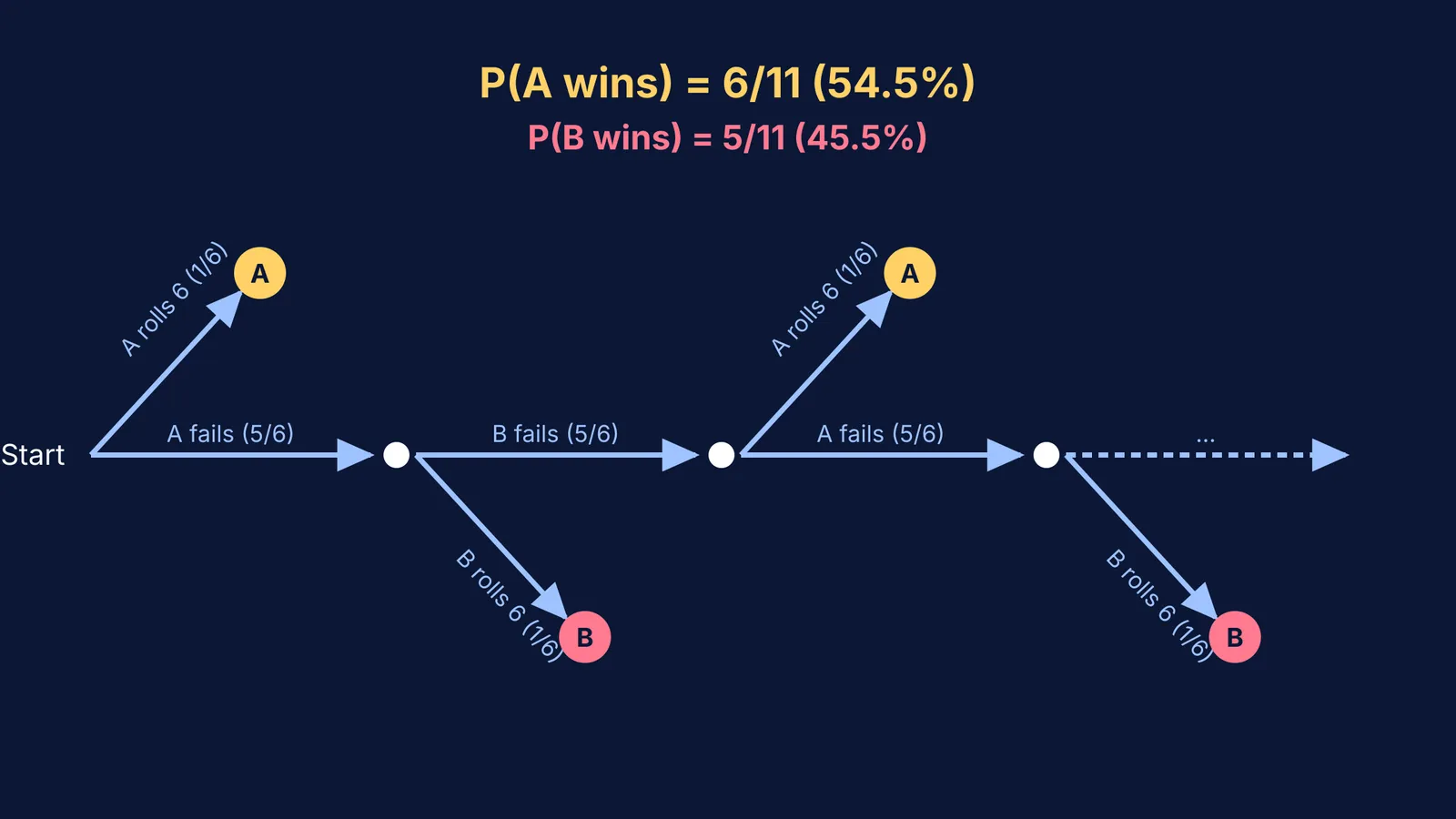
To find the probability that A wins, we can track every turn where A could roll the winning six.
A wins if they succeed on their first turn, or if everyone fails until A's second turn, or if everyone fails until A's third turn, and so on.
They roll a 6 on their first turn (probability 1/6).
They fail (5/6), B fails (5/6), and A rolls a 6 on their second turn. The probability of this sequence happening is 5/6 × 5/6 × 1/6 = 25/216.
Everyone fails until A's third turn: (5/6)⁴ × 1/6 = 625/7776.
This forms an infinite geometric progression, much like the patterns found in sums like 9 + 99 + 999 + …. The first term is a = 1/6, and the common ratio is r = 25/36 (because exactly two non-sixes must be rolled for it to be A's turn again).
Using the sum formula for an infinite geometric series, S = a / (1 − r): P(A wins) = (1/6) / (1 − 25/36) P(A wins) = (1/6) / (11/36) P(A wins) = 36 / 66 = 6/11.
Because there are only two players and someone will eventually win, B's probability is simply 1 − 6/11 = 5/11.
Is there a shortcut for finding the probability?
There is a faster way to find the answer without summing a series. Think about a single "round" of the game: A takes a turn, and if A fails, B takes a turn.
In this single round:
The probability that A wins is 1/6.
The probability that B wins is (5/6) × (1/6) = 5/36.
The ratio of A's chances to B's chances in this round is (1/6) / (5/36) = 6/5.
If neither player wins, the next round looks exactly the same. The ratio of their chances never changes. Therefore, the overall odds in favour of A winning compared to B winning must be 6 to 5.
Since their total probabilities must add up to 1, we divide the total probability into 11 parts (6 + 5). A gets 6 parts (6/11) and B gets 5 parts (5/11). This shortcut works for any game where players take turns repeating the same action.
What if A and B need to throw different numbers?
Exam questions often twist this setup by giving the players different goals. For example: A and B take turns throwing a pair of dice. A wins if they throw a sum of 6, and B wins if they throw a sum of 7.
First, we find their individual chances for a single throw:
There are 5 ways to roll a 6 (1+5, 2+4, 3+3, 4+2, 5+1), so A's chance of succeeding is 5/36.
There are 6 ways to roll a 7 (1+6, 2+5, 3+4, 4+3, 5+2, 6+1), so B's chance of succeeding is 6/36, or 1/6.
Using the symmetry shortcut, let's look at one round. A's chance to win in the round is 5/36. B's chance to win in the round is A failing (31/36) multiplied by B succeeding (1/6), which equals 31/216.
The ratio of their chances is (5/36) : (31/216). Multiply both sides by 216 to clear the fractions, and we get 30 : 31.
Therefore, the probability that A wins the game is 30/61, and B's probability is 31/61. Even though A goes first, B's easier target (a sum of 7 is more likely than a sum of 6) is just enough to give B the overall edge.
When you are practising these kinds of probability setups, it helps to walk through the logic turn by turn. If you get stuck setting up the series or the ratios, the Fermi Problem Library has worked problems with a step-by-step solver that explains the reasoning rather than printing an answer, helping you trace the steps of the game until the pattern clicks.


