

On this page
Thomas Bayes, an English minister and mathematician, formulated one of the most important concepts in modern statistics, but he died in 1761 before sharing it with the world. Two years later, his friend Richard Price found the manuscript and prepared it for the public.
The essay *An Essay towards solving a Problem in the Doctrine of Chances* was published in 1763 in the *Philosophical Transactions of the Royal Society of London* (Royal Society, 1763). In his cover letter submitting the paper, Price noted that the essay had "great merit, and well deserves to be preserved" (Royal Society, 1763). Today, the principles outlined in that essay power everything from medical diagnostics to artificial intelligence.
What was the problem in the doctrine of chances?
At the time, mathematicians could calculate "forward probability"—for instance, figuring out the chance of drawing a certain hand of cards from a perfectly mixed deck.
Bayes wanted to solve the inverse problem: if you are dealt a certain hand, what is the probability that the deck was rigged? He showed how to update a probability—a belief about how the world works—every time you receive new evidence. This continuous updating process became known as Bayes's theorem, and it is a foundational idea in predicting Markov chains and random events.
How did the billiard table experiment work?
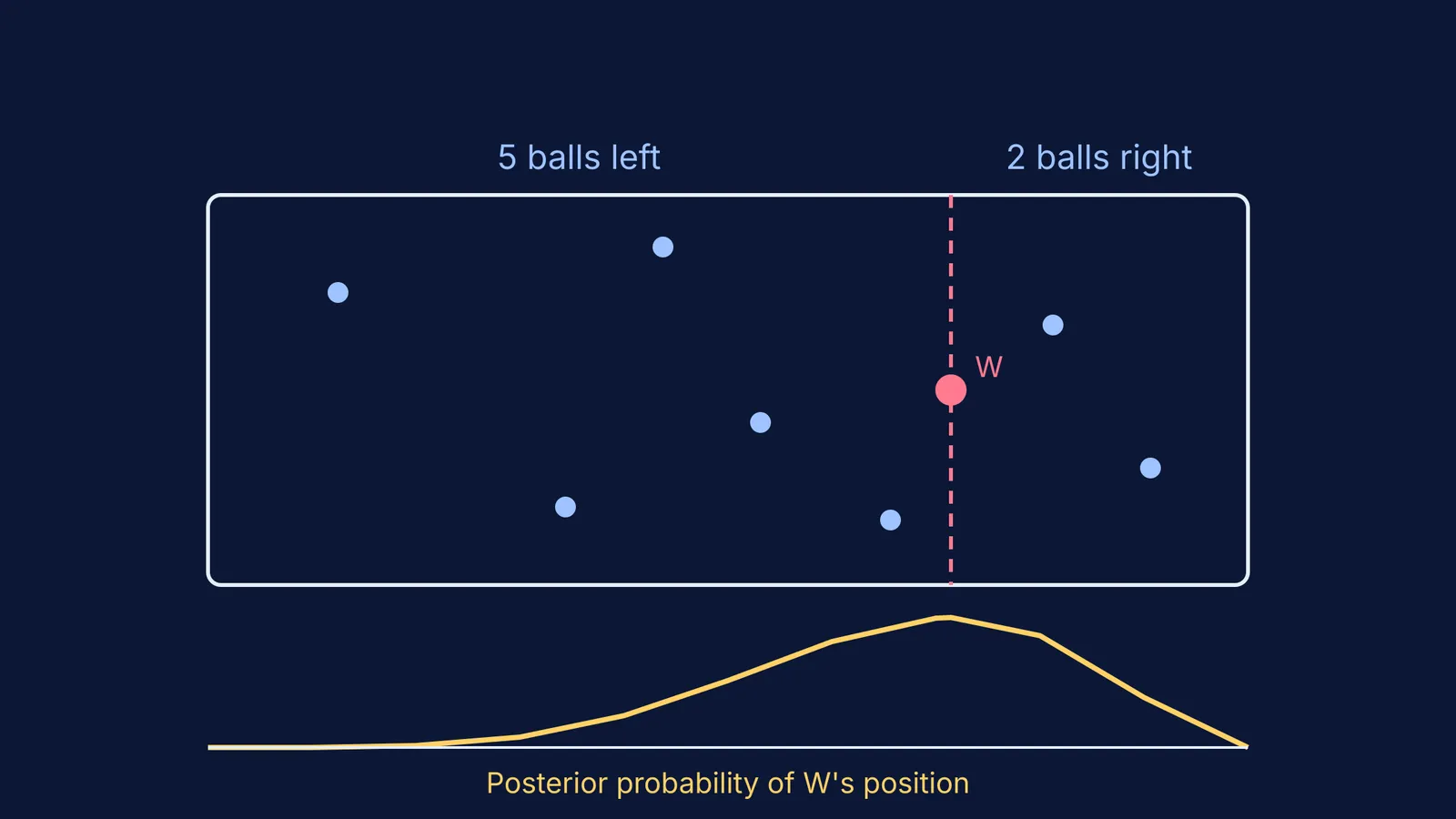
To explain his idea without complex algebra, Bayes asked the reader to imagine a perfectly flat, square table. First, you throw a ball, which we will call W, onto the table. Because you cannot see the table, you assume the ball could have landed anywhere. In Bayesian terms, you have a uniform "prior" distribution for its position.
Next, you throw a second ball, O, onto the same table. A friend tells you that O landed to the left of W. This single piece of evidence instantly changes your mental map of the table. Because O is on the left, W must be somewhere on the right. Your belief about W's position has been updated.
If you throw seven balls and your friend reports that five landed to the left of W and two landed to its right, the peak of your updated belief (the "posterior" probability) sits exactly at 5/7 of the way across the table. Every new ball refines the curve.
How can you use Bayes's theorem to study?
Bayesian updating is the mathematics of active learning. Many students spend their exam preparation reading textbooks or highlighting notes. This feels comfortable, but reading provides no new evidence about what you actually know or where your blind spots are. Your "prior" belief—that you understand the chapter—remains untested.
To study like a Bayesian, you must actively seek out evidence to update your beliefs. This means taking mock tests, solving numericals, and answering questions from memory.
When you get a question wrong, you should not view it as a failure. It is simply a ball landing on the table. The mistake provides hard evidence that you have a gap in your knowledge. You can then update your study plan to focus on that specific weakness rather than rereading the entire chapter, just as you might convert odds against into a firm probability to make a better decision.
This iterative testing is the central philosophy behind Fermi's AI tutor. A student brings a topic, a course, a problem set or a scanned assignment. Fermi works out what they already know, builds a plan for the session, and teaches through it. With every problem the student attempts, the tutor gathers evidence, updating its internal map of the student's proficiency and steering the session toward what they need to learn next.
A Bayesian checklist for exam prep
To apply this evidence-based method to your own study routine, follow these steps:
Set your prior: Choose a chapter and rate your confidence in it from 1 to 10.
Gather evidence: Take a timed 20-question quiz on that chapter without looking at your notes.
Update your belief: Count the mistakes. If you scored poorly, drop your confidence rating and acknowledge the gap.
Target the gap: Spend your next study session targeting only the specific concepts you got wrong, not the parts you already knew.


