On this page
In December 1968, the ecologist Garrett Hardin published "The Tragedy of the Commons" in Science. Its warning stuck: when something belongs to everyone, everyone has a reason to overuse it. Four decades later, Elinor Ostrom won a Nobel prize for showing that real communities often find a way out.
What is the tragedy of the commons?
Hardin's essay opens with a scene: "Picture a pasture open to all" (extract hosted by San Diego State University). Each herdsman asks what he gains by adding one more animal. He keeps all the money from selling it, so Hardin puts the gain at nearly +1. The cost, overgrazing, is shared by every herdsman, so his own part is "only a fraction of -1".
Every herdsman reasons the same way. Hardin wrote: "Each man is locked into a system that compels him to increase his herd without limit -- in a world that is limited." His conclusion: "Freedom in a commons brings ruin to all."
The tragedy of the commons is the overuse of a shared resource that happens when each user keeps the full gain from taking more but shares the cost with everyone (Hardin, Science, 1968).
How does the herder's maths actually work?
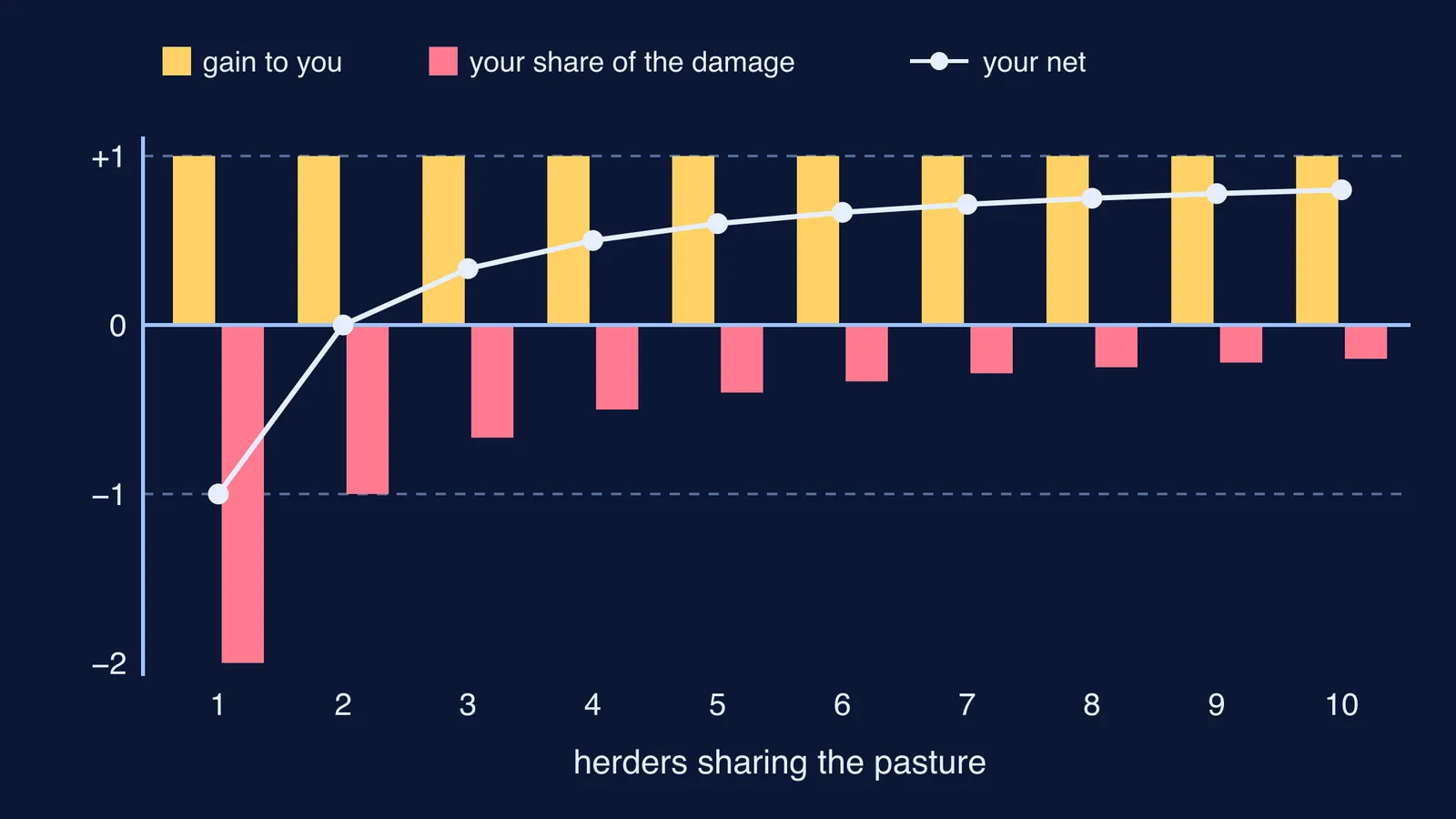
Hardin gave no numbers, so here is a simple model of his reasoning. Suppose one extra cow earns its owner 1 unit and does 2 units of damage to the grass, split equally among the N herders.
Your net gain from one more cow is 1 − 2/N.
Alone (N = 1): 1 − 2 = −1. You don't add the cow.
With 10 herders: 1 − 0.2 = +0.8. The cow looks like a good idea.
All 10 herders add a cow. Each gains 1 but bears 10 × 0.2 = 2 units of damage. Everyone is 1 unit worse off.
The diagram at the top plots this model: the bigger the group, the more tempting the extra cow. Our post on John Nash and the equilibrium that predicts how rivals choose explains why such outcomes stay stuck.
Did Elinor Ostrom prove Hardin wrong?
Partly. Ostrom, a political scientist at Indiana University, shared the 2009 economics Nobel "for her analysis of economic governance, especially the commons" (Nobel Prize facts page).
The prize committee's public explainer says that, from numerous empirical studies, she concluded "common property is often surprisingly well managed". The standard argument, it adds, "neglects the fact that users themselves can both create and enforce rules that mitigate overexploitation." Two of its examples:
In Nepal, farmer-run irrigation with small dams of stone, mud and trees shared water for a long time. Where the government built durable modern dams, head-end farmers no longer needed tail-end farmers' repair work and took more water.
On inner Asia's grasslands, state collectives in China and Russia, and later privatisation in China, did worse over the long term than traditional group herding in Mongolia.
The committee adds that user management is not always best: in the 1930s, failure to privatise oil pools in Texas and Oklahoma caused massive waste. Hardin's pasture had no rules; Ostrom showed users can make their own.
What are Ostrom's eight design principles?
In 1990, Ostrom proposed eight design principles of robust institutions for managing shared resources such as forests or fisheries; a 2010 review of 91 studies in Ecology and Society found them "well supported empirically". In plain words:
Clear boundaries around the users and the resource.
Rules fit local conditions; what you put in matches what you take out.
People affected by the rules can help change them.
Monitors are users or answer to them.
Sanctions start small and grow.
Disputes are settled cheaply.
Outside authorities respect the users' right to make rules.
Small groups nest inside larger ones.
How can you use this in India, or at home?
India's groundwater is a live commons. In the 2025 national assessment, 730 of 6,762 assessment units (10.80%) were "over-exploited", meaning more water was pumped out than the year's recharge put back (Press Information Bureau, December 2025). Our explainer on why groundwater levels are falling in many parts of India covers the science.
Practise the principles on a small commons, such as a shared hostel or PG fridge:
Boundaries: each user gets a shelf.
Fit: whoever cleans that week gets the bigger shelf.
Say: agree the rules together, not by one person's notice.
Monitor: rotate a weekly fridge checker.
Sanctions: a reminder, then an extra cleaning turn, then losing the shelf for a week.
A script to open the meeting: "The fridge is a mess because none of us pays the full cost of leaving food in it. Can we agree three rules and a checker, and review them in a month?"
To see how populations, resources and rates of change link across subjects, the Fermi Concept Library gives every concept in biology and mathematics its own lesson and its place in the map.
For the biggest shared resource of all, read how to talk to your child about climate change, age by age.