

On this page
Your child has probably heard about climate change already, from a school project, a news clip about a heatwave or a friend. The question is not whether to talk about it but how. The short answer: listen first, explain at their level, and give them something to do with their hands.
Why does my child feel worried about climate change?
Because many young people do. A 2021 survey in The Lancet Planetary Health00278-3) asked 10,000 people aged 16 to 25 in ten countries, including India, about their feelings. In that survey, 59% were very or extremely worried about climate change and 84% were at least moderately worried. More than 45% said their feelings about climate change negatively affected their daily life.
UNICEF's guidance for parents says feelings such as anxiety, fear, sadness and anger are natural reactions. It suggests you start by finding out what your child already knows and how they feel, and that it is fine not to have every answer: you can find the answers together.
The conversation can also run the other way. In a North Carolina study published in Nature Climate Change, parents whose middle-school children took part in a climate education programme showed more climate concern than parents in a control group.
How do I explain climate change to my child by age?
Match the depth to the age, and always end on something your family can do.
Ages 4 to 7: keep it concrete and local. "The Earth is wrapped in air like a blanket. When we burn a lot of fuel, the blanket gets thicker and the Earth gets warmer. Lots of people are working on it, and we can help too." Then go outside and notice trees, shade and birds.
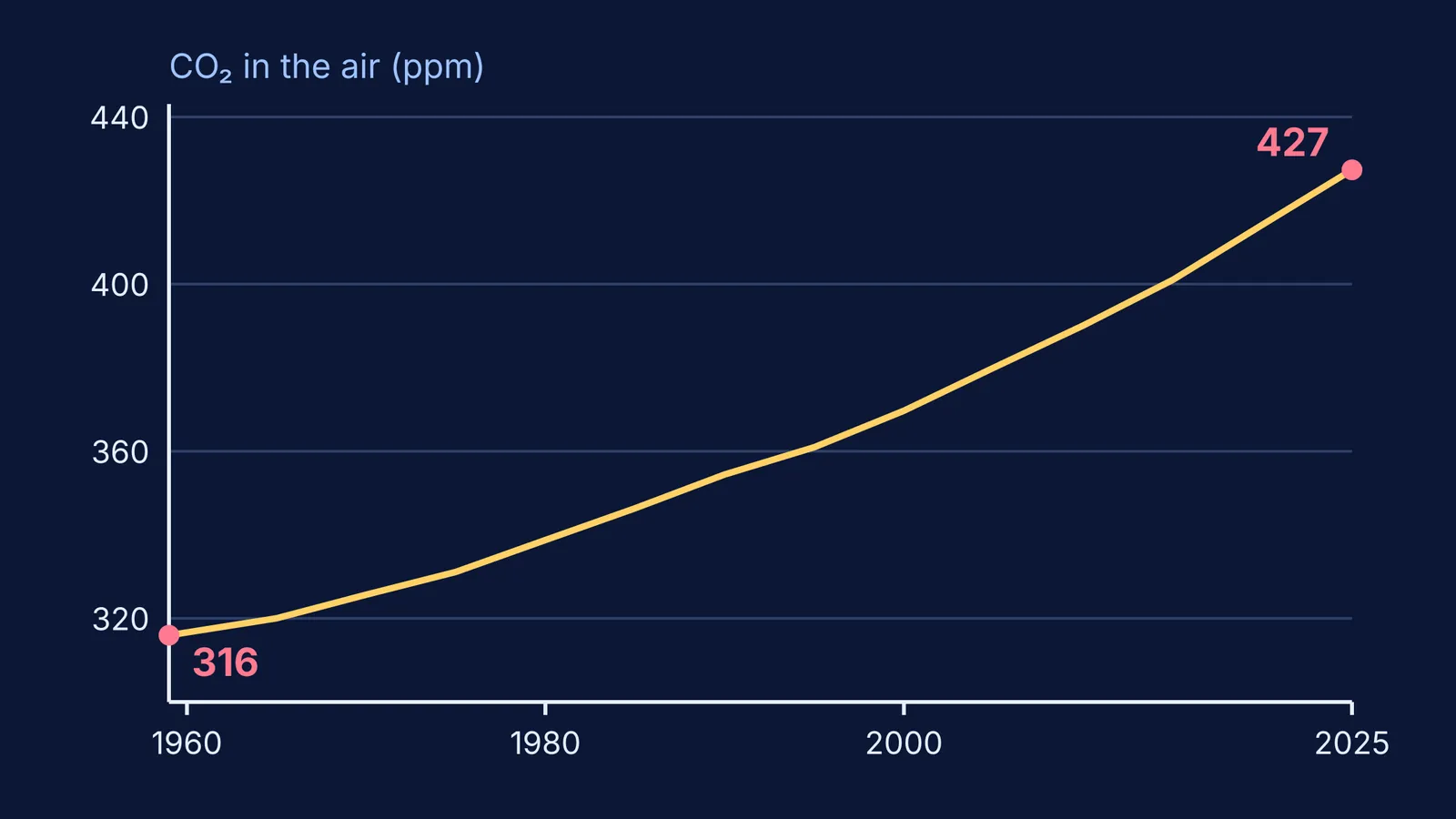
Ages 8 to 11: add one real number. NOAA's Mauna Loa record shows carbon dioxide in the air averaged 316 parts per million (ppm) in 1959 and 427 ppm in 2025. Draw the line together and ask what might make it bend.
Ages 12 to 15: talk about causes and trade-offs. Why does a city road feel hotter than a park? Who gets hit hardest by a heatwave? The story of John Tyndall's 1859 greenhouse gas measurements shows this science is more than 150 years old, not a new fashion.
Ages 16 and up: treat them as a partner. Discuss news reports, careers in energy or environmental science, and what they think the family should change.
What simple experiments show heat and carbon at home?
Experiments turn a scary headline into a question your child can test. Ask them to predict before you start.
Dark versus light. Albedo is the percentage of solar energy a surface reflects, as defined in the UCAR Center for Science Education's albedo activity. UCAR's classroom version uses a lamp and a photo of ice and land; at home, put one thermometer under black paper and one under white paper in the sun and read both every two minutes. The dark one should warm faster, which is one reason melting ice that exposes darker land or sea adds to warming.
Land ice versus sea ice. In NASA JPL's land-ice versus sea-ice lesson, you set up two containers of water: ice cubes on a lump of clay in one, floating ice in the other. Mark the water levels. When the ice melts, the level rises in the land-ice container and barely changes in the floating-ice one, which is why melting ice on land raises the sea.
Your own data. Keep a month-long weather diary of rain and temperature, and in summer check what counts as a heatwave in India.
What can our family actually do about climate change?
UNICEF advises showing a solution for every problem and letting children choose how involved to get. Pick one small action a week and let your child own it:
Week 1: switch off fans and lights in empty rooms, with your child as the "energy monitor".
Week 2: carry a cloth bag and a steel bottle on every outing.
Week 3: walk, cycle or share a ride for one regular trip.
Week 4: grow something on the balcony and track how fast it grows.
At the end of the month, ask what worked and what to keep. Agency comes from seeing that a choice made a difference, however small.
When is climate worry more than everyday worry?
If worry keeps getting in the way of your child's sleep, eating, studying or enjoyment of things they used to love, talk to their school counsellor or a doctor. Tele MANAS, the Government of India's 24x7 tele-mental health service, is on the toll-free number 14416.
If you need a refresher on the science yourself, the Fermi Concept Library covers every concept in physics, chemistry and biology, each with its own lesson. Then start with one question at dinner tonight.


