

On this page
In 1859, the Irish physicist John Tyndall began a series of experiments in London that would form the physical foundation of modern climate science. While mathematicians had previously guessed that the atmosphere kept the Earth warm, no one had measured exactly how the air trapped heat. Tyndall built a precision instrument to test individual gases and found the exact molecules responsible for the greenhouse effect.
What was the ice age mystery?
Tyndall was an avid mountaineer who spent his summers climbing in the Alps. During his expeditions, he observed clear geological evidence that glaciers had once covered much larger areas of Europe. He wanted to understand the physical mechanism that could cause the Earth's temperature to shift drastically enough to trigger an ice age.
Earlier in the century, the French mathematician Joseph Fourier had proposed that the Earth's atmosphere acts like the glass walls of a greenhouse, letting sunlight in but preventing the resulting heat from escaping. However, Fourier did not know which parts of the air were responsible. Tyndall set out to measure the radiant heat absorption of different atmospheric gases experimentally (NASA Earth Observatory).
How did Tyndall measure heat absorption?
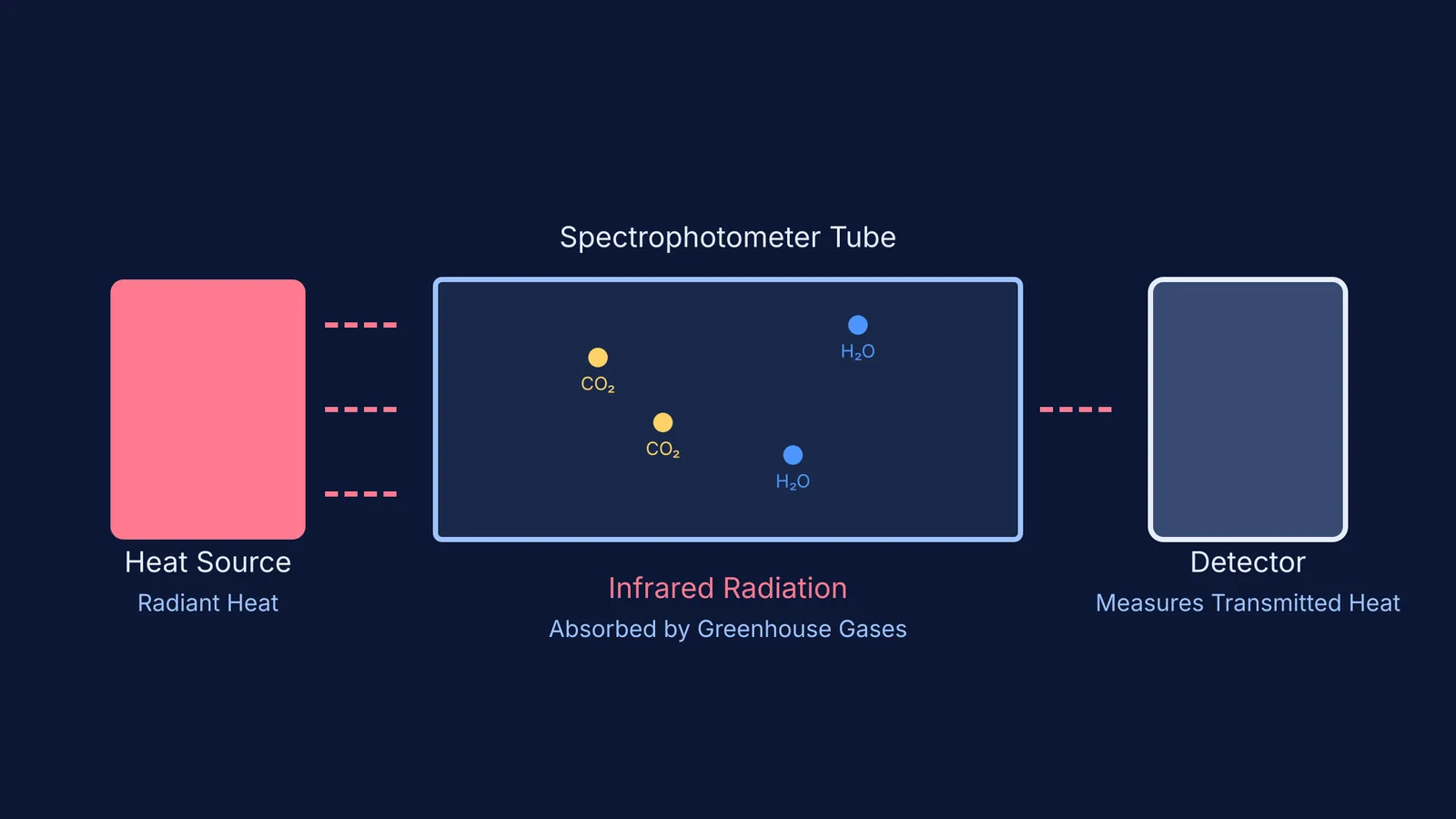
To test the gases, Tyndall constructed the first ratio spectrophotometer. The device allowed him to measure the absorptive powers of different gases by sending radiant heat through them and detecting how much energy passed through to the other side.
By testing different samples, Tyndall could compare how much heat was absorbed by each gas. He evaluated "perfectly colorless and invisible gases and vapors" to see which ones blocked the most heat (NASA Earth Observatory).
Which gases trap heat?
Tyndall's results contradicted the scientific assumption of his day. When he tested the primary components of the atmosphere—oxygen, nitrogen, and hydrogen—he found that they are almost entirely transparent to radiant heat.
However, when he introduced complex molecules into his apparatus, the results changed dramatically. Tyndall discovered that water vapour, carbon dioxide (which he called "carbonic acid"), and ozone are powerful absorbers of radiant heat. The radiant heat was intercepted by these gas molecules before it could reach the other side of his instrument.
Tyndall realised that while these absorbing gases make up only a tiny fraction of the atmosphere, they are entirely responsible for keeping the planet warm. He concluded that water vapour was the primary gas controlling Earth's surface temperature, famously writing that without it, the Earth's surface would be "held fast in the iron grip of frost."
Why is the greenhouse effect important?
Tyndall's 1859 experiments provided the first precise, quantitative proof of how greenhouse gases regulate a planet's temperature. It is important to note that the American scientist Eunice Foote and her 1856 test of carbon dioxide and heat had demonstrated that CO₂ heats up in sunlight three years earlier. Tyndall's contribution was isolating the specific long-wave infrared radiation emitted by the Earth, proving the exact mechanism of the greenhouse effect.
Building on his discoveries about water vapour and carbon dioxide, Tyndall was among the first to speculate that fluctuations in these trace gases could drive significant climate change, explaining the geological evidence of past ice ages. He also applied his understanding of radiant heat to other meteorological phenomena, correctly identifying the radiative processes that cause dew formation in the morning. Furthermore, he noted how these same physical properties contribute to the "heat island" effect observed in rapidly industrializing cities like London, where urban environments remain artificially warmer than their surrounding countryside (NASA Earth Observatory).
His work shifted meteorology from simply tracking weather patterns to studying the fundamental physics of the atmosphere. Decades later, this understanding allowed researchers to calculate how changing emissions would alter the climate, as seen in the work of Guy Callendar and the first evidence of CO2 warming.
Understanding the thermodynamics of gases is a core requirement in physics and chemistry. If you struggle to picture how radiation interacts with molecular structures, the Fermi Simulation Lab provides interactive simulations for the ideas that are easier to see than to read. Whether you are studying the critical temperature of a gas—like the discoveries of Thomas Andrews and the critical temperature of carbon dioxide—or the kinetic theory of gases, visualizing the physics builds lasting intuition.


