On this page
Seed germination, growth phases and the developmental sequence in a plant cell are listed under Unit 4, Plant Physiology, of the NEET (UG) 2026 syllabus. Biology makes up 90 of the paper's 180 questions, says the NEET (UG) 2026 information bulletin, and a right answer earns +4 while a wrong one costs 1 mark.
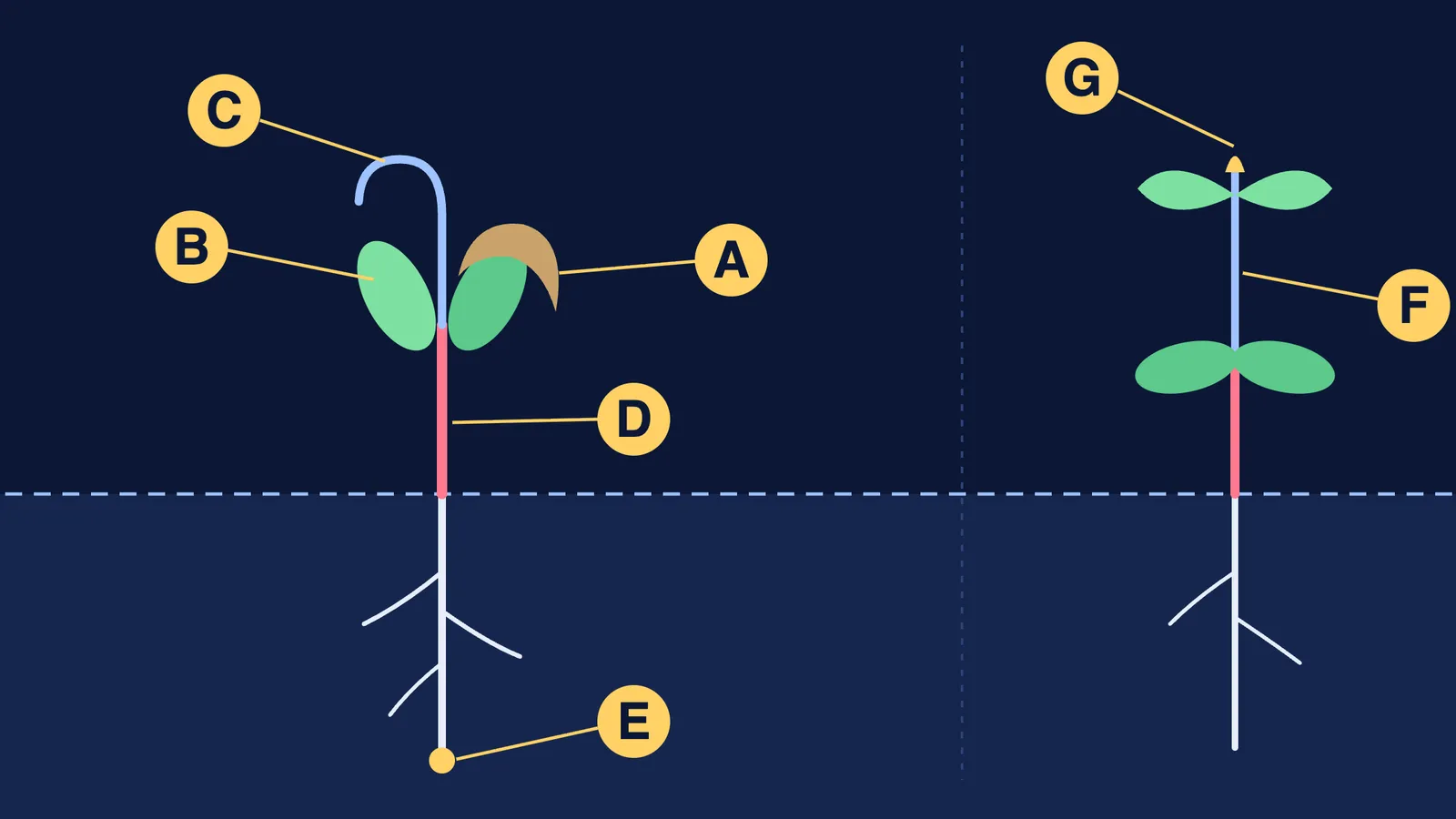
These 14 items are original practice, not past-paper questions or predictions. Each answer is checked against Chapter 13 of NCERT Class 11 Biology, Plant Growth and Development (Reprint 2026-27). The first six refer to the lettered bean seedling above; from Q7 on, the chapter's other figures are described in words.
How do you decode a lettered seedling?
Find the soil line, then the cotyledons. The axis between soil and cotyledons is one part; the axis above them is another. The shoot and root tips are where new cells keep being added. The rest follow.
Codes for each statement pair: (1) Statement I is accurate and II is not (2) II is accurate and I is not (3) each is accurate (4) neither is accurate.
Q1 to Q6: which seedling parts are A to G?
Q1. Ethylene causes apical hook formation in dicot seedlings. Which letter marks such a hook? (1) A (2) D (3) C (4) F
Q2. Match the letters with the parts. List-I: P. A; R. B; S. D; T. F List-II: (i) hypocotyl; (ii) cotyledon; (iii) seed coat; (iv) epicotyl (1) P-ii, R-iii, S-i, T-iv (2) P-iii, R-ii, S-iv, T-i (3) P-iv, R-ii, S-i, T-iii (4) P-iii, R-ii, S-i, T-iv
Q3. Statement I: In dicots, the vascular cambium appears later in life than the meristem at E. Statement II: Most cells produced at E soon lose the capacity to divide and become part of the plant body.
Q4. The meristems at G and E together cause: (1) increase in girth (2) primary growth along the plant's axis (3) forming cork cambium (4) dedifferentiation of parenchyma
Q5. Statement I: Turgidity of cells helps the extension growth that lengthens D and F. Statement II: Light and gravity have no effect on any stage of this seedling's growth.
Q6. Before A split, the seed could have stayed in soil without germinating. Which PGR inhibits seed germination and helps seeds withstand desiccation? (1) Gibberellic acid (2) Abscisic acid (3) Kinetin (4) Indole-3-acetic acid
Answer key for the lettered diagram: the bean seedling, A to G
A: seed coat. B: cotyledon. C: epicotyl hook. D: hypocotyl. E: root apical meristem, near the root tip. F: epicotyl. G: shoot apical meristem, near the shoot tip.
Q1: (3). Figure 13.1 labels this bend the epicotyl hook.
Q2: (4). The hypocotyl lies below the cotyledons; the epicotyl lies above them.
Q3: (3). Section 13.1.1: lateral meristems appear later, and meristem products soon stop dividing.
Q4: (2). Apical meristems drive primary growth; lateral meristems add girth later.
Q5: (1). NCERT says light and gravity affect certain phases of growth.
Q6: (2). ABA induces dormancy and inhibits seed germination.
How do you answer a growth figure you cannot see?
Rebuild it on scrap paper: two axes for a graph, a row of boxes for a flow chart. Mark only what the question names, then test each option against your sketch.
Q7. Equally spaced lines are marked on a growing root tip. Later, where are they furthest apart? (1) In the maturation zone, far from the apex (2) Evenly along the root (3) Only in the root cap (4) Just behind the apex
Answer: (4). Figure 13.3 shows the zones nearest the apex elongating most.
Q8. Statement I: The figure of meristem locations shows vascular cambium in both shoot and root. Statement II: Its arrows mark which way the cells and organ grow.
Answer: (3). Both match Figure 13.2 and its caption.
Q9. A plot of root length against time is a straight line. What happens after each mitotic division here? (1) Both daughters keep dividing (2) One daughter keeps dividing; the other differentiates and matures (3) Neither daughter divides again (4) Both daughters differentiate at once
Answer: (2). NCERT defines arithmetic growth this way.
Q10. In the equation for that straight line, Lt = L0 + rt, what does r stand for? (1) Growth rate, or elongation per unit time (2) Relative growth rate (3) Length at time zero (4) Base of natural logarithms
Answer: (1). Section 13.1.4 defines r so for linear growth.
Q11. Statement I: The S-curve is characteristic of a living organism growing in a natural environment. Statement II: The S-curve is typical of whole plants only, not of their cells or tissues.
Answer: (1). NCERT calls it typical of a plant's cells, tissues and organs too.
Q12. In NCERT's flow chart of a plant cell's development, which stage comes straight after "mature cell"? (1) Plasmatic growth (2) Cell division (3) Expansion (elongation) (4) Senescence
Answer: (4). Figure 13.8 runs mature cell, senescence, death.
Q13. Canary grass coleoptiles lit from one side bend towards the light. What was concluded? (1) The base detects the light (2) Only the tip bends (3) The tip is the site of a transmittable influence that bends the whole coleoptile (4) The coleoptile bends away from the light
Answer: (3). This is the Darwins' conclusion (Figure 13.10).
Q14. NCERT's figure on growth rates has three parts: arithmetic growth, geometric growth and stages of embryo development. What does the third part show? (1) Only arithmetic growth (2) Geometric and arithmetic phases of growth (3) Only the stationary phase (4) Dedifferentiation of embryo cells
Answer: (2). Figure 13.4(c) marks both phases in the developing embryo.
What should a wrong answer here make you redraw?
Missed Q1, Q2 or Q5: sketch a bean seedling and mark where the cotyledons attach.
Missed Q3, Q4 or Q8: draw a plant with its apical meristems and vascular cambium.
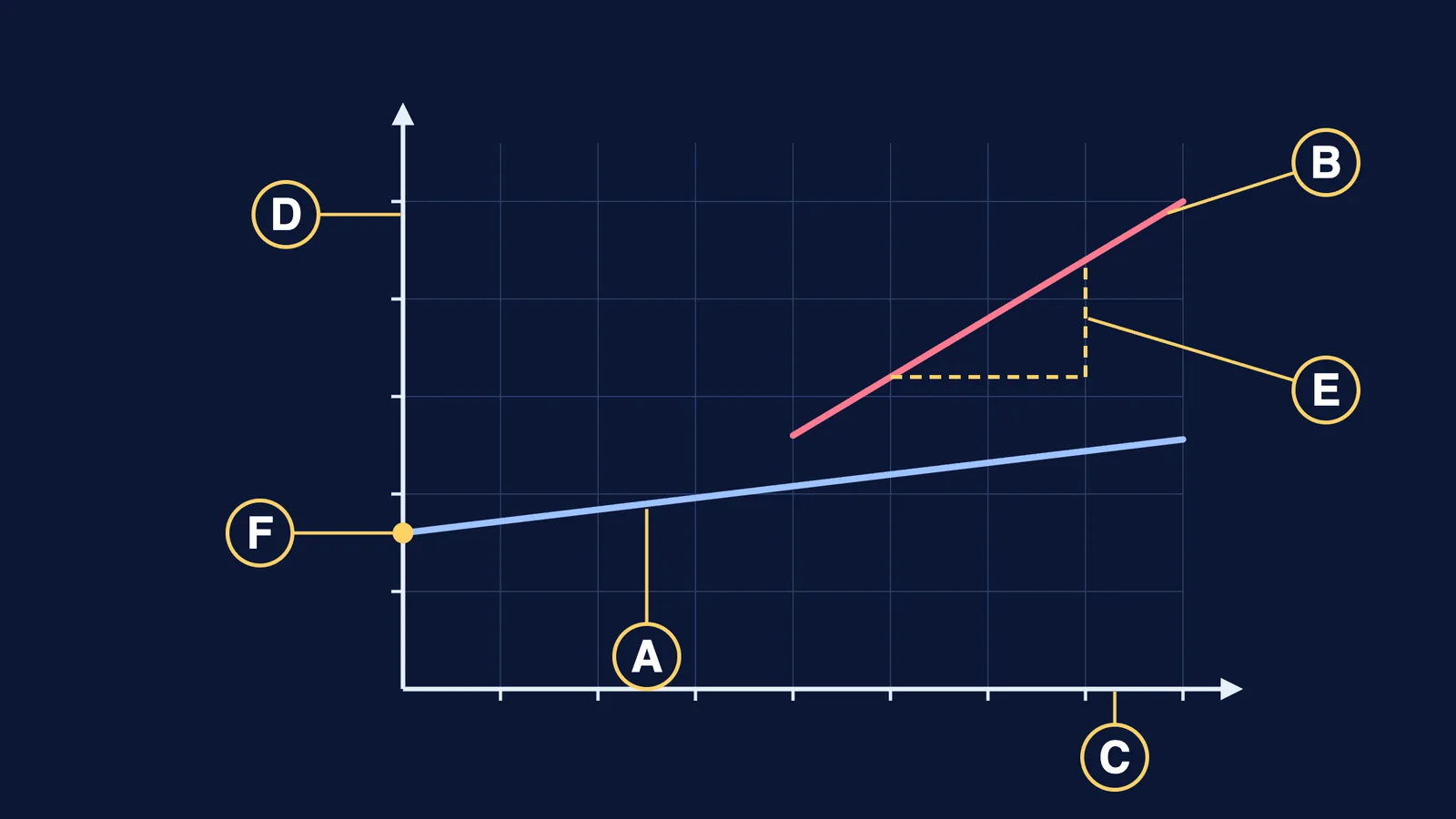
Missed Q9 to Q12 or Q14: plot a straight line and an S-curve on one pair of axes.
For text-only practice, try the plant growth statement and match-the-list set. For theory, read our Plant Growth and Development chapter notes.
Unsure which figure in this chapter you keep misreading? Fermi's AI tutor works out what you already know and builds a plan for the session.