On this page
Plant Growth and Development is Chapter 13 of Class 11 NCERT Biology. Below: the 2026-27 syllabus, worked sums and our practice questions.
What does the 2026-27 syllabus include for this chapter?
The CBSE Biology curriculum for 2026-27 places it in Unit IV, Plant Physiology, which carries 12 marks of the 70-mark Class XI theory paper. Chapters 11, 12 and 13 share those 12 marks; CBSE gives no per-chapter figure.
The current NCERT chapter (Reprint 2026-27) has four sections: Growth; Differentiation, Dedifferentiation and Redifferentiation; Development; and Plant Growth Regulators. Seed germination, listed by CBSE, appears only as growth's first step.
That list is in the NCERT rationalised content booklet for Class XI. Exercises 7 and 9 in the reprint still ask about photoperiod, though that section is gone.
How do plants grow, and how is growth measured?
The NCERT chapter defines growth as a permanent, irreversible rise in the size of a single cell, an organ or part of one.
Open growth: meristems add cells throughout life. Apical meristems lengthen the axis; vascular cambium and cork cambium widen it in dicots and gymnosperms.
Parameters: cell number, length, area, volume, and fresh or dry weight. One maize root apical meristem makes over 17,500 new cells an hour; watermelon cells can enlarge up to 3,50,000 times.
Three phases along a root tip: meristematic (dense protoplasm, large nuclei, thin cellulose walls), elongation (vacuolation, enlargement) and maturation (maximum size, wall thickening).
Conditions: water, oxygen, nutrients, an optimum temperature, light and gravity.
How do you calculate growth rates?
NCERT gives arithmetic growth as Lt = L0 + rt and exponential growth as W1 = W0 e^(rt). Our numbers:
Arithmetic. A 3.0 cm root grows 0.6 cm per day. After 5 days, Lt = 3.0 + (0.6 × 5) = 6.0 cm.
Exponential. A seedling with W0 = 2.0 g and r = 0.1 per day, after 10 days: W1 = 2.0 × e^(0.1 × 10) = 2.0 × e = 5.4 g. Add a lag phase before and a stationary phase after for the sigmoid curve.
Absolute vs relative. Over 4 days, shoot M grows from 2.5 to 4.5 cm and shoot N from 20.0 to 23.0 cm. N's absolute rate is higher (0.75 against 0.5 cm per day), but per unit starting length M grows 0.2 per day and N only 0.0375, so M's relative rate is over five times N's.
What are differentiation, dedifferentiation and redifferentiation?
Differentiation: meristem cells mature for a job; a tracheary element loses its protoplasm and builds a lignocellulosic secondary wall.
Dedifferentiation: cells that stopped dividing divide again, as parenchyma forming interfascicular or cork cambium.
Redifferentiation: cells from those new meristems stop dividing and mature again.
Development combines growth and differentiation, from germination to senescence. Plasticity shows as heterophylly: juvenile and mature leaves differ in cotton and larkspur; air and water leaves differ in buttercup.
What do the five plant growth regulators do?
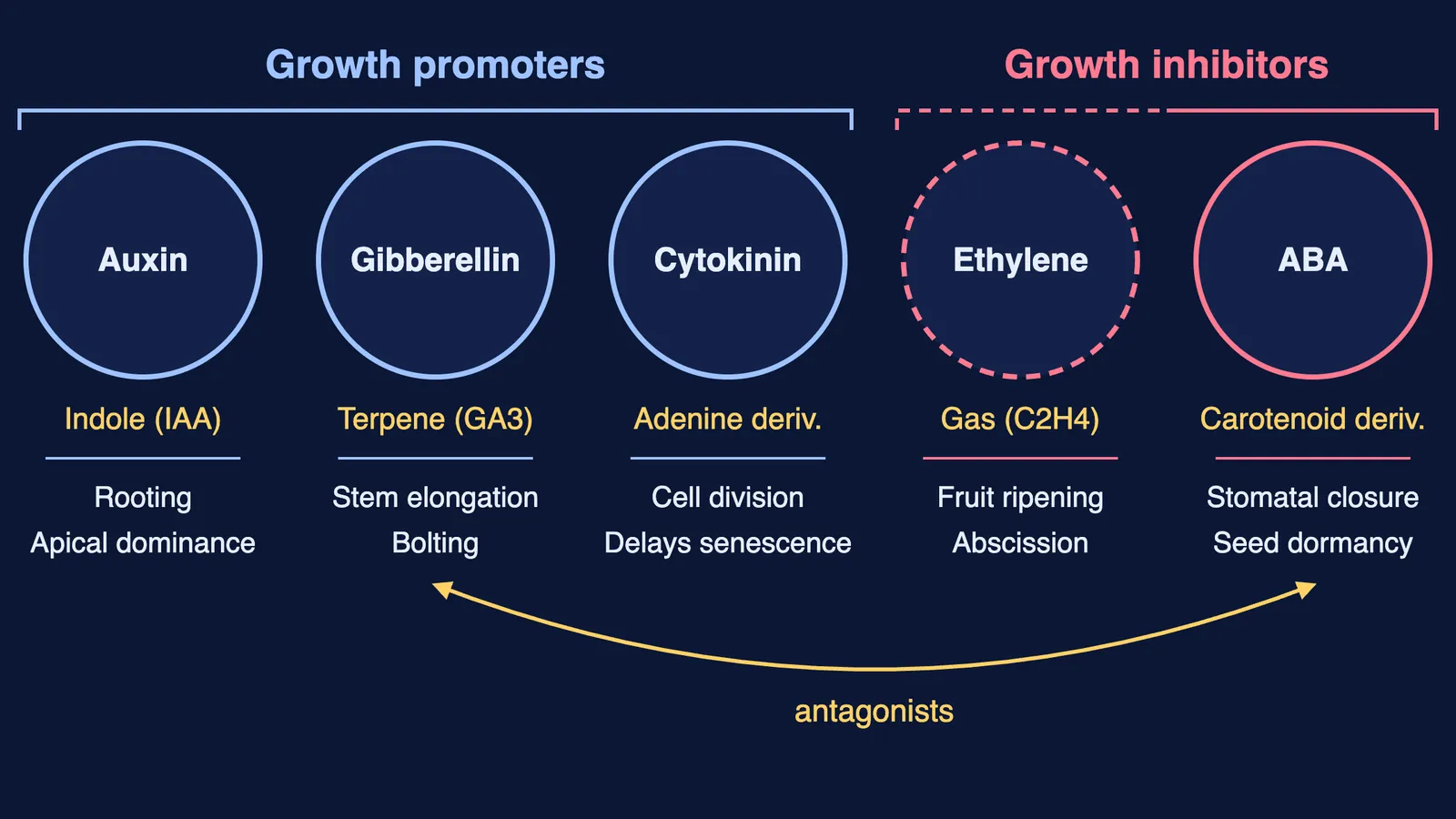
NCERT calls auxins, gibberellins and cytokinins promoters and ABA an inhibitor; ethylene fits either but is largely an inhibitor.
Auxin (IAA): rooting of cuttings, apical dominance, parthenocarpy in tomato; 2,4-D kills dicot weeds.
Gibberellins (GA3): longer grape stalks and sugarcane stems, bolting in beet and cabbage. Kurosawa (1926) produced bakanae symptoms in rice with fungal filtrates.
Cytokinins: cell division, overcoming apical dominance, delaying leaf senescence; kinetin came from autoclaved herring sperm DNA.
Ethylene: fruit ripening, abscission, more female flowers in cucumber; applied as ethephon.
ABA: stomatal closure, seed dormancy, stress tolerance; an antagonist of GAs.
Practice questions for the school exam
Mark labels are our suggestion.
(1 mark) Which PGR is a carotenoid derivative?
(2 marks) A stem grows from 12.0 cm to 15.6 cm in 4 days at a constant rate. Find r and name the growth type.
(2 marks) Over 5 days, a bean seedling's fresh weight rises from 1.5 g to 2.4 g and a maize seedling's from 6.0 g to 7.5 g. Which has the higher absolute growth rate, and which the higher relative growth rate?
(3 marks) A parenchyma cell between vascular bundles starts dividing, joins the cambium ring, and its daughters mature into secondary xylem. Name the process at each step.
(3 marks) A mango orchard flowers unevenly and stored tomatoes ripen slowly. Name one compound that helps both, and how.
(5 marks) Compare auxins and cytokinins on apical dominance, cell division and leaf senescence.
Answers: (1) ABA. (2) 0.9 cm per day; arithmetic. (3) Maize for absolute (0.30 against 0.18 g per day); bean for relative (0.12 against 0.05 per day). (5) Ethephon, which releases ethylene.
Not sure where to start? A student brings a topic, a course, a problem set or a scanned assignment, and Fermi's AI tutor works out what they already know, builds a plan for the session, and teaches through it.
For the unit, see Plant Physiology for NEET; for meristems, Anatomy of Flowering Plants for Class 11; and for the divisions behind growth, Cell Cycle and Cell Division for Class 11.