On this page
Introduction to Accounting opens NCERT's Financial Accounting Part I and sets the vocabulary for the rest of Class 11 Accountancy. This guide covers what the 2026-27 syllabus keeps, the ideas examiners test, and a drill with answers.
What does Chapter 1 cover in the 2026-27 syllabus?
The CBSE Accountancy curriculum for 2026-27 places Introduction to Accounting in Unit 1: Theoretical Framework, together with Theory Base of Accounting. Unit 1 carries 12 of the 80 theory marks, and that figure is shared by both chapters, so there is no separate mark count for this chapter alone.
It lists the meaning, objectives, advantages and limitations of accounting; users and their needs; qualitative characteristics; the role of accounting in business; and basic terms such as capital vs revenue expenditure, current vs non-current items, and trade vs cash discount. It prints no exclusion note for this chapter. We followed the current NCERT chapter, which carries "Reprint 2026-27" on every page.
What is accounting, and who uses the information?
The NCERT chapter defines accounting as a four-step process: identify an organisation's economic events, measure them in money, record them, and pass the required information on to the users who need it. Learn the four steps in order: identification comes first and communication last.
Only events measurable in money are recorded, so appointing a new manager is not entered.
Users fall into two groups:
Internal users: management, from the chief executive to store managers, who plan, control and decide.
External users: investors, lenders, creditors, tax authorities, regulators, employees, customers and competitors. A lender asks whether loans will be repaid; a customer asks whether the business will last.
The objectives follow: record transactions systematically, work out profit or loss, show the financial position, and inform users.
NCERT names four qualitative characteristics: reliability (you can trust it), relevance (it arrives in time to affect a decision), understandability (the reader takes the meaning intended) and comparability (you can set it against last year or another firm).
Its main limitation: it looks back at past transactions and records only money figures, so non-financial and qualitative facts are missing.
Which basic accounting terms do students mix up?
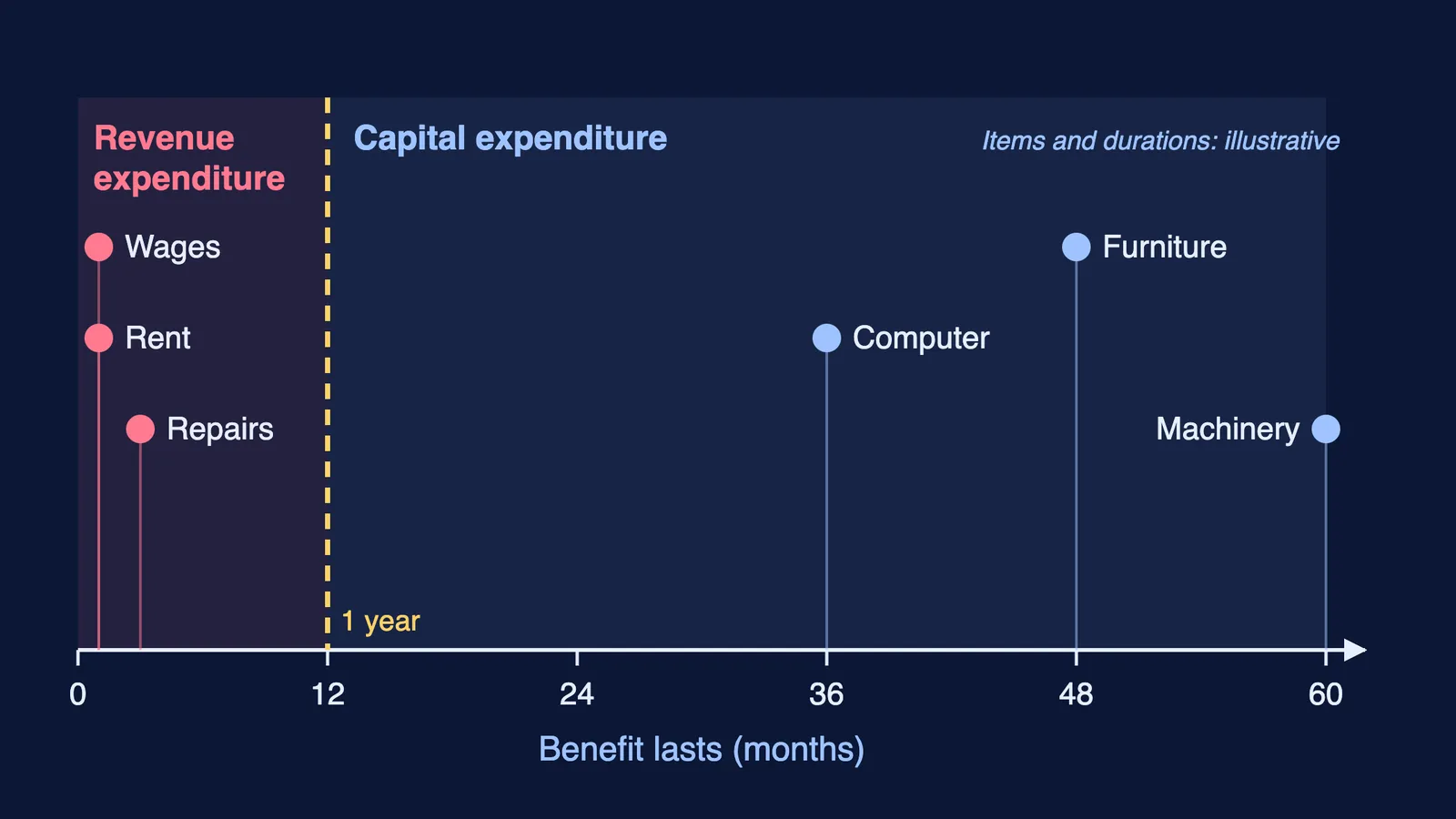
Capital vs revenue expenditure. If the benefit is used up within a year, it is revenue expenditure (an expense); if the benefit lasts more than a year, it is capital expenditure (an asset). The chart at the top shows the one-year line.
Current vs non-current. Current items are realised or settled within 12 months or within the operating cycle (stock, debtors, cash); long-term loans and fixed assets are non-current.
Trade vs cash discount. A trade discount is a cut in the list price at the time of sale. A cash discount is given later, at payment, to a debtor who pays within the agreed time.
Worked example (our numbers). Meera Traders sells goods with a list price of ₹40,000 at a 10% trade discount and offers a 2% cash discount for payment within 15 days.
Trade discount: 10% of ₹40,000 = ₹4,000, so the invoice is for ₹36,000.
The customer pays on day 10, so the cash discount is 2% of ₹36,000 = ₹720.
Cash received: ₹36,000 − ₹720 = ₹35,280.
The cash discount is worked on the invoice amount, not the list price. Also separate profit from gain: if revenue is ₹3,20,000 and expenses are ₹2,75,000, profit is ₹45,000. Selling an old printer carried in the books at ₹8,000 for ₹9,500 gives a gain of ₹1,500, because it is incidental to the business.
Quick classification drill
Classify each item for a stationery shop.
Pens bought for resale
Monthly electricity bill
Delivery van
Amount owed by a school that bought on credit
Owner takes ₹5,000 for a family trip
Bank loan repayable in five years
Answers: 1. purchase of goods; 2. revenue expenditure; 3. capital expenditure, non-current asset; 4. debtor, current asset; 5. drawings; 6. non-current liability.
Practice questions for Introduction to Accounting
The mark labels below are our suggestion; CBSE does not print a per-question split for this chapter.
(1 mark) Name the qualitative characteristic that needs a common unit of measurement and a common reporting format.
(1 mark) State one limitation of accounting information.
(3 marks) Distinguish between internal and external users, with two examples of each and the information each needs.
(3 marks) A wholesaler's list price is ₹25,000. It allows an 8% trade discount and a 3% cash discount for prompt payment. Find the cash received if the buyer pays on time. (Answer: ₹22,310.)
(4 marks) Explain how capital expenditure differs from revenue expenditure, and classify a new printer, its ink refills and the repair of a broken shop window.
Next, read the theory base of accounting, from GAAP to Ind AS, then see how capital, assets and liabilities fit together in the accounting equation with a worked example.
Starting a new subject this year? Fermi's AI tutor can work out what you already know and build a plan for the session, so you sit down to a clear next step.