On this page
Unit 6 of CBSE Class 11 Physical Education mixes definitions with exam sums. Here are the 2026-27 topics, key terms, body types and two worked BMI and waist-hip ratio sums.
What does Unit 6 cover in 2026-27?
The CBSE Physical Education (048) curriculum for 2026-27 gives Unit 6, "Test, Measurements & Evaluation", 08 of the 70 theory marks, with no concept-based (b*) marks. Five topics:
Meaning of test, measurement and evaluation
Their importance in sports
Calculating BMI, waist-hip ratio and 3-site skinfolds
Somatotypes: endomorphy, mesomorphy, ectomorphy
Measuring health-related fitness
The prescribed CBSE Class XI textbook also classifies tests (psychomotor, anthropometric, affective, cognitive) and splits test administration into pre-planning, testing operation and post-test functions.
What is the difference between test, measurement and evaluation?
In the textbook, a test is the tool, measurement is the number it produces, and evaluation is your judgement of that number. In a 50 m sprint, the sprint is the test, 8.2 seconds the measurement, and "above class average" the evaluation.
The curriculum's learning outcomes add two pairs:
Norm-referenced vs criterion-referenced: a norm-referenced judgement compares you with your class or age group; a criterion-referenced one compares you with a fixed standard, as a Dublin City University primer sets out. "Faster than 70% of the class" is norm-referenced; "BMI between 18.5 and 24.9" is criterion-referenced.
Formative vs summative: the CBSE CCE manual describes formative assessment as frequent and built into teaching, giving feedback you act on, and summative assessment as the check at the close of a unit or semester that sums up learning.
On importance in sports, the textbook groups uses by the athlete (motivation, self-appraisal, goal setting), the coach (diagnosis, grouping, prediction) and the training programme (benchmarking, norms, redesign, quality check).
How do you calculate BMI and waist-hip ratio?
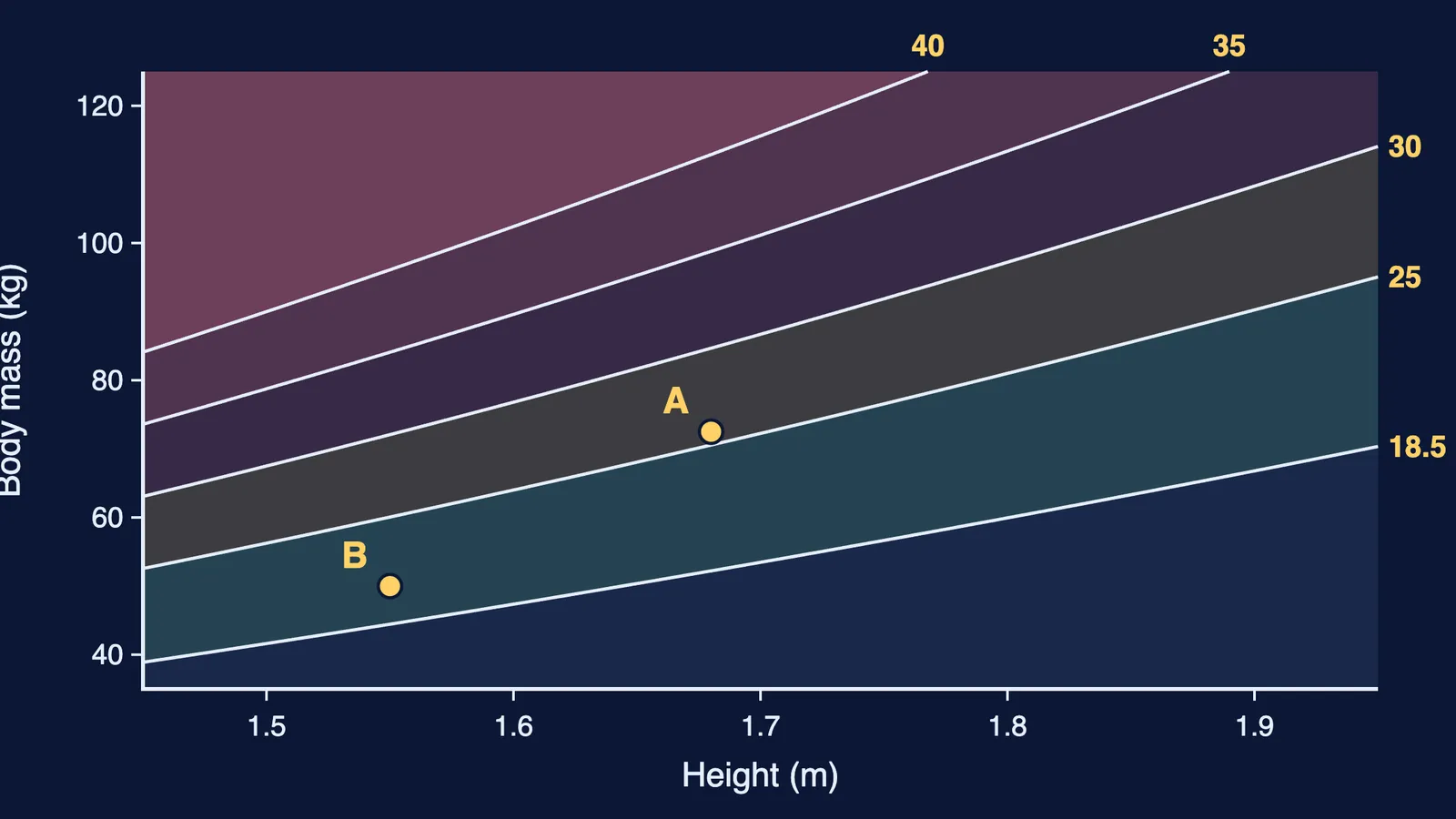
The Class XI textbook gives BMI = body mass (kg) ÷ height (m)², and waist-hip ratio (WHR) = waist girth ÷ hip girth, with both girths in the same unit. Its BMI table: below 18.5 underweight, 18.5-24.9 normal, 25.0-29.9 overweight, 30.0-34.9 class I obesity, 35.0-39.9 class II, 40.0 and above class III. For WHR it gives the WHO healthy limits of 0.9 or less for men and 0.85 or less for women.
Example A. An adult male coach: 168 cm, 72.5 kg, 88 cm waist, 100 cm hips.
Height² = 1.68 × 1.68 = 2.8224 m².
BMI = 72.5 ÷ 2.8224 = 25.7 kg/m², in the 25.0-29.9 overweight band.
WHR = 88 ÷ 100 = 0.88, within the 0.9 limit for men.
Example B. An adult woman: 155 cm, 50 kg, 74 cm waist, 96 cm hips.
Height² = 1.55 × 1.55 = 2.4025 m².
BMI = 50 ÷ 2.4025 = 20.8 kg/m², which is normal weight.
WHR = 74 ÷ 96 = 0.77, within the 0.85 limit for women.
Example A is overweight by BMI yet has a healthy WHR; as the textbook notes, a high BMI does not always mean extra fat.
The adult cut-offs (overweight from 25, obesity from 30) and the 5-19 rule are both in the WHO obesity and overweight fact sheet.
What are endomorphy, mesomorphy and ectomorphy?
The CBSE Class XII textbook links the three body types (endomorph, mesomorph, ectomorph) to William Herbert Sheldon (1942). In the Heath-Carter method, per this INFLIBNET unit on somatotyping, endomorphy rates how fat a physique is relative to its size, mesomorphy how robust its muscle and bone are, and ectomorphy how linear or slender it is.
A somatotype is three numbers in that order: 3-5-2 means endomorphy 3, mesomorphy 5, ectomorphy 2. In that method, endomorphy comes from the sum of triceps, subscapular and supraspinale skinfolds; mesomorphy from bone breadths and limb girths; and ectomorphy from height divided by the cube root of weight.
For skinfolds, the Class XI textbook has you lift the fold with thumb and fingers, set the calliper jaws about half a centimetre below it, and take the reading about 2 seconds after release, at a standard 10 g/mm².
Practice questions
Mark labels are our suggestion.
A student does 22 push-ups in a minute and the teacher calls it "average". Identify the test, measurement and evaluation. (3 marks)
Calculate the BMI of an adult who is 1.60 m tall and weighs 64 kg, and name the category. (2 marks)
A man's waist is 34 inches and his hips 40 inches. Find his WHR and say whether it is within the WHO limit. (2 marks)
Compare a marathon runner and a shot-putter using the three somatotype components. (3 marks)
Answers to 2 and 3: BMI = 64 ÷ 2.56 = 25.0, overweight because that band starts at 25.0. WHR = 34 ÷ 40 = 0.85, within the men's limit.
The Class 12 test and measurement in sports guide covers fitness test batteries; our Unit 5 guide to physical fitness and wellness explains the health-related components.
Not sure where to start? Fermi's AI tutor works out what you already know and builds a plan for the session.