

On this page
Unit 5 of the CBSE Class 11 Physical Education syllabus is "Physical Fitness, Wellness and Lifestyle", and the CBSE 2025-26 curriculum for Physical Education (048) gives it 5 marks in the 70-mark theory paper. Here is what it asks, what each term means, and a weekly plan that fits around school and coaching.
What does Unit 5 of Class 11 PE cover?
The CBSE 2025-26 syllabus lists five topics for the unit:
Meaning and importance of wellness, health and physical fitness
Components and dimensions of wellness, health and physical fitness
Traditional sports and regional games for promoting wellness
Leadership through physical activity and sports
Introduction to first aid: PRICE
Its learning outcomes say you should be able to explain wellness and define its components, classify physical fitness, and distinguish skill-related from health-related components.
What are the components of physical fitness?
Physical fitness is "a set of attributes that are either health- or skill-related", in the definition proposed by Caspersen, Powell and Christenson in Public Health Reports (1985). The same paper defines exercise as physical activity that is planned, structured and repetitive and aims to improve or maintain fitness.
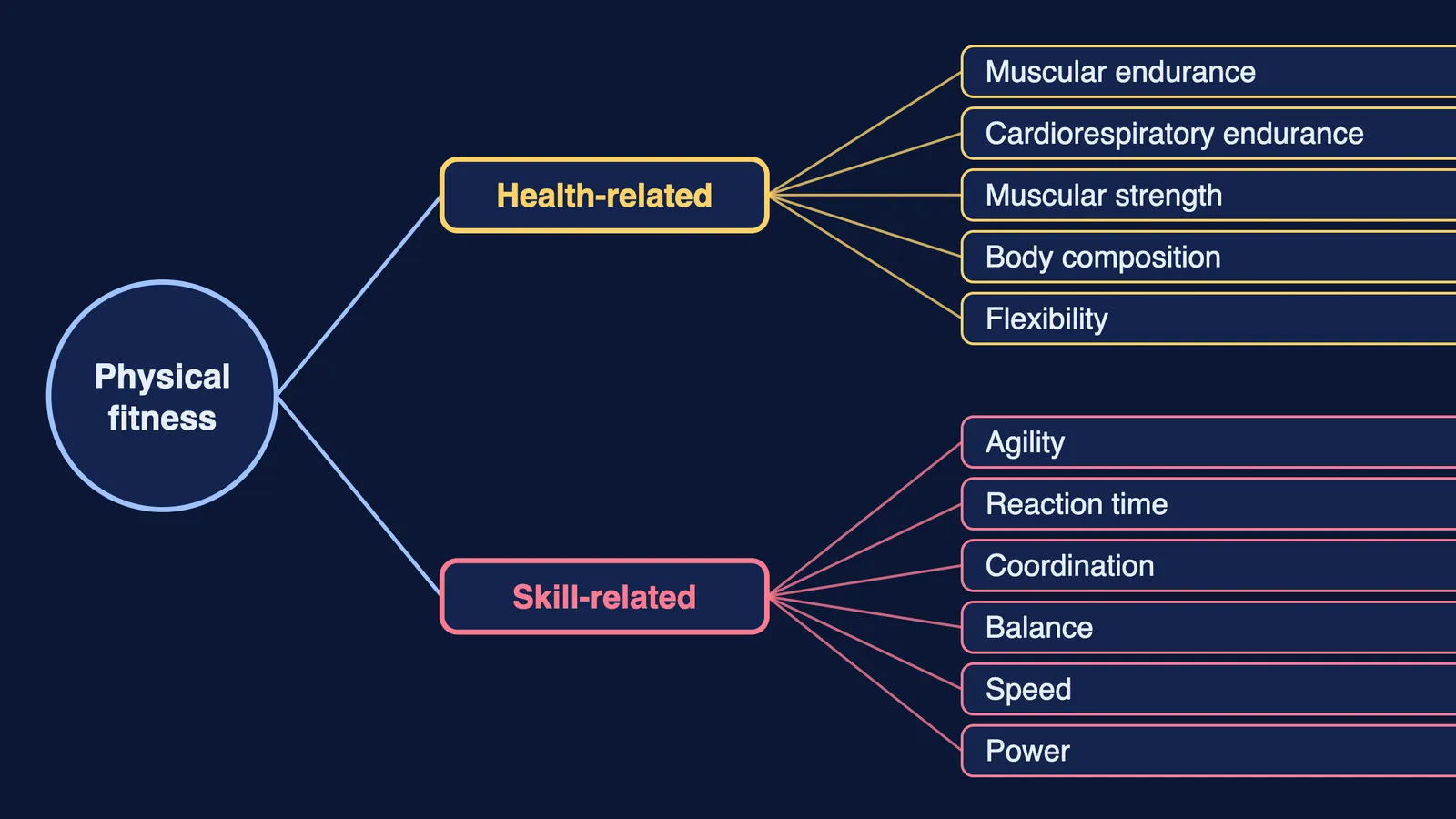
The CBSE Class XI Physical Education textbook splits fitness into two branches:
Health-related fitness: cardiorespiratory endurance, muscular strength, muscular endurance, flexibility and body composition.
Skill-related fitness: agility, reaction time, coordination, balance, speed and power.
A quick way to tell them apart: health-related components matter to everyone, every day, like climbing stairs with a school bag. Skill-related components decide how well you play a sport, like a badminton player's reaction time or a kabaddi raider's agility.
What are the dimensions of wellness?
Wellness is wider than fitness. The CBSE textbook names seven interlinked components: physical, emotional, mental (also called intellectual), social, environmental, occupational and spiritual. Its example: someone who trains hard but regularly eats junk food, smokes and drinks alcohol is still raising their chances of cardiovascular disease. Wellness looks at the whole lifestyle, not one habit.
How do lifestyle habits lead to lifestyle diseases?
Lifestyle diseases belong to the group WHO calls noncommunicable diseases (NCDs), whose main types are cardiovascular diseases (such as heart attacks and stroke), cancers, chronic respiratory diseases and diabetes. NCDs killed at least 43 million people in 2021, 75% of non-pandemic deaths worldwide, according to the WHO fact sheet on noncommunicable diseases. The same fact sheet names the risk factors: tobacco use, physical inactivity, harmful use of alcohol, unhealthy diets and air pollution.
People who are insufficiently active have a 20-30% higher risk of death than people who are sufficiently active, says the WHO physical activity fact sheet.
India's own numbers show why this matters. The ICMR-INDIAB national study, which surveyed 113,043 people across 31 states, union territories and the National Capital Territory between 2008 and 2020, found diabetes in 11.4% and prediabetes in 15.3% of adults aged 20 and over.
Changing a habit is a process, not a single decision. The textbook's Trans-theoretical (stages-of-change) model, with its stages of precontemplation, contemplation, preparation, action, maintenance and termination or adoption, helps you see where you are and what the next small step is.
How much physical activity does a Class 11 student need?
For children and adolescents, an average of 60 minutes a day of moderate-to-vigorous aerobic activity across the week provides health benefits, according to the WHO 2020 guidelines summarised in the British Journal of Sports Medicine. The guidelines also recommend regular muscle-strengthening activity and less sedentary time.
Most teenagers fall short. A WHO release from November 2026 found that 28% of girls and 22% of boys reported no day in the previous week with 60 active minutes.
How can you fit 60 active minutes around coaching?
This plan adds up to 420 active minutes, an average of 60 a day, and trains endurance, strength and flexibility:
Monday: 40 minutes cycling or brisk walking to school or coaching, plus 20 minutes skipping (60).
Tuesday: 45 minutes of football, badminton, kho-kho or kabaddi, plus a 15-minute circuit of squats, push-ups and planks (60).
Wednesday: three 20-minute brisk walks between study blocks (60).
Thursday: repeat Tuesday (60).
Friday: 45 minutes of jogging, then 15 minutes of stretching or yoga for flexibility (45 active).
Saturday: 90 minutes of a sport with friends (90).
Sunday: a 30-minute family walk plus the 15-minute circuit (45).
If study sessions overrun because you are unsure where to begin, Fermi's AI tutor can work out what you already know and build a plan for the session, so your active hour stays in the timetable. When an idea in the biomechanics unit is hard to picture from the page, the Fermi Simulation Lab has interactive simulations for ideas that are easier to see than to read.
Pick one day of the plan and start it this week.


