On this page
Unit 9, Psychology and Sports, carries 7 marks in the 70-mark theory paper of CBSE Class 11 Physical Education (048), according to the CBSE 2026-27 curriculum. The book CBSE prescribes is its own Class XI Physical Education textbook (second edition, January 2023). This guide stays with the Class 11 unit; personality, motivation and aggression come in Class 12, covered in our Class 12 psychology and sports guide.
The curriculum lists five topics, one per section below, and expects you to link each concept to real sports situations.
What is sports psychology and why does it matter?
The CBSE textbook defines psychology today as the scientific study of behaviour and mental processes. Sports psychology joins psychology with kinesiology, the study of movement, and asks how the mind affects performance and how sport affects the mind.
Two dates to learn: in 1925 Coleman Griffith founded the University of Illinois's Athletic Research Laboratory, and in 1986 the American Psychological Association created Division 47 for the field.
For the "importance" answer, group the textbook's points:
Exercise benefits: cognitive (attention, problem-solving), emotional (better mood, less anxiety), social interaction, and distraction from a bad mood.
Sports participation: life skills, friendships, self-efficacy and decision-making.
Performance: confidence, focus, emotional control, coping with errors and team cohesion.
Exercise adherence: understanding why people drop out, so they keep exercising.
What are the stages of growth and development?
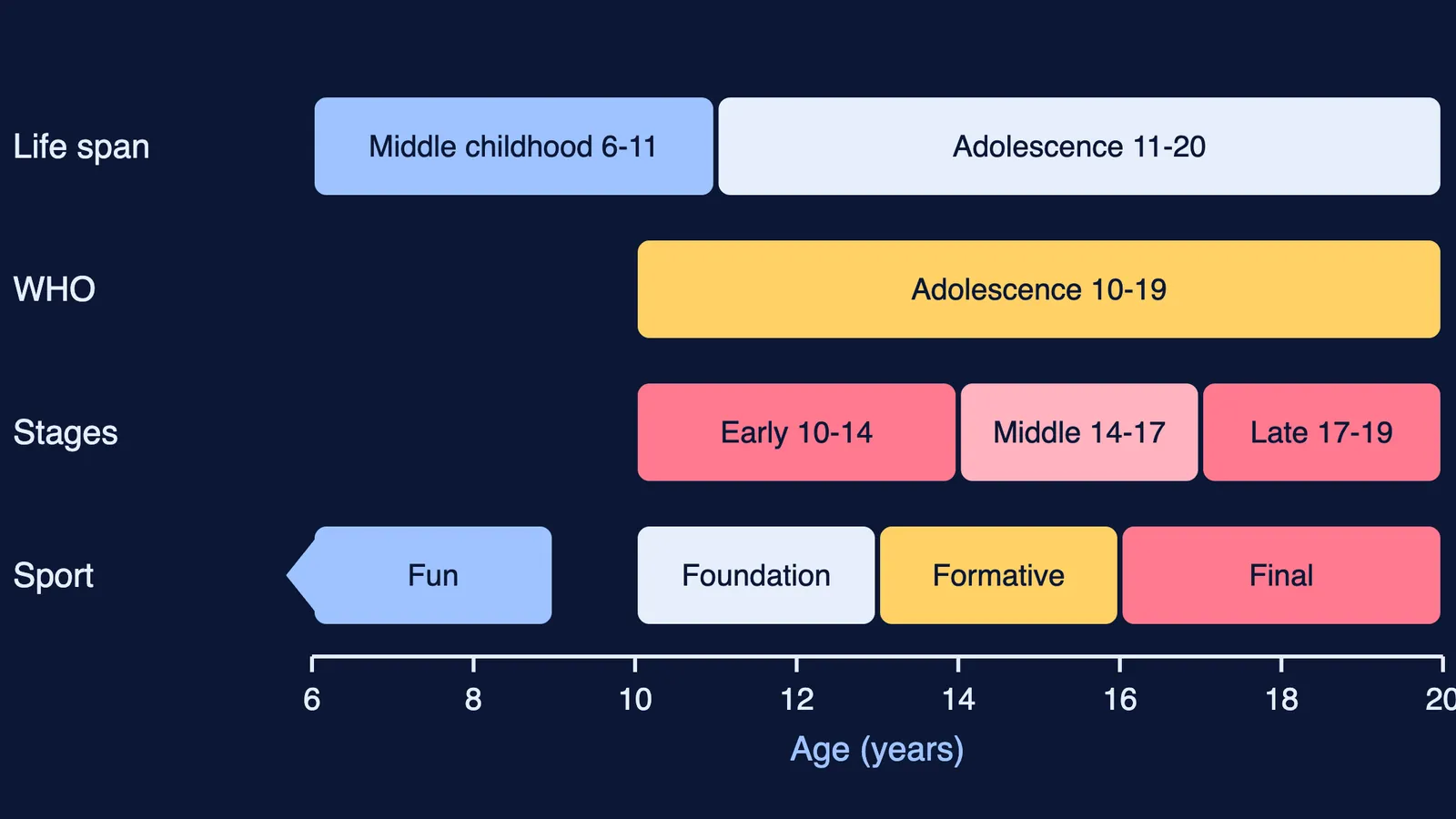
The textbook names four interacting areas of development: physical, mental (cognitive), social and emotional. It divides the life span into infancy (0-2), childhood (2-11), adolescence (11 to about 20) and adulthood (from 20).
It then gives a sports model with four phases, each with a coaching rule:
Fun phase (below 9): short attention span; keep drills varied and the atmosphere stress-free.
Foundation phase (10-12): growth spurt begins; low-intensity conditioning, small-sided games, no stress on winning or losing.
Formative phase (13-15): sensitive to peer pressure; practise in real match situations and allow more decision-making.
Final phase (16-19): abstract reasoning; give individual roles and match-intensity drills.
Girls tend to mature earlier than boys, so the phases may shift slightly.
What problems do adolescents face, and how are they managed?
The World Health Organization defines adolescence as ages 10 to 19. The textbook splits it into early (10-14), middle (14-17) and late (17-19) adolescence, and covers four problems:
Substance abuse: cognitive techniques (adults show concern, set limits and agree team rules) plus behavioural ones (positive peer influence, free time filled with sport).
Eating disorders: anorexia nervosa and bulimia nervosa; managed through diet awareness and promotion of fitness.
Anti-social behaviour: aggression is eased by catharsis, letting young people express feelings, and by breaking its "circular effect" early with positive reinforcement.
Poor exercise adherence: dropouts have intrapersonal causes (boredom, low motivation), interpersonal ones (family or peer pressure) and structural ones (time, injury, cost, facilities).
Tele MANAS is the Union Health Ministry's free, 24x7 tele-mental health helpline.
What is team cohesion in sports?
Cohesion means sticking together: team cohesion is the sum of forces that keep members in a team. The textbook separates two kinds:
Task cohesion: how well members work together towards a shared goal.
Social cohesion: how much members like each other and enjoy being a team.
Its determinants are personal (satisfaction, similar experience), team (prior success, communication, team goals), leadership (effort to build cohesion) and environmental (group size). Benefits: team stability and team efficacy for the group; better performance, momentum and mood for each player.
Example: a school kabaddi side of close friends who argue over who raids has high social but low task cohesion. The fix is clear roles and a shared goal, not another outing.
What are attention, resilience and mental toughness?
Attention has two dimensions: width (broad or narrow) and direction (external or internal). A fielder reading the whole ground uses broad external focus; a shooter fixed on the target uses narrow focus.
Mental toughness is natural and developed traits that keep you determined, focused and in control under pressure.
Resilience is bouncing back from setbacks. The textbook names three types: natural, adaptive and restored (learned).
Practice questions for Unit 9
Our own questions; mark labels are our suggestion.
Distinguish task cohesion from social cohesion with one sports example each. (3 marks)
A 14-year-old footballer takes every comment from teammates to heart. Name the sports phase and suggest two coaching steps. (3 marks)
Explain the three types of constraint that make adolescents drop out of sport. (3 marks)
A coach notices that one player has stopped turning up to practice and another shoves an opponent after every foul. Name each adolescent problem and explain how it can be managed. (5 marks)
A goalkeeper facing a penalty and a midfielder scanning for a pass need different attention. Classify each by width and direction. (2 marks)
Not sure where to start revising? Fermi's AI tutor works out what you already know and builds a plan for the session. For an earlier unit, revise physical fitness, wellness and lifestyle.