On this page
Psychology and Sports is part of the Class 12 Physical Education course. In the CBSE Physical Education curriculum for 2026-27, it is Unit 9 and carries 7 of the 70 theory marks.
The 2026-27 curriculum lists five topics:
Personality: definition and types (Jung's classification and the Big Five)
Motivation: types and techniques
Exercise adherence: reasons, benefits and strategies
Aggression in sports: meaning, concept and types
Psychological attributes: self-esteem, mental imagery, self-talk and goal setting
If you also take Psychology, our guide to self and personality in Class 12 psychology goes deeper on the theories.
What are the personality types in sports psychology?
Jung's classification sorts people into types, such as introverts and extraverts. A review by Allen, Greenlees and Jones (2013) explains the problem with types: test scores form a normal curve, and most people fall in the middle.
So the Big Five places you on five scales instead. The review defines them as:
Extraversion: the quantity and intensity of your interactions with other people.
Neuroticism: how prone you are to emotional instability (its opposite is emotional stability).
Openness: your tendency to seek out new experiences.
Agreeableness: your concern for cooperation and social harmony.
Conscientiousness: organisation and goal-directed behaviour.
The review reports that national and international athletes scored lower on neuroticism and higher on conscientiousness and agreeableness than club or regional athletes. It also cites a meta-analysis by Rhodes and Smith (2006) linking physical activity with extraversion (r = .23), conscientiousness (r = .20) and, weakly and negatively, neuroticism (r = -.11). These are small-to-medium links: personality tilts the odds but does not decide who plays or succeeds.
What is the difference between intrinsic and extrinsic motivation?
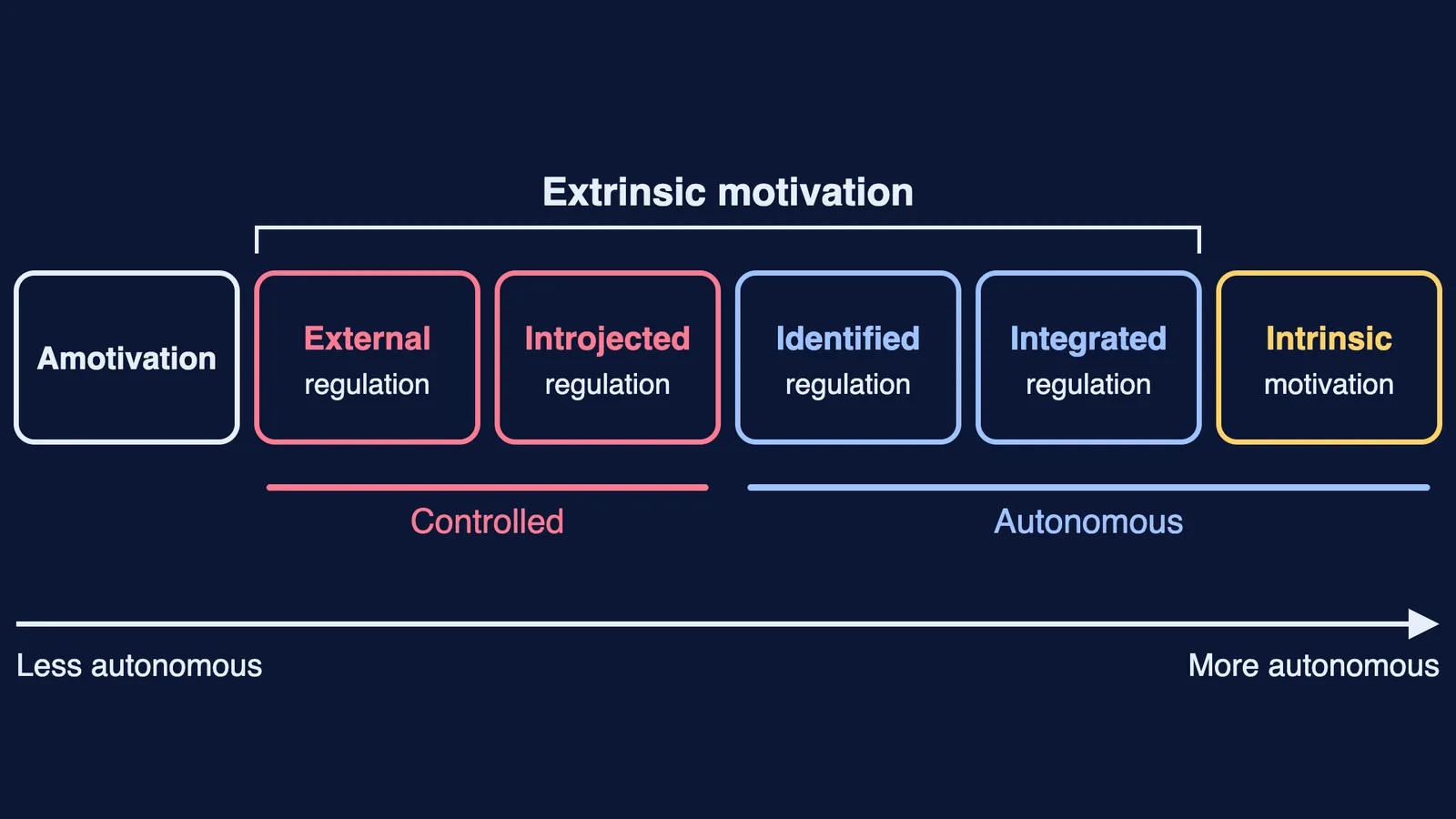
Intrinsic motivation means doing an activity for its own sake, for the interest and enjoyment in it, according to Ryan and Deci (2020). Extrinsic motivation covers behaviour done for reasons other than that enjoyment, such as rewards, approval or a goal you value.
Ryan and Deci arrange these on a scale of autonomy, shown in the diagram above. External regulation (playing for a prize) and introjected regulation (playing to avoid guilt) feel controlled. Identified and integrated regulation (training because you value fitness) feel freely chosen. Amotivation means lacking any intention to act.
A worked example: Aman bowls in the nets because he loves a good outswinger (intrinsic). Kabir bowls because selection trials are next month (extrinsic). If trials are cancelled, Kabir's reason disappears and Aman's does not.
What is exercise adherence and why does it matter?
Exercise adherence means sticking with regular activity over months, not just starting it. Most teenagers do not: the WHO physical activity fact sheet says 86% of adolescents aged 11-17 do not meet recommended activity levels. WHO counts an adolescent's active day as one with at least 60 minutes of moderate-to-vigorous activity.
Strategies that help:
Pick an activity you enjoy, so the motivation is closer to intrinsic.
Fix a time and place, such as 6:30 pm in the colony ground.
Train with a friend or team.
Mark active days on a calendar and keep the streak going.
What are the types of aggression in sport?
Hostile aggression aims to hurt someone, while instrumental aggression is used as a means to an outcome such as winning the ball, according to Bovolon and colleagues (2024). A tackle meant to injure is hostile; a tackle meant to stop a goal is instrumental. At higher competitive levels, athletes tend to show more instrumental and fewer hostile behaviours. The Allen review adds that athletes lower in agreeableness, extraversion or emotional stability are more prone to aggression.
Both numbers are listed on the Tele MANAS website.
How do self-talk and other psychological attributes help?
Self-esteem is how you value yourself, mental imagery is rehearsing a skill in your mind, goal setting turns a wish into a measurable target, and self-talk is what you say to yourself during play.
A meta-analysis by Hatzigeorgiadis and colleagues (2011) pooled 32 studies and found self-talk interventions had a moderate positive effect on sports performance. It worked better for fine skills and for new tasks, and instructional self-talk (such as "eyes on the seam") suited fine skills better than motivational self-talk (such as "come on, you can do this").
A one-week revision plan for Unit 9
Day 1: list the Big Five with one sports example each.
Day 2: draw the motivation scale from memory.
Day 3: exercise adherence: three reasons, benefits and strategies.
Day 4: write a "differentiate" answer on aggression using a kabaddi example.
Day 5: the four psychological attributes, one example each.
Day 6: answer a past paper section under time, then fix the gaps.
Next, link this unit to Unit 10 with our guide to training in sports for Class 12. For your science subjects, Fermi's AI tutor works out what you already know and builds a plan for the session, so you start with a clear next step.