On this page
Self and personality is Chapter 2 of the NCERT Class 12 psychology textbook. Board answers reward exact definitions and clean comparisons, so here are both, plus a revision drill.
What do self and personality mean in Class 12 psychology?
NCERT defines the self as "the totality of an individual's conscious experiences, ideas, thoughts and feelings with regard to herself or himself" (NCERT Chapter 2, Self and Personality).
Personality refers to "our characteristic ways of responding to individuals and situations": unique, relatively stable qualities that show up across situations and over time. The word comes from the Latin persona, the mask actors wore in Roman theatre (NCERT).
Three cognitive aspects of self are often asked together:
Self-esteem: the value judgment a person makes about themselves.
Self-efficacy: the belief that you have the ability a situation needs; NCERT links it to Bandura's social learning theory.
Self-regulation: the ability to organise and monitor your own behaviour, helped by observing it, self-instruction and self-reinforcement.
How are type and trait approaches different?
The type approach places people into broad categories by similar behaviour, while the trait approach studies specific attributes on which people differ in consistent, stable ways (NCERT).
Type examples: Hippocrates' four humours (sanguine, phlegmatic, melancholic, choleric), the Charak Samhita's vata, pitta and kapha, the trigunas (sattva, rajas, tamas), Sheldon's endomorph, mesomorph and ectomorph, Jung's introverts and extraverts, and Friedman and Rosenman's Type-A and Type-B. NCERT warns that typologies are appealing but too simplistic.
Trait examples: Allport's cardinal, central and secondary traits; Cattell's 16 source traits, found by factor analysis; Eysenck's neuroticism versus emotional stability and extraversion versus introversion, with psychoticism added later; and Costa and McCrae's Big Five, which NCERT calls the most promising empirical approach (NCERT).
What is Freud's structure of personality?
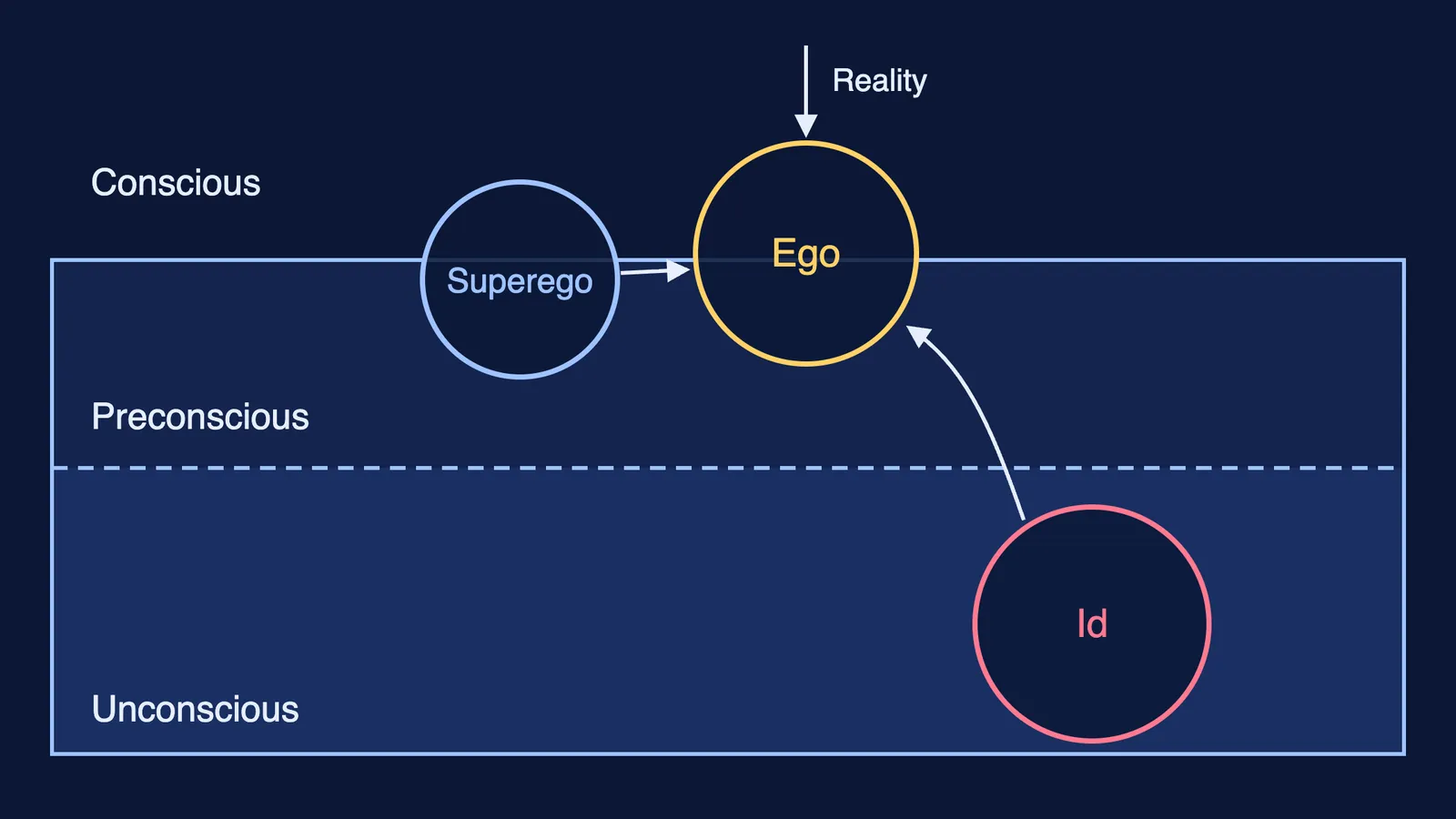
Freud described three levels of consciousness (conscious, preconscious and unconscious) and three structural elements of personality: id, ego and superego (NCERT).
Id: the source of instinctual energy; it works on the pleasure principle.
Ego: grows out of the id and works on the reality principle.
Superego: the moral branch, built by internalising parental authority.
NCERT's own example is a boy who wants an ice-cream cone: the id says grab it, the ego says ask first or be punished, and the superego tells him asking is morally right. Use it in your answer, and add that these are concepts, not physical structures.
How is personality assessed?
Besides psychometric tests, covered in the previous chapter, NCERT describes self-report measures, projective techniques and behavioural analysis (NCERT).
Self-report: MMPI (Hathaway and McKinley; MMPI-2 has 567 true/false statements and 10 subscales), the Eysenck Personality Questionnaire, and Cattell's 16PF.
Projective: the Rorschach inkblot test (10 inkblots), the Thematic Apperception Test (30 picture cards and one blank card), Rosenzweig's picture-frustration study, sentence completion and draw-a-person.
Behavioural analysis: interviews, observation, behavioural ratings, nomination and situational tests.
Know the weaknesses too: social desirability and acquiescence in self-reports, the halo effect in ratings, and projective scoring that is lengthy and sometimes subjective. NCERT also cautions students not to test or interpret the personality of friends, because that takes great skill and training.
How should you revise self and personality?
Write the definitions of self and personality from memory, then check them.
Draw a two-column grid, type and trait, and fill in five names on each side without looking.
Sketch Freud's diagram (NCERT Fig. 2.2) and label id, ego, superego and the three levels.
Sort these into self-report, projective or behavioural: TAT, 16PF, nomination, Rorschach, MMPI, situational stress test.
Answer NCERT's review question: "What is trait approach to personality? How does it differ from type approach?" Give a definition and example of each, and one limitation of types.
Turn steps 1 and 4 into flashcards with our guide to making active recall cards from your notes, and practise longer questions with how to answer case-based questions in CBSE board exams. If your family is still choosing subjects, read should your child take psychology in Class 11.
If psychology sits next to physics, chemistry or biology in your timetable and you don't know where to start in those, Fermi's AI tutor can work out what you already know and build a plan for the session.
If revision stress feels heavy, Tele-MANAS, the government's toll-free 24/7 mental health helpline, is on 14416 (Ministry of Health and Family Welfare, via PIB).