On this page
Chapter 3 of NCERT's Class 12 sociology textbook, Indian Society, studies three institutions: caste, tribe and family (NCERT Class 12 sociology, Chapter 3). For every topic, ask what has continued and what has changed; many of the chapter's ten end-of-chapter questions turn on exactly that.
What are the features of the caste system?
The NCERT chapter separates two terms. Varna is the four-fold, all-India division into brahmana, kshatriya, vaishya and shudra. Jati is the regional or local system of hundreds or even thousands of castes and sub-castes.
The textbook lists six commonly cited features:
Caste is determined by birth.
Marriage is restricted to members of the group (endogamy).
Rules govern food and who may share it.
Castes are arranged in a hierarchy of rank and status.
Castes have sub-castes, a segmental organisation.
Castes were traditionally linked to hereditary occupations.
Behind these rules sit two principles: separation (each caste kept apart) and hierarchy (each caste a ranked part of the whole), with ranking based on ritual purity and pollution.
What changes did colonialism bring about in the caste system?
Some scholars argue that caste as we know it today is more a product of colonialism than of ancient tradition, NCERT notes (NCERT, Chapter 3). Learn three changes:
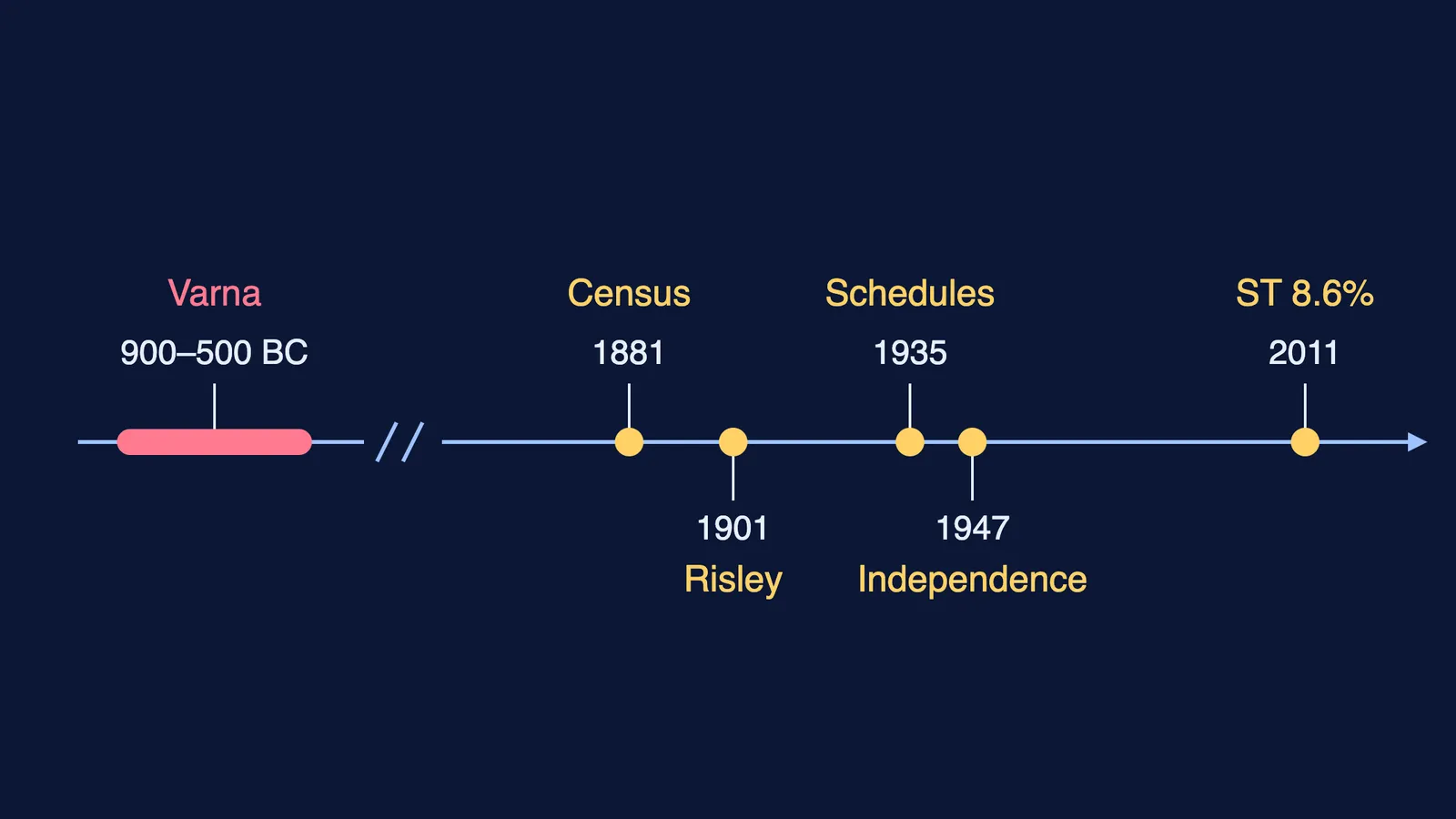
Counting: the census, first begun in the 1860s, became a regular ten-yearly exercise from 1881.
Ranking: the 1901 Census under Herbert Risley tried to record each caste's position in the social hierarchy, and hundreds of petitions arrived from castes claiming a higher place. Scholars feel that once caste was counted and recorded, it became less fluid and took on a new life.
Scheduling: the Government of India Act of 1935 legally recognised lists, or schedules, of castes and tribes for special treatment, the origin of the terms Scheduled Castes and Scheduled Tribes.
How has caste changed since Independence?
The Constitution committed the state to abolishing caste, but change was uneven (NCERT, Chapter 3). Cities and new jobs loosened caste rules, though factory recruitment often followed caste lines and endogamy stayed largely unaffected.
Politics is perhaps the most important sphere of change. M.N. Srinivas gave the chapter two concepts. Sanskritisation is a process in which a middle or lower caste adopts the ritual, domestic and social practices of a higher caste to raise its status. A dominant caste is a numerous intermediate caste that gained land rights through post-Independence land reforms, such as the Jats of Punjab or the Patidars of Gujarat.
The sharpest point: caste has tended to become ‘invisible’ for the upper-caste urban middle and upper classes who benefited most from it, and all too visible for Scheduled Castes, Scheduled Tribes and backward castes.
How are tribes classified in India?
Tribes have often been defined by what they were not: no religion with a written text, no state of the normal kind, no sharp class divisions (NCERT, Chapter 3). They are classified by permanent traits (region, language, physical traits, habitat) and acquired traits (livelihood, incorporation into Hindu society).
About 85% of India's tribal population lives in ‘middle India’, from Gujarat and Rajasthan to West Bengal and Odisha, and over 11% lives in the North Eastern states, according to the NCERT chapter. By Census 2011, Scheduled Tribes are 8.6% of India's population, about 104 million people.
Against the idea that tribes are isolated and primitive, cite Gond kingdoms such as Garha Mandla, Munda settled agriculture, and tribal land taken for dams and mines. An educated tribal middle class now drives new assertions of identity, as the sociologist Virginius Xaxa argues in a passage the textbook quotes.
What forms can the family take?
A nuclear family is one set of parents and their children; an extended or joint family has more than one couple, often across more than two generations (NCERT, Chapter 3). Families also vary by residence (matrilocal or patrilocal) and inheritance (matrilineal or patrilineal), and change with society: when men migrate from Himalayan villages, the share of women-headed families can rise.
How do you answer a continuity and change question?
Use a three-part frame: Then (the earlier state), Lever (the force that changed it), Now (what is true today, including what did not change).
Worked example: ‘What changes did colonialism bring about in the caste system?’
Then: before colonial intervention, scholars feel, caste identities were more fluid and less rigid.
Lever: the census from 1881, Risley's 1901 ranking exercise, and the 1935 schedules.
Now: caste became fixed in official records, castes organised to claim higher status, and the Scheduled Castes and Scheduled Tribes categories still shape policy.
Closing line: colonialism did not just record caste; it changed the institution itself.
If your timetable also includes physics, chemistry, biology or maths, Fermi's AI tutor can work out what you already know and build a plan for the session, so revision starts with a clear next step.