On this page
Chapter 5 of the NCERT Class 12 sociology book *Indian Society* asks a hard question: if inequality is all around us, why does it so often look natural, or even deserved? The NCERT chapter Patterns of Social Inequality and Exclusion answers that it is neither, and then tests the idea on four groups.
What is social about social inequality and exclusion?
The chapter gives three answers, a clean opening for most long answers (NCERT, Indian Society, Chapter 5):
It is about groups, not individuals.
It is not only economic, though social and economic inequality are usually linked.
It is systematic and structured: there is a definite pattern.
In NCERT's words, social stratification is a system by which categories of people in a society are ranked in a hierarchy. Three principles explain it: stratification is a feature of society, not of individual differences; it persists over generations, because position is ascribed at birth and reinforced by endogamy; and it is supported by belief or ideology, such as the opposition of purity and pollution in caste.
Which key terms do you need for this chapter?
Learn each as a one-line definition, in the NCERT chapter's own sense:
Prejudice: a pre-conceived opinion or attitude held by members of one group towards another; it can be favourable or unfavourable.
Stereotype: a fixed and inflexible characterisation of a group of people.
Discrimination: actual behaviour towards another group or individual, not just an attitude.
Social exclusion: the ways individuals may become cut off from full involvement in the wider society; NCERT stresses it is systematic, not accidental.
Untouchability: an extreme aspect of caste with three dimensions, exclusion, humiliation-subordination and exploitation.
Dalit: literally downtrodden, a term coined by the ex-untouchable communities and their leaders.
Adivasi: literally original inhabitants, a term coined in the 1930s.
How does the chapter treat caste, tribe, gender and disability?
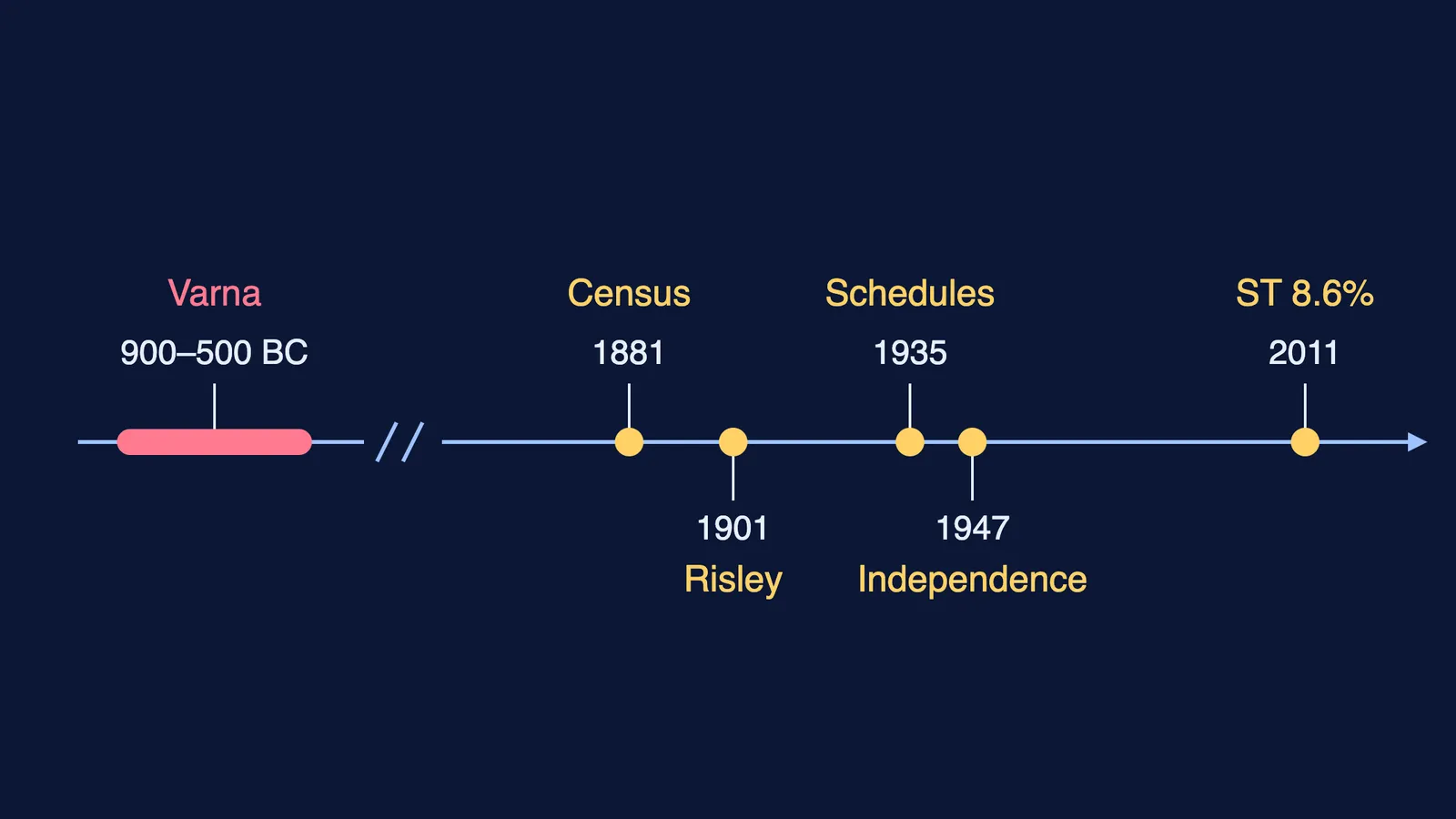
Caste. The link between caste and occupation has become much less rigid since the nineteenth century, but the chapter's key point is that the caste-class correlation is still remarkably stable at the macro level. The Constitution abolished untouchability (Article 17), and the Scheduled Castes and Scheduled Tribes (Prevention of Atrocities) Act of 1989 strengthened punishment for violence and humiliation against Dalits and adivasis. NCERT reads the many laws on this subject as proof that law alone cannot end a social practice. Other Backward Classes are defined negatively, as neither forward castes nor Dalits.
Tribe. Adivasi poverty is traced to colonial forest policy, which cut adivasis off from forests they had long used, and to mining and dam projects after Independence, such as Sardar Sarovar on the Narmada. Statehood for Jharkhand and Chhattisgarh is the chapter's example of what adivasi movements won.
Gender. Gender inequality is social, not biological, the chapter argues, pointing to matrilineal societies such as the Khasis of Meghalaya. Know the reformers (Raja Rammohun Roy, Ranade, Jyotiba Phule, Sir Syed Ahmed Khan) and two women writers: Tarabai Shinde (*Stree Purush Tulana*, 1882) and Begum Rokeya Sakhawat Hossain (*Sultana's Dream*, 1905).
Disability. People are disabled not only by impairment but because society is built in a way that does not cater to their needs. Anita Ghai compares this invisibility to Ralph Ellison's *Invisible Man*. Census 2011 sought information on eight types of disability, against five in Census 2001. The law in force now is the Rights of Persons with Disabilities Act, 2016, listed by the Department of Empowerment of Persons with Disabilities.
Worked example: how do you read the poverty table?
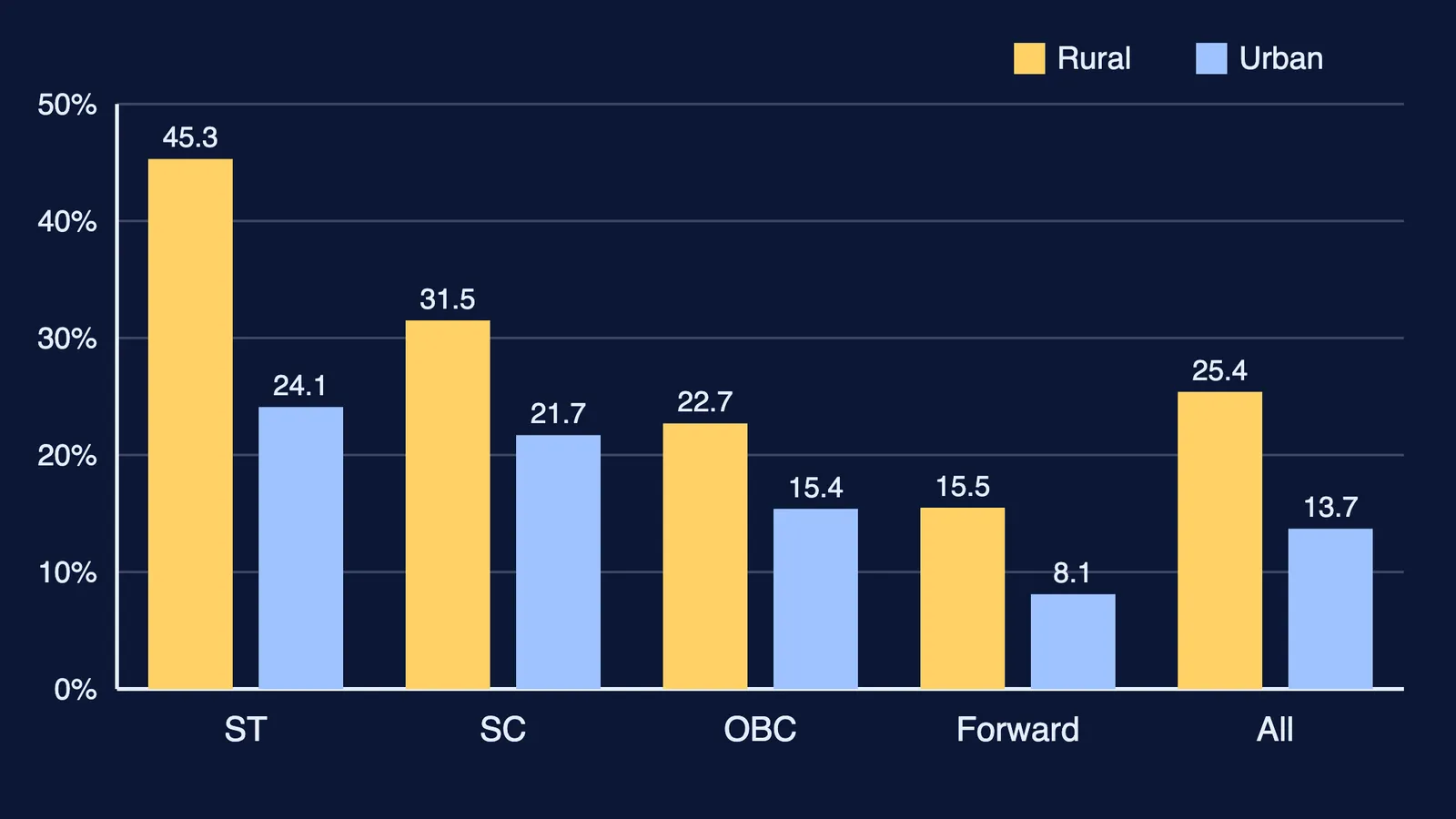
Table 1 of the NCERT chapter, drawn from a 2014 NITI Aayog report and Panagariya and More (2013), gives each group's share below the poverty line in 2011-12. Exercise question 3 asks roughly how many times higher than the average each lower caste's poverty is. Working against the table's rural and urban averages:
Rural Scheduled Tribes: 45.3 / 25.4 = about 1.8 times the rural average.
Rural Scheduled Castes: 31.5 / 25.4 = about 1.2 times.
Rural OBCs: 22.7 / 25.4 = about 0.9, just below the average.
Urban Scheduled Tribes: 24.1 / 13.7 = about 1.8 times; urban Scheduled Castes 21.7 / 13.7 = about 1.6; urban OBCs 15.4 / 13.7 = about 1.1.
Now turn arithmetic into sociology in one sentence: "In 2011-12, rural Scheduled Tribe poverty (45.3%) was about 1.8 times the rural average (25.4%), which supports the chapter's claim that caste and tribe still shape life chances."
How should you revise this chapter in four sittings?
Write the three senses of social and the three principles of stratification from memory, then check.
Say the seven key terms aloud, each with an Indian example of your own.
For each of the four groups, note one cause, one law or movement, and one name.
Redo the Table 1 ratios, then answer the chapter's other questions on Tables 1 and 2.
If physics, chemistry or maths is competing for the same evenings, Fermi's AI tutor can work out what you already know and build a plan for the session, so the science half of your week has a clear next step.