

On this page
Training in Sports closes Class 12 Physical Education. In the CBSE 2026-27 Physical Education curriculum (code 048) it is Unit 10, worth 9 of the 70 theory marks. This guide follows the official CBSE Class XII Physical Education textbook, the book the syllabus prescribes, so your definitions match it.
What is in Unit 10 Training in Sports?
The 2026-27 syllabus lists five topics:
Concept of talent identification and talent development in sports
Introduction to the sports training cycle: micro, meso and macro cycle
Types and methods to develop strength, endurance and speed
Types and methods to develop flexibility and coordinative ability
Circuit training: introduction and its importance
The CBSE textbook gives the cycle lengths: a micro cycle lasts 3 to 10 days, a meso cycle 3 to 6 weeks, and a macro cycle 3 to 12 months.
What are the types and methods of strength, endurance and speed?
All three come from the CBSE Class XII textbook, pages 363 to 383.
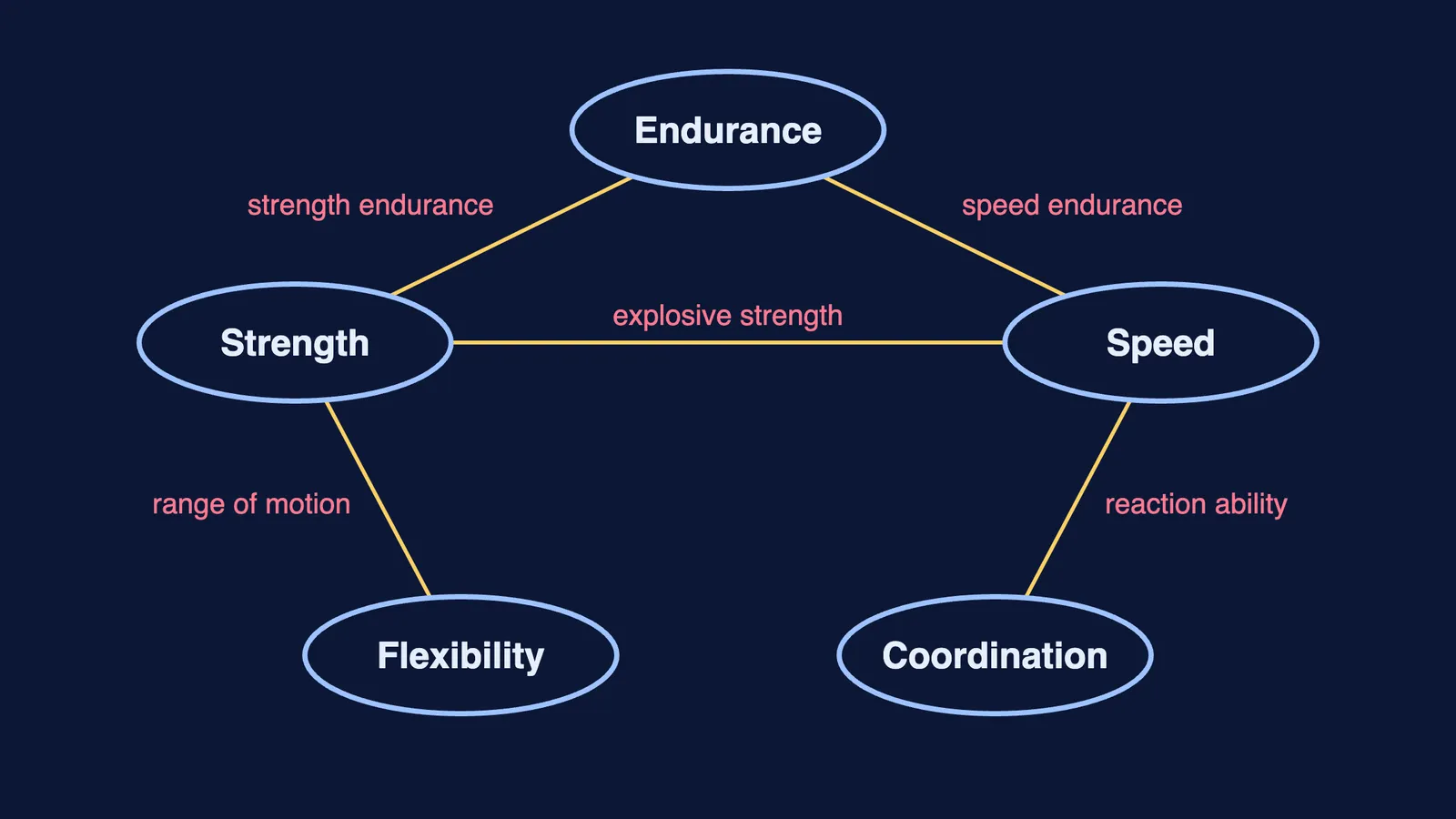
Strength. The textbook quotes H. Singh: strength is "the ability to overcome resistance or to act against resistance." It divides strength into static (isometric) and dynamic (isotonic), and dynamic strength into maximum strength, explosive strength and strength endurance. The three methods are isometric exercise (force with no visible movement, like pushing a wall), isotonic exercise (visible movement, like weight training and calisthenics) and isokinetic exercise, introduced by J.J. Perrine in 1968 and done on specially designed machines.
Endurance. Harre defines endurance as "the ability to resist fatigue." By the nature of the activity it is basic, general or specific. By duration it is speed endurance (up to 45 seconds, such as a 400 m sprint), short-term (45 seconds to about 2 minutes), medium-term (2 to about 11 minutes) and long-term (more than 11 minutes). The methods are continuous (slow, fast, variable pace and fartlek, a Swedish word for "speed play"), interval and repetition.
Speed. Johnson and Nelson define speed as "the capacity of an individual to perform successive movement of the same pattern at a fast rate." The five types are reaction ability, acceleration ability, movement speed, locomotor ability and speed endurance. The two methods are acceleration runs, 6 to 12 repetitions with complete recovery, and pace runs at a uniform speed, used for races of 800 m and above.
How do you develop flexibility and coordinative abilities?
The textbook describes flexibility as the range of motion around a joint. It is passive (with outside help, such as a partner) or active, and active flexibility is static or dynamic. The four methods are slow stretching, slow stretch and hold, the ballistic method, and PNF, in which you contract the muscle for 5 to 7 seconds, then stretch and hold for 8 to 10 seconds, repeated 4 to 8 times. The book suggests holding a static stretch about 30 seconds to improve flexibility and about 10 seconds in a cool-down, and notes many experts believe ballistic stretching can lead to injury.
Coordinative abilities depend on how the central nervous system controls movement. The textbook names seven: orientation, differentiation, coupling, rhythm, reaction, adaptation and balance. To remember them in order: Old Dogs Can Run Rings Around Bulls.
How should you write a 5-mark answer on training methods?
Here is a worked example for "Explain the methods to develop endurance", built from pages 372 to 379 of the CBSE textbook:
Define: Harre, "the ability to resist fatigue."
Classify: three methods, continuous, interval and repetition.
Explain each with one figure: slow continuous work lasts at least 30 minutes; in interval work the heart rate rises to about 180 beats per minute and work restarts when it falls to 120 to 130; repetition work is at 90 to 100% intensity with complete recovery.
Add a sports example: a fartlek run around the school ground, changing pace with the terrain.
End with a safety point, such as warming up first and raising the load gradually, which the book lists for strength training.
The same frame works for strength, speed and flexibility.
Can you use the unit to plan your own week?
The WHO 2020 guidelines recommend an average of 60 minutes a day of moderate-to-vigorous, mostly aerobic, physical activity for children and adolescents. Most teenagers miss it: the WHO physical activity fact sheet reports that 86% of adolescents aged 11 to 17 had fewer than seven active days in the last week.
A light week can double as revision if you label each session with its ability and method:
Monday: 30 minutes of easy jogging (slow continuous method)
Tuesday: squats, push-ups and a plank (isotonic and isometric strength)
Wednesday: acceleration runs after a warm-up, full rest between (speed)
Thursday: slow stretch and hold (flexibility)
Friday: fartlek on the school ground (endurance)
Saturday: football, badminton or kabaddi (coordinative abilities)
Sunday: rest
The textbook says strength training needs appropriate supervision, so do it with your PE teacher. If you have an injury or a health condition, check with a doctor first.
Terms such as glycogen and mitochondria are biology. If they feel like words to memorise rather than ideas you understand, the Fermi Concept Library has a lesson for every concept in biology, physics and chemistry.
Pick one ability tonight, write its five-step answer, and test yourself on it tomorrow.


