On this page
For CBSE Class 10 Science in 2026-27, this chapter stays in the syllabus but leaves the board paper. The CBSE Class X Science curriculum for 2026-27 puts it in a box under Unit I that reads: "The following topics are included in the syllabus but will be assessed only formatively to reinforce understanding without adding to summative assessments." Its Note for Teachers adds that Periodic Classification of Elements "will not be assessed in the year-end examination", and that "credit may be given for Periodic Assessment/Portfolio".
So you study it for school tests and your portfolio, and the practice questions below are written for that.
Where is the chapter in 2026-27, and how is it marked?
The NCERT Class 10 Science textbook (Reprint 2026-27) no longer contains this chapter; its contents page lists 13 other chapters. CBSE prints it as Unit 1 of its Reading Material, Science Class X (2026-27), a prescribed book. Study from that.
The curriculum gives the year-end theory paper 80 marks and internal assessment 20 marks. The 20 are split into Periodic Assessment 05, Multiple Assessment 05, Portfolio 05 and Subject Enrichment (Practical Work) 05. These cover the whole subject; no figure is printed for this chapter. The ideas still help elsewhere: the 2026-27 sample paper asks why carbon forms far more compounds than silicon, the element below carbon.
What does the chapter cover, from triads to the modern table?
Facts here are from the CBSE Reading Material.
Döbereiner's triads (1817): in three similar elements ordered by atomic mass, the middle mass is roughly the average of the other two. He found only three triads.
Newlands' Law of Octaves (1866): ordered by atomic mass, every eighth element resembled the first. It worked only up to calcium.
Mendeléev's Periodic Table: with 63 elements known, he used atomic mass and the formulae of oxides and hydrides. He left gaps for eka-boron, eka-aluminium and eka-silicon, later filled by scandium, gallium and germanium. He also put cobalt (58.9) before nickel (58.7) to keep similar elements together. Limitations: no fixed place for hydrogen, no room for isotopes, and irregular steps in atomic mass.
Modern Periodic Table: Moseley's 1913 work made atomic number the basis, so properties are a periodic function of atomic number. The table has 18 groups and 7 periods.
How do you find an element's group, period and valency?
Write the electronic configuration, then read it. The number of shells gives the period; the valence electrons give the group (1 or 2 electrons: group 1 or 2; 3 to 8: add 10; helium, with 2, sits in group 18). More practice: how to find group and period from electronic configuration.
Z = 13: 2, 8, 3. Three shells, so period 3. Three valence electrons, so group 13. Valency 3.
Z = 17: 2, 8, 7. Period 3, group 17. Valency 8 − 7 = 1.
Z = 20: 2, 8, 8, 2. Period 4, group 2. Valency 2.
Triad check (standard masses, not in the Reading Material): S 32.1, Se 79.0, Te 127.6 gives (32.1 + 127.6) ÷ 2 = 79.85, close to 79.0, so a triad. O 16.0, S 32.1, Se 79.0 gives 47.5, far from 32.1, so not.
Which trends should you know?
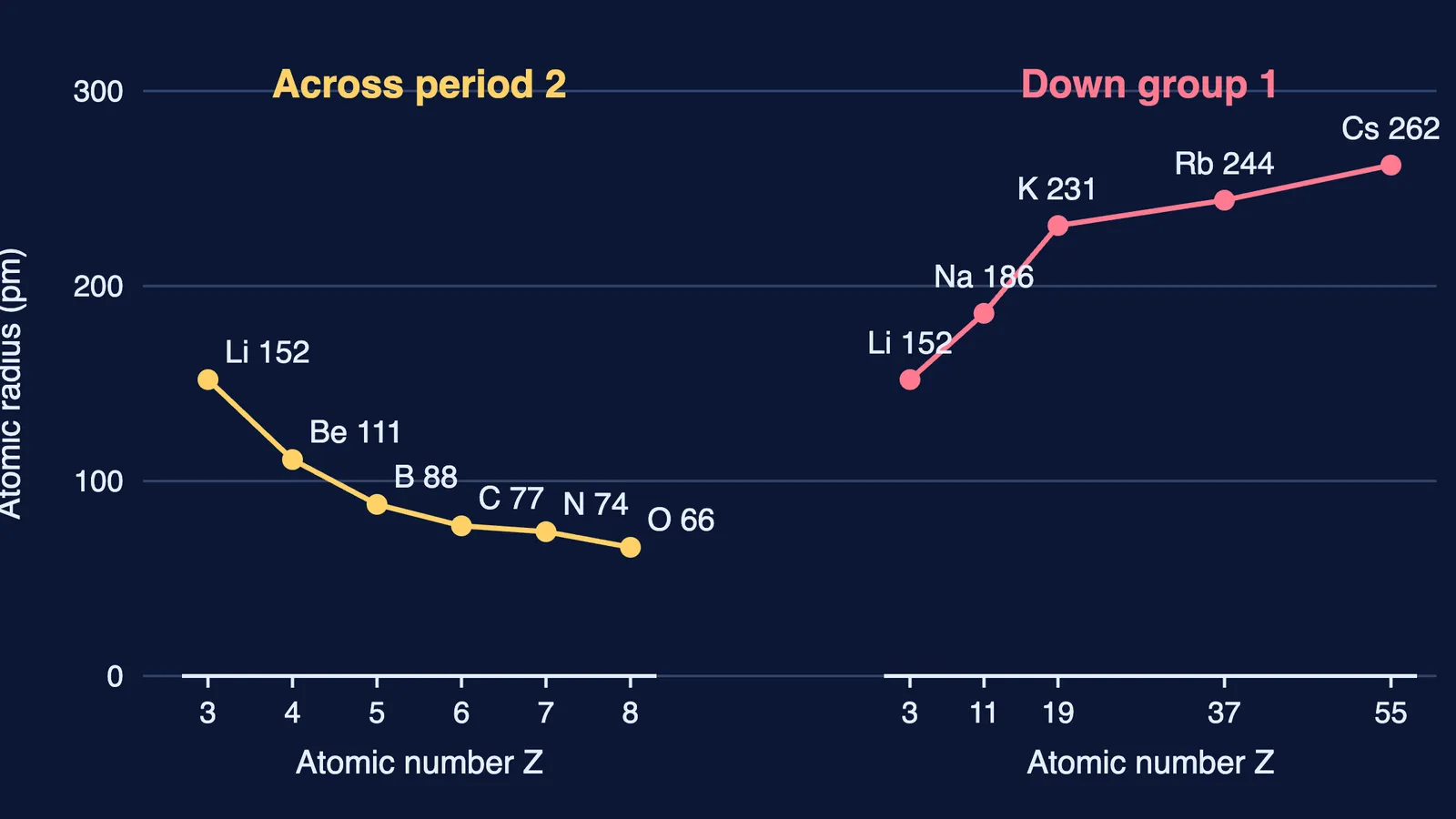
Atomic size: it falls across period 2, from Li 152 pm to O 66 pm, because rising nuclear charge pulls electrons closer. It rises down group 1, from Li 152 pm to Cs 262 pm, because new shells are added (Reading Material, Activities 7 and 8).
Metallic character: decreases across a period, increases down a group. Metalloids such as silicon and germanium sit along the zig-zag line. Metal oxides are generally basic and non-metal oxides acidic, which links to Metals and Non-metals Class 10.
How should you prepare it for school-based assessment?
The curriculum suggests a brief portfolio write-up. Try a one-page timeline of the four attempts, each with one success and one limitation, plus a hand-drawn graph of the radius data above.
Practice questions (our own, in the formats used in CBSE papers; marks are our suggestion):
(1 mark) An element has configuration 2, 8, 5. Its period and group are: (a) 2 and 15 (b) 3 and 15 (c) 3 and 5 (d) 5 and 3. Answer: (b).
(1 mark) Assertion: A sodium atom is larger than a lithium atom. Reason: Going down a group adds a shell. Answer: both true; the reason explains it.
(2 marks) Three similar elements have atomic masses 20, 33 and 80. Do they form a Döbereiner triad? Answer: no; the average of 20 and 80 is 50.0, which is 17 away from 33.
(3 marks) For Z = 19, write the configuration, period, group and metal or non-metal. Larger or smaller than Z = 11? Answer: 2, 8, 8, 1; period 4; group 1; metal; larger, with one more shell.
Stuck on why atoms shrink across a period? Fermi's AI tutor works out what you already know, builds a plan for the session and teaches through it, drawing the figure and checking understanding as it goes.
Class 11 goes further: Classification of Elements and Periodicity in Properties.