On this page
Chapter 3 of the NCERT Class 11 Business Studies textbook (Reprint 2026-27) is titled "Private, Public and Global Enterprises"; the CBSE curriculum lists the same unit as "Public, Private and Global Enterprises". Most questions ask you to tell the three forms of public enterprise apart. For the private-sector forms (sole proprietorship to company), see our forms of business organisation guide.
What does the 2026-27 syllabus include from this chapter?
The CBSE Business Studies curriculum for 2026-27 lists for Unit 3: public and private sector enterprises, the three forms of public sector enterprises, features of global enterprises, joint ventures, and public private partnership.
Marks: Units 3 and 4 (Business Services) share one cell: 14 marks together, out of 80 for theory. There is no separate figure for this chapter.
Not listed: NCERT's section 3.4, "Changing Role of Public Sector" (industrial policy since 1991, disinvestment, sick units and MoUs), is not named in the curriculum's Unit 3 content. Check with your teacher.
How do the three forms of public enterprise differ?
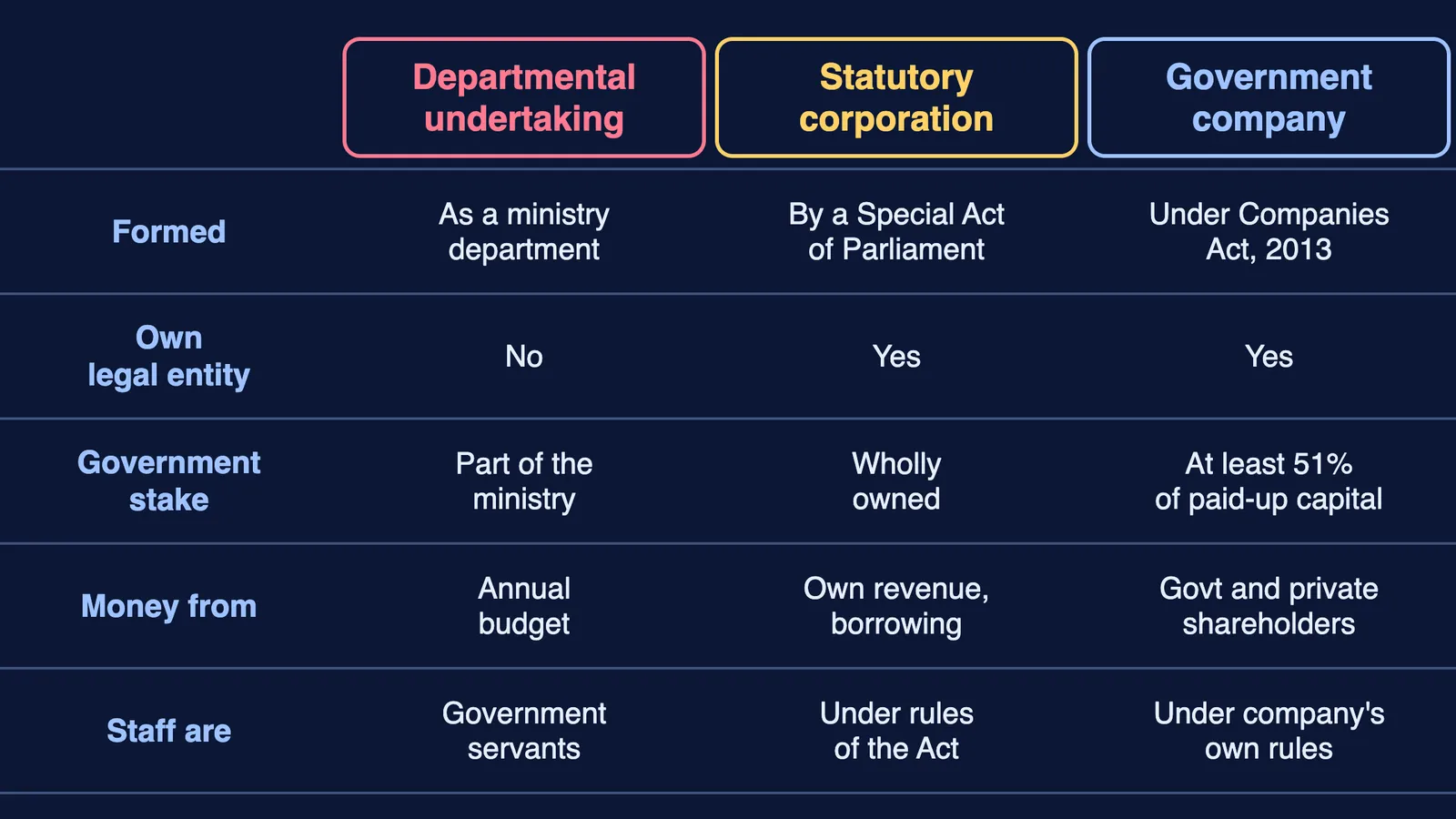
The NCERT chapter gives three forms. Learn each on the same bases, because "distinguish between" answers are marked basis by basis.
Departmental undertaking: the oldest form, run as a department of a ministry. It is not a separate legal entity, is funded by an annual appropriation from the budget, and its staff are government servants. NCERT's examples are the railways and the post and telegraph department.
Statutory corporation: created by a Special Act of Parliament, which sets out its powers, functions and staff rules. It is wholly owned by the state, is a body corporate that can sue and be sued, and is usually financed independently through borrowing and its own revenue.
Government company: registered under the Companies Act, 2013. NCERT cites section 2(45) of that Act: the central government, any state government, or the Centre and one or more states together must own "not less than 51 per cent" of its paid-up capital. Staff follow its own Memorandum and Articles of Association, and it can raise money from the capital market.
Is it a government company? A worked check
Three made-up companies each have paid-up capital of Rs 10 crore.
Company A: the central government holds Rs 3 crore and a state government Rs 2.5 crore. Together that is Rs 5.5 crore, or 55 per cent. It is a government company.
Company B: the central government holds Rs 4 crore and a state government Rs 1 crore. Together that is Rs 5 crore, or 50 per cent, which is below 51. It is not a government company.
Company C: one state government alone holds Rs 5.1 crore, exactly 51 per cent. "Not less than 51" includes 51, so it is a government company.
What are global enterprises, joint ventures and PPPs?
Global enterprises (multinational corporations) operate in several countries. NCERT lists seven features: huge capital resources, foreign collaboration, advanced technology, product innovation, marketing strategies, expansion of market territory and centralised control. For trade across borders, see our guide to international business and the export-import procedure.
Joint ventures pool two or more businesses' resources and expertise, sharing risks and rewards. NCERT describes two types:
Contractual joint venture: no new jointly owned entity; the parties agree to work together, and a franchise is the typical example.
Equity-based joint venture: a separate entity is created, jointly owned and managed, with profits and losses shared as agreed.
NCERT names six benefits: more resources and capacity, access to new markets and distribution networks, access to technology, innovation, lower cost of production, and an established brand name.
Public private partnership (PPP) divides tasks, obligations and risks between government entities and private partners, for infrastructure and other services. The government brings capital and assets; the private partner brings management expertise. NCERT's Indian example is the 135 km Kundli Manesar Expressway, where the government provided the land and the company laid the surface.
Practice questions
Our own questions; the mark labels are our suggestion.
(1 mark) A state government holds 49 per cent and the central government 3 per cent of a company's paid-up capital. Is it a government company?
(3 marks) A public body created by an Act of Parliament sues in its own name and earns from selling services. Identify the form and state two features that support your answer.
(4 marks) Distinguish between a departmental undertaking and a government company on four bases.
(3 marks) Two firms form a new company in which each holds half the shares and shares profits. Name the type of joint venture and give two of its features.
(4 marks) Explain any four benefits a foreign company might gain from a joint venture with an Indian company.
Question 1: yes, 52 per cent. For application answers, read our tips on business studies case study answers.
Not sure where to start? Fermi's AI tutor works out what you already know and builds a plan for the session, so you sit down to a clear next step.