

On this page
Case study questions form the analytical backbone of the CBSE Class 12 Business Studies examination, accounting for a significant share of marks across 3-mark, 4-mark, and 6-mark questions. Many students understand the syllabus thoroughly yet lose marks because they treat a case study like an English reading comprehension passage, writing sprawling summaries rather than targeted business analyses. Scoring full marks requires understanding how evaluators score answers and adopting a disciplined three-stage presentation format.
How are Business Studies case study marks awarded?
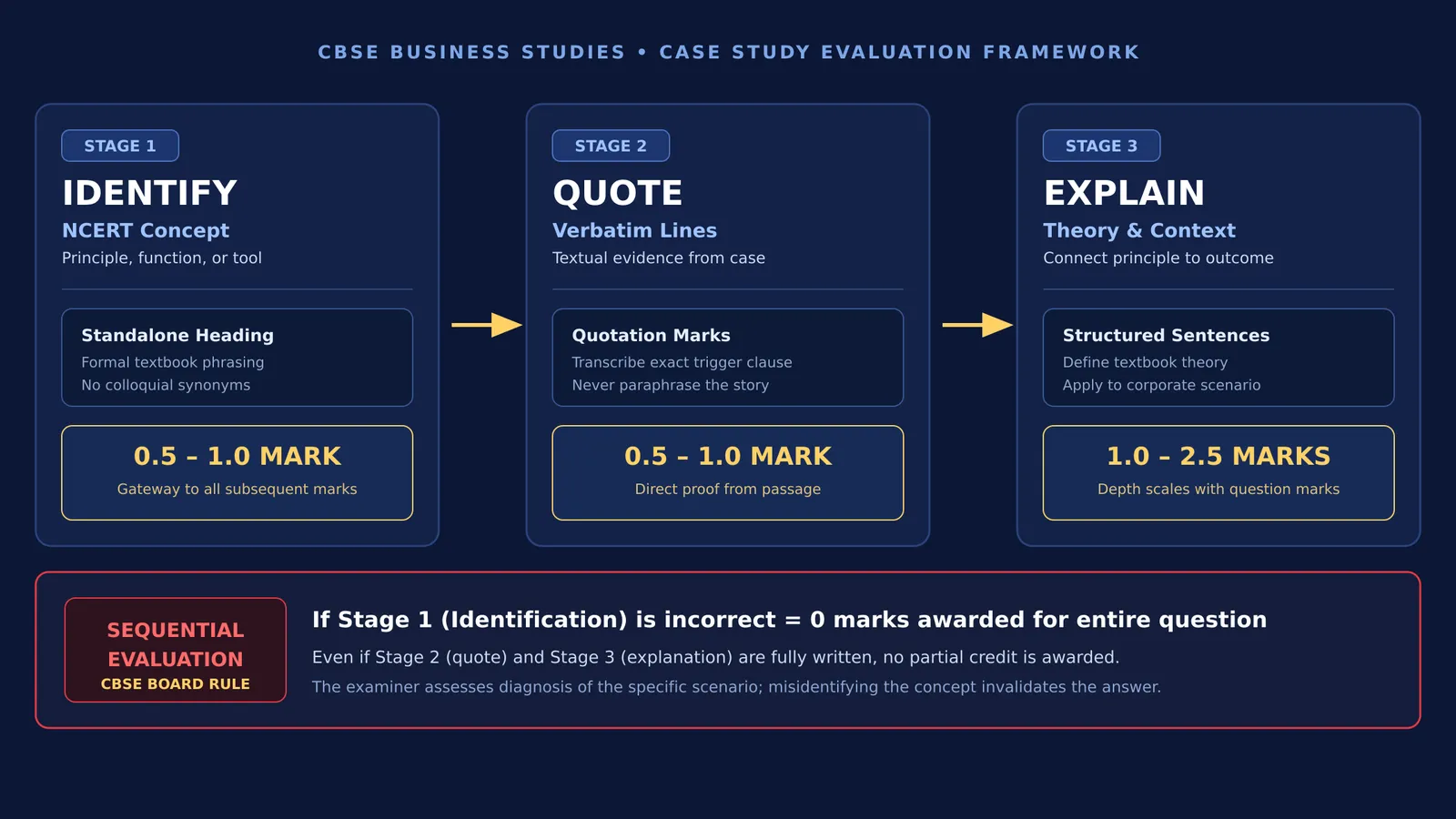
Official evaluation guidelines establish that Business Studies case questions are evaluated through strict step-wise marking. According to the CBSE Class 12 Business Studies Marking Scheme, marks for application-based questions are divided across three distinct components:
Identification: Usually 0.5 to 1 mark for naming the exact concept, principle, function, or dimension.
Quoting the lines: 0.5 to 1 mark for citing the verbatim sentence or phrase from the passage that justifies your identification.
Explanation: 1 to 2.5 marks for explaining the concept using textbook terminology and relating it to the scenario.
Under CBSE evaluation rules, marking in case studies is strictly sequential. If your identification of the concept is incorrect, the examiner awards zero marks for the entire question. Even if you write an accurate explanation of an alternative concept, no partial credit is granted because the question assesses whether you can diagnose the specific corporate scenario. Understanding this sequential dependence, as detailed in our guide on how to use CBSE marking schemes, prevents students from writing vague, catch-all answers.
The 80-mark theory paper distributes case questions across short and long answer categories. According to the official CBSE Class 12 curriculum guidelines, 3-mark questions require answers of 50 to 75 words, 4-mark questions require approximately 150 words, and 6-mark questions require approximately 200 words. Keeping within these limits while satisfying all three criteria requires structural precision.
Why should you read the question before the case?
The most common tactical error students make is reading the case study narrative from top to bottom before looking at the question at the end. A typical case study describes a fictitious company, introducing founder names, market competition, product launches, and operational conflicts. Reading this narrative without a goal overloads your working memory with irrelevant operational trivia.
Educational psychologists Matthew McCrudden and Gregory Schraw explained this mechanism in their 2007 study on the Goal-Focusing Model published in *Educational Psychology Review*. Their research demonstrated that providing readers with specific relevance instructions before they engage with a text leads them to selectively allocate attention to task-relevant sentences while efficiently filtering out irrelevant content.
When you read the question prompt first, you equip yourself with an immediate relevance filter. If the question asks, 'Identify the principle of Fayol violated in the above situation by quoting lines,' your mind scans specifically for authority gaps, conflicting instructions, or breakdown in order. You ignore details about factory location or company profits, zeroing in directly on the operative sentence. For students looking to build deliberate study routines and master structured problem decomposition across complex subjects, Fermi's AI tutor can work out what you already know and build a plan for the session.
How do you format the three-step answer?
To ensure the examiner spots every mark-bearing element immediately, present each identified point using a clear three-tier structure:
Identification (Heading): State the formal NCERT concept name as a standalone heading. Never use colloquial synonyms. Write "Principle of Management: Unity of Command" rather than "one boss rule," or "Dimension of Business Environment: Technological Environment" rather than "modern IT systems."
Quoted Lines: Cite the exact evidence from the text inside quotation marks. If the sentence is lengthy, quote the essential operative clause or use an ellipsis (`...`), ensuring the trigger phrase remains intact.
Explanation: Provide a crisp two-to-three sentence explanation containing official NCERT keywords, concluding with one sentence linking the theoretical principle back to the firm's action.
Consider this worked scenario:
*Question:* Raman runs an export garment firm. Due to urgent delivery deadlines, the production manager instructed workers to run overtime, while the sales manager directed them to halt production to package completed orders for immediate airfreight. Workers became confused, and neither target was met. Identify and explain the principle of management violated, quoting the relevant lines from the case. (3 marks)
*Model Answer:*
1. Identified Principle: Principle of Unity of Command.
2. Quoted Lines: "the production manager instructed workers to run overtime, while the sales manager directed them to halt production to package completed orders..."
3. Explanation: According to Henri Fayol, an employee should receive orders from, and be responsible to, only one superior at a time. Receiving dual orders creates confusion, causes operational conflict, and undermines organizational discipline. In this case, receiving contradictory directives from two managers prevented workers from executing either task.
Structuring your answers this way removes ambiguity for the examiner, mirroring the clarity required when tackling assertion-reason questions.
What are the most common case study mistakes?
Even well-prepared students frequently lose marks through small presentation errors:
Paraphrasing instead of quoting: When the prompt specifies "by quoting lines," writing "the case mentions that the manager gave two orders" forfeits the quoting mark. You must transcribe the exact words within quotation marks.
Over-quoting entire paragraphs: Copying five lines of text demonstrates an inability to isolate the operative trigger. Quote only the specific clause that proves your concept.
Missing secondary directives: High-mark case studies often contain a two-part instruction, such as "Identify the function of management and state any three of its limitations." Answering the case identification but forgetting the textbook theory forfeits half the question's value.
Building fluency with application-based questions requires active retrieval practice. Meta-analytic findings indicate that practice tests transfer to unfamiliar question formats significantly better than passive chapter re-reading. While Business Studies tests qualitative diagnosis, the Fermi Problem Library provides worked problems with a step-by-step solver that explains the reasoning rather than printing an answer, training the disciplined precision that board examiners reward.


