On this page
Internet and Web is the NCERT chapter behind the networks unit in Class 12 Informatics Practices. This guide covers what the 2026-27 syllabus keeps, walks through the web half, and ends with practice questions in the sample paper's style.
What does the 2026-27 syllabus include from this chapter?
The CBSE Informatics Practices curriculum for 2026-27 gives Unit 3, Introduction to Computer Networks, 10 marks; the four theory units total 70 and practicals carry 30. It lists network types, devices and topologies, then the Internet, URL, WWW, websites, static and dynamic pages, hosting, browsers and cookies.
Two mismatches with the NCERT chapter (Reprint 2026-27) matter: the book describes ring topology, which the curriculum's list (star, bus, tree, mesh) leaves out, and the curriculum names PAN, which the chapter does not define. Our computer networks guide for CBSE Class 12 Computer Science defines PAN and works through a five-mark campus question.
Which network facts does the chapter test?
From the NCERT chapter:
A LAN extends up to 1 km at 10 Mbps to 1000 Mbps; a MAN covers a city, up to 30-40 km; the Internet is the largest WAN.
A repeater regenerates a weakened signal, usually after about 100 m of cable.
A hub sends data out on every port; a switch sends it only to the addressed device.
A router connects a LAN to the Internet; a gateway is a network's entry and exit point.
A full mesh of n nodes needs n(n-1)/2 wires, so 5 computers need 10.
How is a URL built, and is the web the same as the Internet?
NCERT says Tim Berners-Lee invented the World Wide Web in 1990 by defining HTML for pages, URI for addresses and HTTP for fetching them. A URL is a URI that gives a resource's location and the protocol to reach it. Take a made-up address, https://www.example.com/notices/exam-dates.html:
https is the protocol (others include http and FTP).
www is the subdomain.
example.com is the domain name.
/notices/exam-dates.html is the path to one page.
The Internet is the global network of devices; the web is the linked pages shared over it. Email, chat and VoIP run on the Internet but are not the web.
What happens when you open a web page?
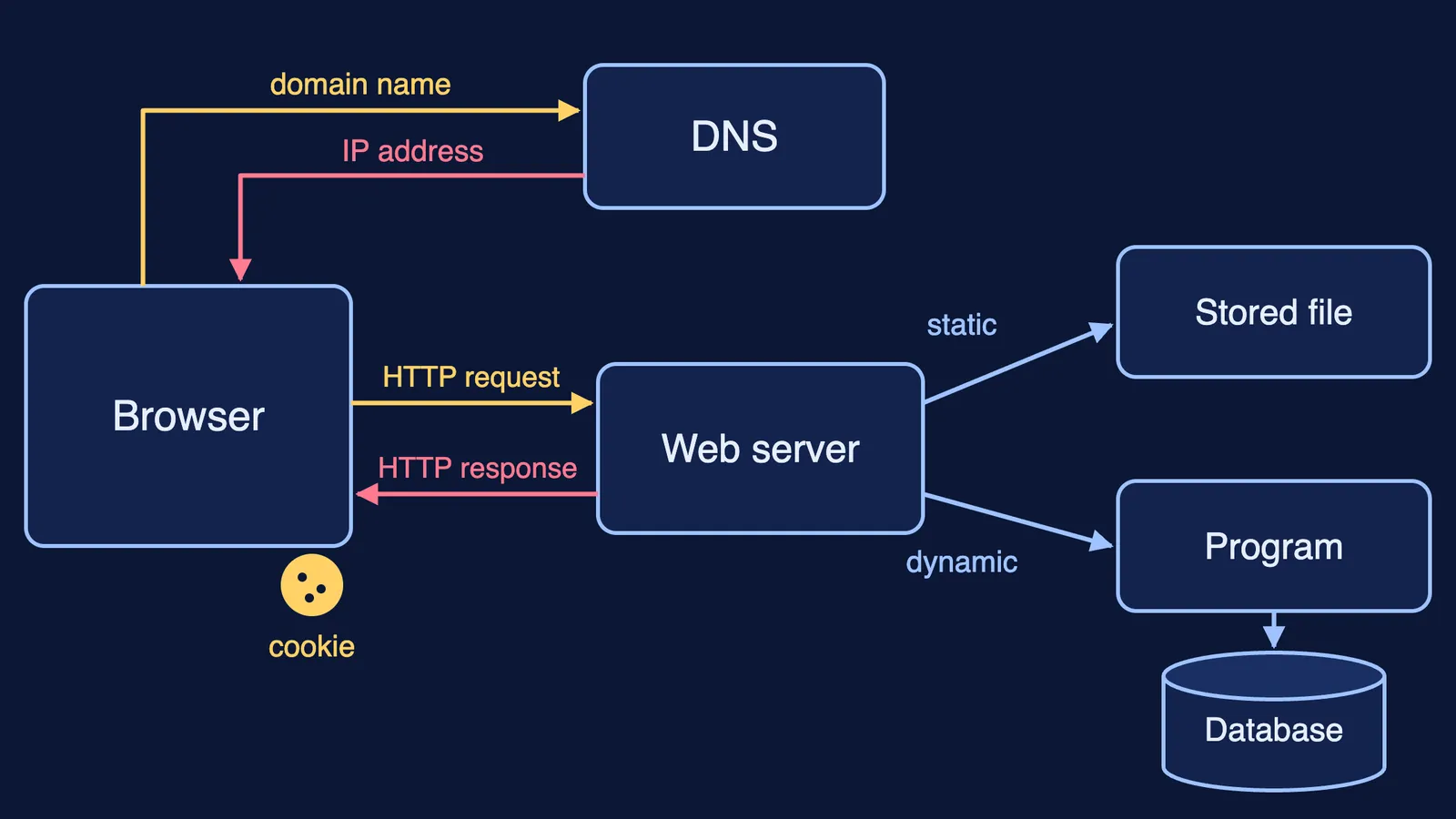
The domain name system (DNS) finds the server's IP address for your domain.
The browser sends an HTTP request to that web server.
For a static page, the server sends the stored file unchanged, so everyone sees the same page.
For a dynamic page, the server first runs a program, often reading a database, to build the page.
The server sends the HTTP response, or Error 404 if the page is missing.
A web page is one document viewed in a browser; a website is a set of hyperlinked pages under one domain name, stored on a web server. To host it: choose a hosting provider, register a domain through a registrar, upload the files, and map the domain to the server's IP address.
What do browser settings, add-ons, plug-ins and cookies do?
A browser is software for viewing web pages. Its settings cover privacy, search engine, downloads and autofill.
A plug-in is a complete program that other applications can also use, such as Flash.
An add-on (an extension in some browsers) is not a complete program; it adds one function to the browser.
A cookie is a text file a website sends to your browser, which stores it and returns it so the site recognises you: language, auto login, shopping choices. You can block them in Privacy and Security settings.
Practice questions in the 2026-27 sample paper style
The CBSE 2026-27 sample paper tests this unit with 1-mark MCQs and blanks, a 2-mark definition and a 5-mark campus case. These questions are ours.
(1 mark, MCQ) After login, a news site shows your city's headlines. The page is: A. static B. dynamic C. a plug-in D. a cookie.
(1 mark, Assertion-Reason) A: VoIP uses the Internet but is not part of the WWW. R: The WWW is the collection of interlinked web pages accessed over the Internet.
(2 marks) Give two differences between an add-on and a plug-in.
(5 marks, case) A school website lets students log in to see marks. (i) Its holiday list shows the same dates to every visitor: static or dynamic? (ii) Which service maps the domain to the server's IP address? (iii) Which device connects the school LAN to the Internet? (iv) Should each lab use a hub or a switch, and why? (v) Give one use of cookies on this site.
Answers: 1. B. 2. Both true; R explains A. 3. Plug-in: complete program, usable by other applications; add-on: incomplete, extends only the browser. 4. (i) Static (ii) DNS (iii) Router (iv) Switch: it sends data only to the addressed computer (v) Auto login.
Not sure where to start? Fermi's AI tutor can work out what you already know and build a plan for the session. The next unit is in our Class 12 societal impacts guide.