On this page
Once a business has dozens of credit deals a month, journalising each one gets slow. NCERT's chapter Recording of Transactions-II splits the journal into special purpose books (daybooks) so that similar transactions sit together. This guide covers the five non-cash books with one worked month. The cash book has its own guide: cash book Class 11: simple, two-column and petty cash.
What does the 2026-27 syllabus include, and how many marks?
The CBSE Accountancy curriculum for 2026-27 lists the purchases, sales, purchases return and sales return books and the journal proper under Unit 2, Accounting Process, with this note: "Including trade discount, freight and cartage expenses for simple GST calculation." None of the five is dropped.
Unit 2 carries 44 of the 80 theory marks. Those marks are shared with vouchers, the journal, cash book, ledger, bank reconciliation, depreciation, provisions and reserves, trial balance and rectification of errors, so there is no separate figure for this chapter. The current text is NCERT Financial Accounting I, chapter 4 (Reprint 2026-27).
Which transaction goes in which book?
Following NCERT chapter 4:
Purchases book: credit purchases of goods, from the supplier's invoice. Cash purchases go to the cash book.
Purchases return book: goods sent back to a supplier, from your debit note.
Sales book: credit sales of goods, from your sales invoice.
Sales return book: goods a customer returns, from the credit note you issue.
Journal proper: everything else, such as opening, adjustment, rectification and closing entries, credit purchases of assets, and goods taken for personal use.
Each book records the invoice's net amount; trade discount is deducted on the invoice and never posted. GST follows NCERT chapter 3: a deal within the state carries CGST and SGST, and one with another state carries IGST.
Worked example: April at Nila Home Store
Nila Home Store in Pune sells home goods. Assume GST at 18% (9% CGST plus 9% SGST, or 18% IGST).
Purchases book
Apr 3, invoice 211, Kaveri Traders, Pune: 40 lamps at ₹600 = ₹24,000, less 10% trade discount = ₹21,600, plus CGST ₹1,944 and SGST ₹1,944 = ₹25,488.
Apr 12, invoice 87, Sutlej Fabrics, Ludhiana: 25 bedsheets at ₹800 = ₹20,000, less 5% = ₹19,000, plus IGST ₹3,420 = ₹22,420.
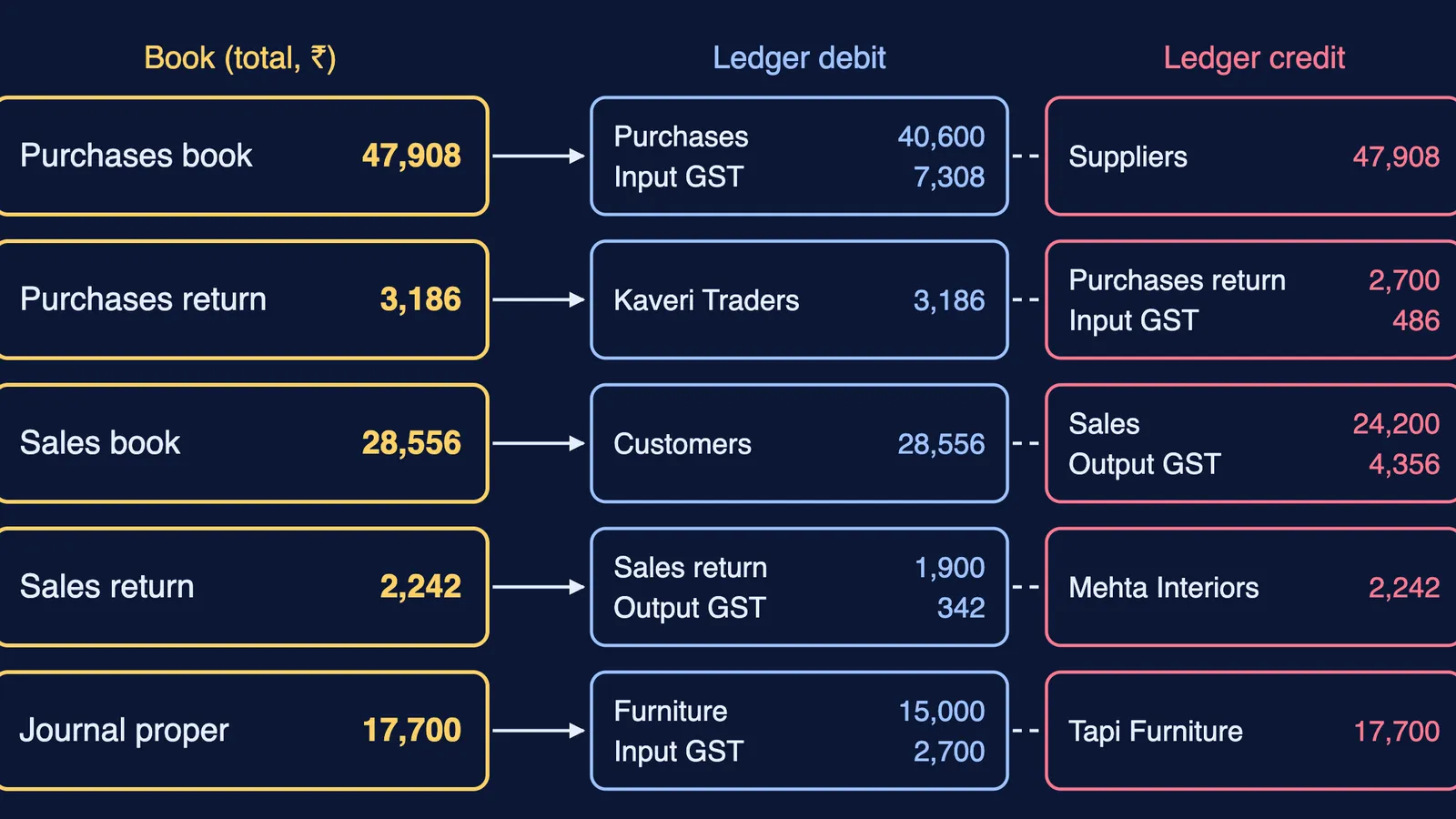
Total ₹47,908. Nila also paid ₹350 cartage in cash for the lamps; that goes in the cash book, not here.
Purchases return book
Apr 15, debit note DN-01, Kaveri Traders: 5 damaged lamps at ₹600 = ₹3,000, less 10% = ₹2,700, plus CGST ₹243 and SGST ₹243 = ₹3,186.
Sales book
Apr 18, invoice S-31, Mehta Interiors, Pune: 10 lamps at ₹1,000 and 5 bedsheets at ₹1,200 = ₹16,000, less 5% = ₹15,200, plus CGST ₹1,368 and SGST ₹1,368 = ₹17,936.
Apr 24, invoice S-32, Rao Decor, Hyderabad: 8 bedsheets at ₹1,250 = ₹10,000, less 10% = ₹9,000, plus IGST ₹1,620 = ₹10,620.
Total ₹28,556.
Sales return book
Apr 27, credit note CN-01, Mehta Interiors: 2 lamps at ₹1,000 = ₹2,000, less 5% = ₹1,900, plus CGST ₹171 and SGST ₹171 = ₹2,242.
Journal proper
Apr 20: a display rack bought on credit from Tapi Furniture, Pune. Furniture A/c Dr ₹15,000; Input CGST A/c Dr ₹1,350; Input SGST A/c Dr ₹1,350; To Tapi Furniture A/c ₹17,700. It is an asset, not stock, so it stays out of the purchases book.
How do you post the books to the ledger?
Post party accounts entry by entry and book totals at the month end:
Purchases book: credit Kaveri ₹25,488 and Sutlej ₹22,420; debit Purchases A/c ₹40,600, Input CGST ₹1,944, Input SGST ₹1,944 and Input IGST ₹3,420.
Purchases return book: debit Kaveri ₹3,186; credit Purchases Return A/c ₹2,700, Input CGST ₹243 and Input SGST ₹243.
Sales book: debit Mehta ₹17,936 and Rao ₹10,620; credit Sales A/c ₹24,200, Output CGST ₹1,368, Output SGST ₹1,368 and Output IGST ₹1,620.
Sales return book: debit Sales Return A/c ₹1,900, Output CGST ₹171 and Output SGST ₹171; credit Mehta ₹2,242.
At the month end, Kaveri Traders shows a credit balance of ₹22,302 and Mehta Interiors a debit balance of ₹15,694. Input CGST ends at ₹3,051 debit (1,944 less 243, plus 1,350 from the rack) and Output CGST at ₹1,197 credit. With the rack entry from the journal proper, all postings total ₹99,592 on each side. For the ledger format and balancing, see our guide to journal and ledger in Class 11.
Practice questions
Mark labels are our suggestion.
(1 mark) Office computers bought on credit go in which book?
(3 marks) Name the source document for each return book and who prepares it.
(4 marks) Gauri Stores, Jaipur, sells 30 kettles at ₹500 to a Jaipur customer, less 8% trade discount, GST 18%. Enter it in the sales book and post it.
(6 marks) Make up three purchase invoices (one inter-state) and one debit note, record them and post them to the ledger.
Stuck on which book a transaction belongs in? Fermi's AI tutor can work out what you already know and build a plan for the session, so you sit down to a clear next step.