On this page
Here is what CBSE keeps on cash books for 2026-27, one original two-column cash book worked in full, a petty cash book, and the slips that cost marks.
What does the 2026-27 CBSE syllabus keep in special purpose books?
In the CBSE Accountancy (code 055) curriculum for 2026-27, special purpose books sit inside "Unit-2: Accounting Process", which carries 44 marks out of the 80-mark theory paper.
The cash book line names three books: a simple cash book, a cash book with bank column, and a petty cash book. A cash book with a discount column is not named, so spend your practice time on these three.
Your textbook is NCERT Accountancy Part I, Chapter 4, "Recording of Transactions-II", marked Reprint 2026-27 (NCERT Chapter 4). It calls the first two books the single column and double column cash book.
What is a cash book, and how is the two-column version different?
A cash book is the book in which a business records every cash receipt and cash payment, starting from the opening balance, and it serves as both the journal and the cash account in the ledger (NCERT, section 4.1).
Receipts go on the left (Dr.) side and payments on the right (Cr.) side.
A simple cash book has one amount column on each side, for cash only.
A two-column cash book adds a Bank column beside Cash on each side.
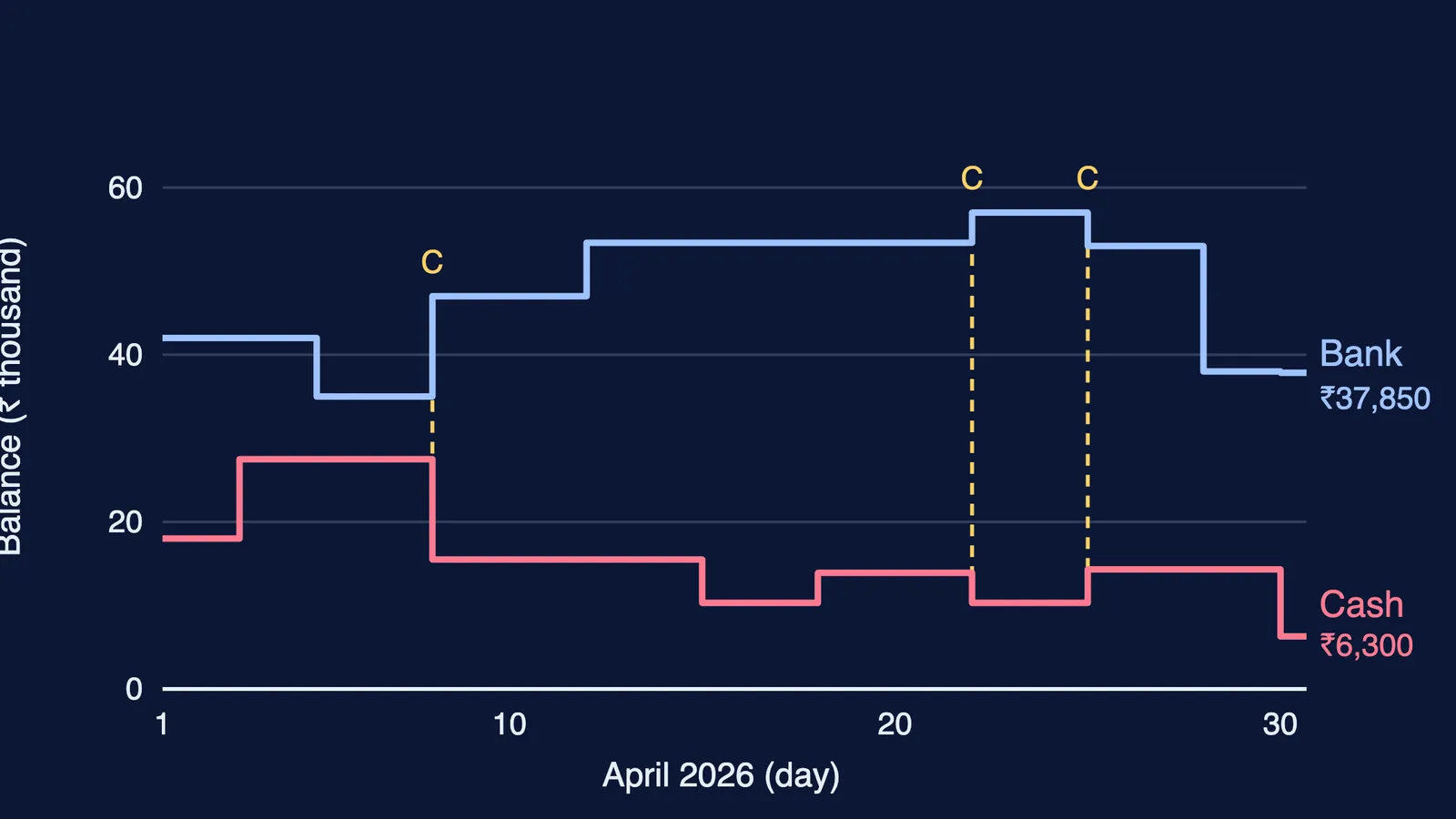
When cash moves between office and bank, both halves sit in the cash book: write C (contra) in the L.F. column and post nothing to the ledger.
A cheque banked the same day goes to the Bank column. One banked later goes to Cash first, then moves by contra entry on the day of deposit.
The Bank column can end with a credit balance (an overdraft). The Cash column never can.
How do you prepare a two-column cash book? A worked example
Meher Stationers, an invented shop, starts April 2026 with ₹18,000 cash in hand and ₹42,000 at the bank.
Apr 3: Cash sales, ₹9,500.
Apr 5: Paid rent by cheque, ₹7,000.
Apr 8: Deposited cash into the bank, ₹12,000.
Apr 12: Received a cheque from Kabir for ₹6,400 and banked it the same day.
Apr 15: Bought goods for cash, ₹5,200.
Apr 18: Received a cheque from Anaya for ₹3,600; banked it on Apr 22.
Apr 25: Withdrew ₹4,000 from the bank for office use.
Apr 28: Paid Ritu, a supplier, ₹15,000 by cheque.
Apr 30: Paid salary in cash, ₹8,000; the bank charged ₹150 for its services.
Dr. Cash: Balance b/d 18,000; Sales 9,500; Anaya 3,600 (Apr 18); Bank (C) 4,000 (Apr 25). Total ₹35,100.
Cr. Cash: Bank (C) 12,000 (Apr 8); Purchases 5,200; Bank (C) 3,600 (Apr 22); Salary 8,000. Total ₹28,800.
Dr. Bank: Balance b/d 42,000; Cash (C) 12,000; Kabir 6,400; Cash (C) 3,600. Total ₹64,000.
Cr. Bank: Rent 7,000; Cash (C) 4,000; Ritu 15,000; Bank charges 150. Total ₹26,150.
Balance c/d: cash ₹35,100 − ₹28,800 = ₹6,300; bank ₹64,000 − ₹26,150 = ₹37,850. Entered on the Cr. side, they make both sides total ₹35,100 (cash) and ₹64,000 (bank), and May opens with them as Balance b/d.
The Apr 8, 22 and 25 entries are contra. Posting them to the ledger would count the same money twice.
How does a petty cash book work under the imprest system?
Under the imprest system, the petty cashier is given a fixed sum, makes small payments from it, and is reimbursed exactly what was spent, so each period starts with the full imprest again (NCERT, section 4.1.3).
The receipts side has one amount column; the payments side has a total column plus analysis columns for common expenses, ending with Miscellaneous.
Meher's petty cashier receives an imprest of ₹2,500 on 1 May 2026 and pays postage ₹180, auto fares of ₹240 and ₹130, printer paper ₹415 and tea for visitors ₹160.
Columns: Postage ₹180; Conveyance ₹370; Stationery ₹415; Miscellaneous ₹160.
Spent ₹1,125; balance in hand ₹2,500 − ₹1,125 = ₹1,375.
The head cashier reimburses ₹1,125, restoring ₹2,500.
Each expense account is debited with its column total, not every voucher.
What mistakes cost marks in cash book questions?
Posting contra entries to the ledger. The C in the L.F. column means stop.
Entering a cheque in the Bank column on receipt when it was banked later.
Leaving out bank charges the bank has already debited.
Adding cash and bank together when balancing.
Showing a credit balance in the Cash column.
Reimbursing the full imprest instead of the amount spent.
Once your cash book balances, its bank column feeds the bank reconciliation statement in Class 11. If a total still will not agree, our guide to rectification of errors in Class 11 shows how to trace it.
Not sure where to start revising? Fermi's AI tutor can work out what you already know and build a plan for the session, so you sit down to a clear next step.