On this page
Secularism is Chapter 8 of NCERT's Class 11 textbook *Political Theory*, and the CBSE 2026-27 Political Science curriculum gives it 6 of the 40 marks for Political Theory (80 theory marks in all). NCERT asks what kind of state can stop religious domination between and within communities. For background, see our guide to Constitution: why and how.
What is secularism in Class 11 Political Science?
NCERT defines secularism as a normative doctrine that aims at a society free of both inter-religious and intra-religious domination (NCERT, Chapter 8).
Inter-religious domination: members of one community are targeted because of their religious identity, and their basic freedoms are denied.
Intra-religious domination: discrimination inside a religion, such as unequal treatment of women, or dalits being barred from temples.
In NCERT's positive framing, secularism seeks freedom inside each religion and equality both among religions and inside them. NCERT stresses it is not anti-religious.
What makes a state secular?
NCERT sets three tests (NCERT, Chapter 8):
It is not theocratic, that is, not run by a priestly order (NCERT's example is the Papal states of medieval Europe).
It has no formal, legal alliance with any religion (NCERT's counter-example: sixteenth-century England's established Anglican Church).
Its goals come at least partly from non-religious sources, such as peace, religious freedom, freedom from oppression on religious grounds, and equality between and within religions.
How is Indian secularism different from the Western model?
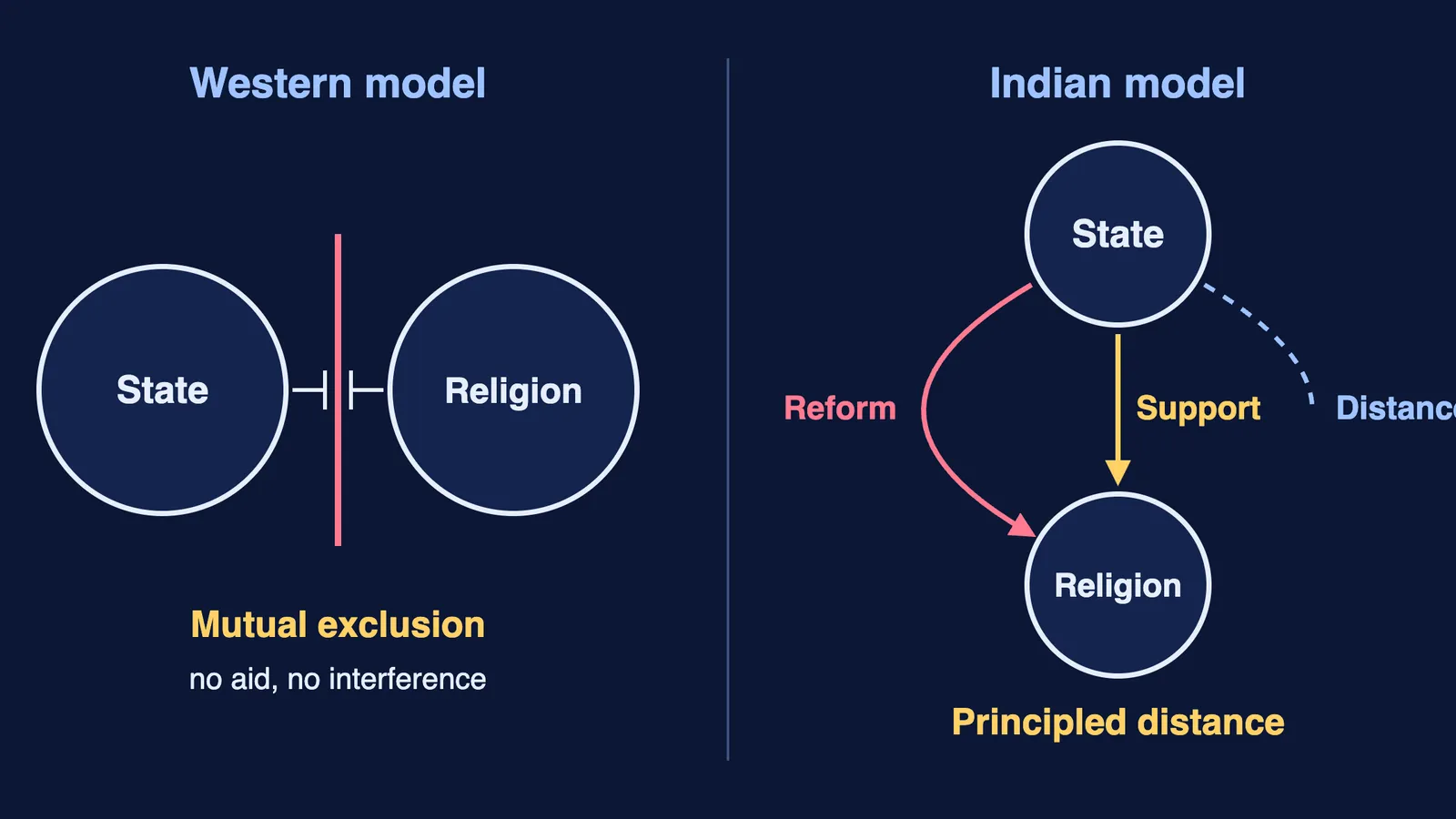
NCERT's Western model, based on the American state, treats separation as mutual exclusion: the state neither funds religious schools nor interferes in religious practice. Freedom and equality are read for individuals, leaving little room for minority rights, and NCERT says this model has no place for state-supported religious reform.
Indian secularism, NCERT argues, differs in three ways (NCERT, Chapter 8):
It opposes intra-religious and inter-religious domination equally.
It protects minority communities as well as individuals, including their own culture and educational institutions.
It allows state-supported religious reform. Article 17 abolishes untouchability and forbids its practice in any form (Article 17).
NCERT calls this approach principled distance. The state may engage with religion negatively (banning untouchability), engage positively (aid to minority-run educational institutions), or keep its distance, depending on which choice best serves peace, freedom and equality. Article 30 lets minorities based on religion or language set up and run educational institutions, and bars the state from discriminating against them when granting aid. Our guide to rights in the Indian Constitution covers the Fundamental Rights.
NCERT's boxes contrast Nehru, who wanted the state to protect all religions equally and adopt none, with Kemal Ataturk's Turkey, which NCERT says suppressed religion (the Hat Law banned the fez).
What are the criticisms of Indian secularism?
The curriculum names Western import, minoritism, interventionism and vote banks; NCERT adds two more. Learn each with NCERT's reply (NCERT, Chapter 8).
Anti-religious: NCERT replies that secularism opposes institutionalised religious domination, which is not the same as opposing religion.
Western import: NCERT replies that secularism has Western and non-Western roots: church-state separation in the West, peaceful coexistence of communities in India.
Minoritism: NCERT uses two analogies (an asthmatic train passenger, a ramp to a first-floor auditorium) to argue that minority rights protect fundamental interests rather than grant privileges.
Interventionist: NCERT replies that principled distance also allows non-interference. On personal laws, which it calls a dilemma, it suggests the state back liberal and democratic voices within each religion, without coercion.
Vote bank politics: NCERT says the claim is not entirely false; seeking votes is normal, but harmful when a group is treated as one block or helped at others' cost.
Impossible project: NCERT points to histories of coexistence, such as the Ottoman Empire.
Worked example: apply principled distance
For any state action, ask three questions from NCERT's chapter: does it establish a religion, which domination does it target, and which mode is it (negative engagement, positive engagement or distance)?
A made-up case: a law opens all public temples to people of every caste. It establishes no religion and targets intra-religious domination. Like NCERT's untouchability example, it is negative engagement, the state-supported reform NCERT says Indian secularism allows.
Secularism Class 11 practice questions
These use the 1, 2, 4 and 6-mark question types in the CBSE question paper design (its marks table is set out for the Class XII books). Mark splits are our suggestions.
(1 mark) What is a theocratic state? *Run by a priestly order.*
(2 marks) Distinguish inter-religious from intra-religious domination. *One mark each.*
(4 marks) A state ends a caste-based temple-entry bar and gives grants to a college run by a religious minority. Using NCERT's terms, name the mode of engagement in each case and explain why. *Each case: mode (1), reason (1).*
(6 marks) A classmate says funding minority schools makes a state non-secular. Explain how NCERT's two models would treat this funding, then give the minoritism criticism and NCERT's reply. *Two models (3), criticism (1), reply (2).*
For your STEM subjects, Fermi's AI tutor can work out what you already know and build a plan for the session.