On this page
Chapter 6 of NCERT's Class 11 textbook Indian Constitution at Work, Judiciary (Reprint 2026-27), asks how courts can check the government yet stay within the Constitution's limits. Independence, jurisdiction, PIL and judicial review are the answers. For the basics, see our guide to Constitution: Why and How?.
In the CBSE 2026-27 curriculum, Executive, Legislature and Judiciary share 12 marks, so there is no separate figure for this chapter. The curriculum keeps every section of the NCERT chapter.
What does independence of the judiciary mean?
NCERT gives three parts: the executive and legislature must not obstruct the courts, must not interfere with their decisions, and judges must work without fear or favour (NCERT, Chapter 6). Independence is not freedom from accountability: the judiciary answers to the Constitution, democratic traditions and the people.
How the Constitution protects it, in NCERT's list:
The legislature plays no part in appointing judges, who need legal experience, not political loyalty.
Judges have security of tenure; a Supreme Court judge serves until 65 (Article 124).
Salaries and allowances do not need the legislature's approval.
Courts can punish contempt, and Parliament cannot discuss a judge's conduct except during removal proceedings.
Appointments. NCERT notes a convention of making the senior-most Supreme Court judge the Chief Justice of India, broken in 1973 (A. N. Ray) and 1975 (M. H. Beg). Between 1982 and 1998 the Supreme Court revisited what "consulting" the Chief Justice means, and settled on the Chief Justice recommending names in consultation with the four senior-most judges, the principle of collegiality (NCERT, Chapter 6).
Removal. A judge can be removed only for proven misbehaviour or incapacity, through a motion passed in each House by a majority of total membership and two-thirds of members present and voting (Article 124(4)). NCERT's example is the 1991 motion against Justice V. Ramaswami: it got two-thirds of those voting but not half the total strength, so he was not removed.
What are the jurisdictions of the Supreme Court?
India has a single integrated judiciary shaped like a pyramid: Supreme Court, High Courts, district courts, then subordinate courts (NCERT, Chapter 6).
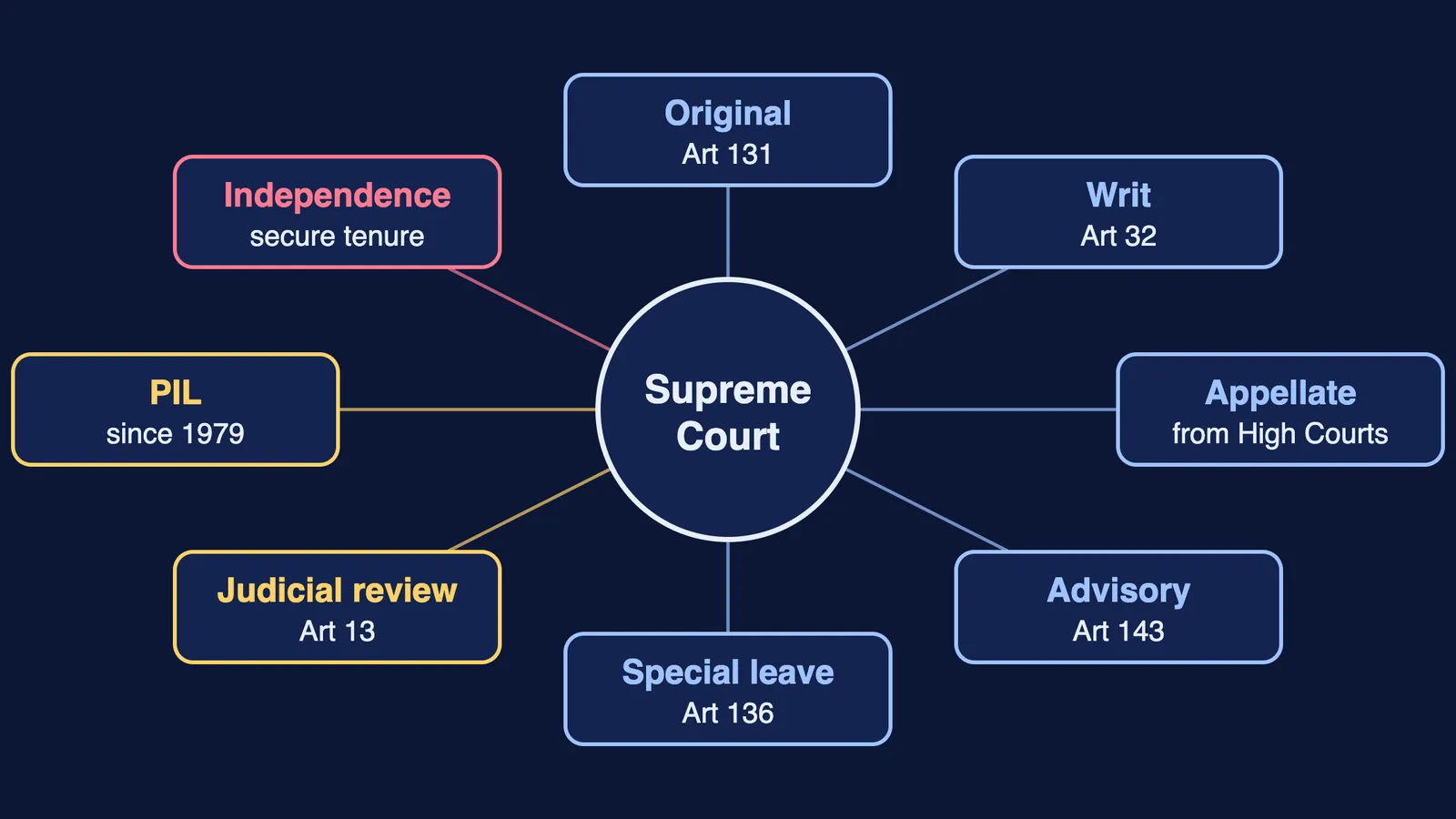
Original: disputes between the Union and states, or among states, go straight to the Supreme Court and no other court (Article 131).
Writ: anyone whose fundamental right is violated can go directly to the Supreme Court, which can issue writs such as habeas corpus and mandamus (Article 32). High Courts can issue writs too (Article 226).
Appellate: the Court hears appeals from High Courts, usually when the High Court certifies a serious question of law or the Constitution.
Advisory: the President can refer a question of public importance (Article 143). Neither side is bound: the Court may decline, the President may reject the advice.
The Court can also grant special leave to appeal against any judgment of any court in India (Article 136).
What is PIL and judicial activism?
Normally only the person affected can go to court. NCERT dates the change to around 1979, when the Court began hearing cases filed on others' behalf. One early PIL, Hussainara Khatoon vs Bihar, followed 1979 newspaper reports on undertrial prisoners in Bihar. In Sunil Batra vs Delhi Administration (1980), a prisoner's note to Justice Krishna Iyer was treated as a petition (NCERT, Chapter 6).
NCERT gives both sides. For: PIL widened access to courts, pushed executive accountability, and the Court asked election candidates to file affidavits on their assets, income and education. Against: it overburdened courts and blurred the line between the judiciary and the other organs.
What is judicial review in Class 11?
Judicial review lets the Supreme Court, and High Courts, test whether a law fits the Constitution and strike it down as inapplicable if it does not (NCERT, Chapter 6). The term never appears in the Constitution; NCERT says it is implied by a written constitution and by the rule that laws abridging fundamental rights are void (Article 13). It covers fundamental rights and the federal division of powers.
NCERT follows the right-to-property dispute with Parliament to the Kesavananda Bharati case (1973), which held that not even an amendment can violate the basic structure, that property was not part of it, and that the Court decides what is. For the other two organs, see our guide to Executive and Legislature; Class 12 returns to court-government tension in The Crisis of Democratic Order.
How do you practise exam answers on Judiciary?
There is no Class 11 sample paper, so these follow the Class 12 design of 1-, 2-, 4- and 6-mark questions (CBSE). Try these, written by us:
(1 mark) Kerala and Karnataka dispute a law passed by Parliament. Which jurisdiction applies?
(2 marks) Distinguish a writ from judicial review.
(4 marks) Explain how removal of judges protects their tenure.
(6 marks) Assess judicial activism, giving two gains and two concerns NCERT lists.
For question 1, give the jurisdiction (original), the article (131) and the reason (a federal dispute only the Supreme Court hears). That pattern fits every jurisdiction question.
Fermi's AI tutor can work out what you already know and build a plan for the session, so you sit down to a clear next step.