

On this page
Chapters 4 and 5 of NCERT's Class 11 textbook Indian Constitution at Work, Executive and Legislature, come down to one question: who answers to whom? Get that right and the President, the Prime Minister and the two Houses fall into place. If the three organs of government feel hazy, start with our Class 9 guide to working of institutions.
What is the executive in Class 11 Political Science?
NCERT defines the executive as the branch of government responsible for implementing laws and policies adopted by the legislature (NCERT, Chapter 4). Ministers form the political executive; civil servants who run day-to-day administration form the permanent executive.
Parliamentary vs presidential system: what is the difference?
In a presidential system, the president is head of state as well as head of government; NCERT names the United States and Brazil as examples (NCERT, Chapter 4). In a parliamentary system, the prime minister is head of government and a president or monarch is a mostly ceremonial head of state, as in Germany, Japan and the United Kingdom.
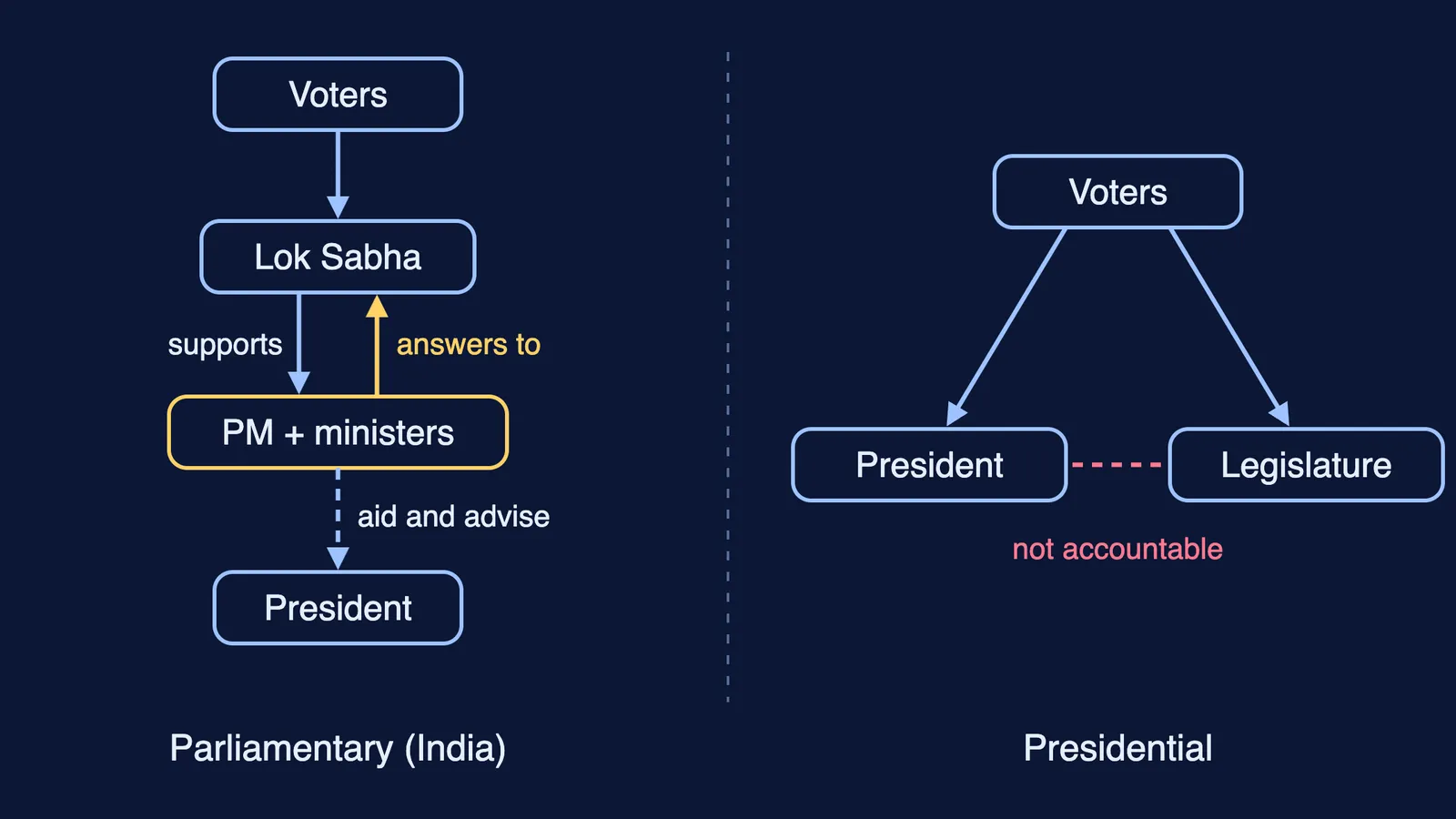
The real test is accountability: the textbook's chart says a parliamentary prime minister is accountable to the legislature, while a presidential president is not.
India chose the parliamentary model because it already knew it from the Acts of 1919 and 1935, and the framers wanted safeguards against a personality cult around one chief executive, the chapter explains.
What are the powers of the President of India?
Under Article 53, the executive power of the Union is vested in the President. Elected MPs and elected MLAs choose the President (Article 54) for five years (Article 56), and candidates must be at least 35 (Article 58). The only ground for impeachment is violation of the Constitution, NCERT notes.
Article 74(1) says a Council of Ministers headed by the Prime Minister will aid and advise the President, who may ask for reconsideration but must then act on the advice given after it.
NCERT lists three areas where the President uses discretion (NCERT, Chapter 4):
Returning the Council's advice for reconsideration.
Delaying assent to bills other than Money Bills. With no time limit in the Constitution, a President can hold a bill indefinitely: the pocket veto. President Zail Singh did this with the 1986 Indian Post Office (Amendment) Bill, which never became law.
Choosing a Prime Minister in a hung Lok Sabha. In 1998 President Narayanan asked Atal Behari Vajpayee for proof of support and a confidence vote within ten days of being sworn in.
How powerful is the Prime Minister?
The President appoints the Prime Minister (Article 75), but the post goes to whoever has majority support in the Lok Sabha and is lost when that support goes (NCERT, Chapter 4). The Prime Minister picks the ministers and hands out portfolios. The Council of Ministers, including the Prime Minister, cannot exceed 15% of the Lok Sabha's total membership under Article 75(1A), and Article 75(3) makes it collectively responsible to the Lok Sabha.
How do Lok Sabha and Rajya Sabha differ?
Parliament is the President plus two Houses, the Council of States and the House of the People (Article 79).
Lok Sabha: directly elected from 543 constituencies, a number unchanged since the 1971 census (NCERT, Chapter 5); lasts five years unless dissolved earlier (Article 83); minimum age 25 (Article 84).
Rajya Sabha: up to 238 members elected by state MLAs plus 12 nominated by the President (Article 80); never dissolved, with one-third retiring every second year (Article 83); six-year terms (NCERT, Chapter 5); minimum age 30 (Article 84).
Money: a Money Bill cannot start in the Rajya Sabha, which must return it within 14 days (Article 109). If the Houses deadlock on an ordinary bill, the President can call a joint sitting (Article 108).
Unlike the equal seats in the US Senate, more populous states get more Rajya Sabha seats: Uttar Pradesh sends 31 members and Sikkim one (NCERT, Chapter 5). How the Union and the states share power is in our explainer on federalism and the three lists.
How do you write the parliamentary vs presidential answer?
A worked structure for a four-mark question:
Define each in one line: who heads the state, and who heads the government.
State the accountability difference: a prime minister answers to the legislature; a presidential head does not.
Give NCERT's examples: Germany, Japan and the UK against the US and Brazil.
End with India's reason: experience under the 1919 and 1935 Acts, and a guard against a personality cult.
Then close the book, draw India's who-answers-to-whom arrows from memory, and label each one with its article: 74, 75(3), 79. Any arrow you cannot label is the page to reread.
If physics and maths share your Class 11 timetable, Fermi's AI tutor can work out what you already know there and build a plan for the session, so you sit down to a clear next step.
Next, see how MPs reach the Lok Sabha in the first place in our guide to how an Indian election works.


