

On this page
Every government decision raises one Class 9 question: who gets to decide, and who can stop them? The chapter Working of Institutions answers it through four bodies: Parliament, the Prime Minister and Cabinet, the President and the judiciary. Here is each one, with the article of the Constitution behind it, and one decision traced through all four.
What does the Working of Institutions chapter cover?
In the CBSE Social Science syllabus for 2026-27, Working of Institutions is chapter 4 of Democratic Politics, with four parts: how a major policy decision is taken, Parliament, the political executive and the judiciary. The whole political science unit carries 18 of the 80 theory marks in that syllabus. Its learning outcomes ask you to examine how the three organs of government depend on each other, appreciate why the executive is accountable to the legislature, and evaluate the rule of law in India. Expect "why is it set up this way" questions, not only "what is".
How does Parliament work, and why are there two Houses?
Article 79 says Parliament consists of the President and two Houses, the Council of States (Rajya Sabha) and the House of the People (Lok Sabha), as the text of Article 79 shows. Many students forget that the President is part of Parliament.
The Lok Sabha is directly elected: Article 81 allows not more than 530 members from the states and not more than 20 from the union territories. The Rajya Sabha represents the states: Article 80 provides 12 members nominated by the President and not more than 238 representatives of the states and union territories.
The two Houses are not equal. On a Money Bill, the Rajya Sabha must return the bill to the Lok Sabha within 14 days, and it can only recommend changes, which the Lok Sabha may accept or reject, under Article 109. The House the people elect directly controls the money.
Who really runs the government: the Prime Minister or the President?
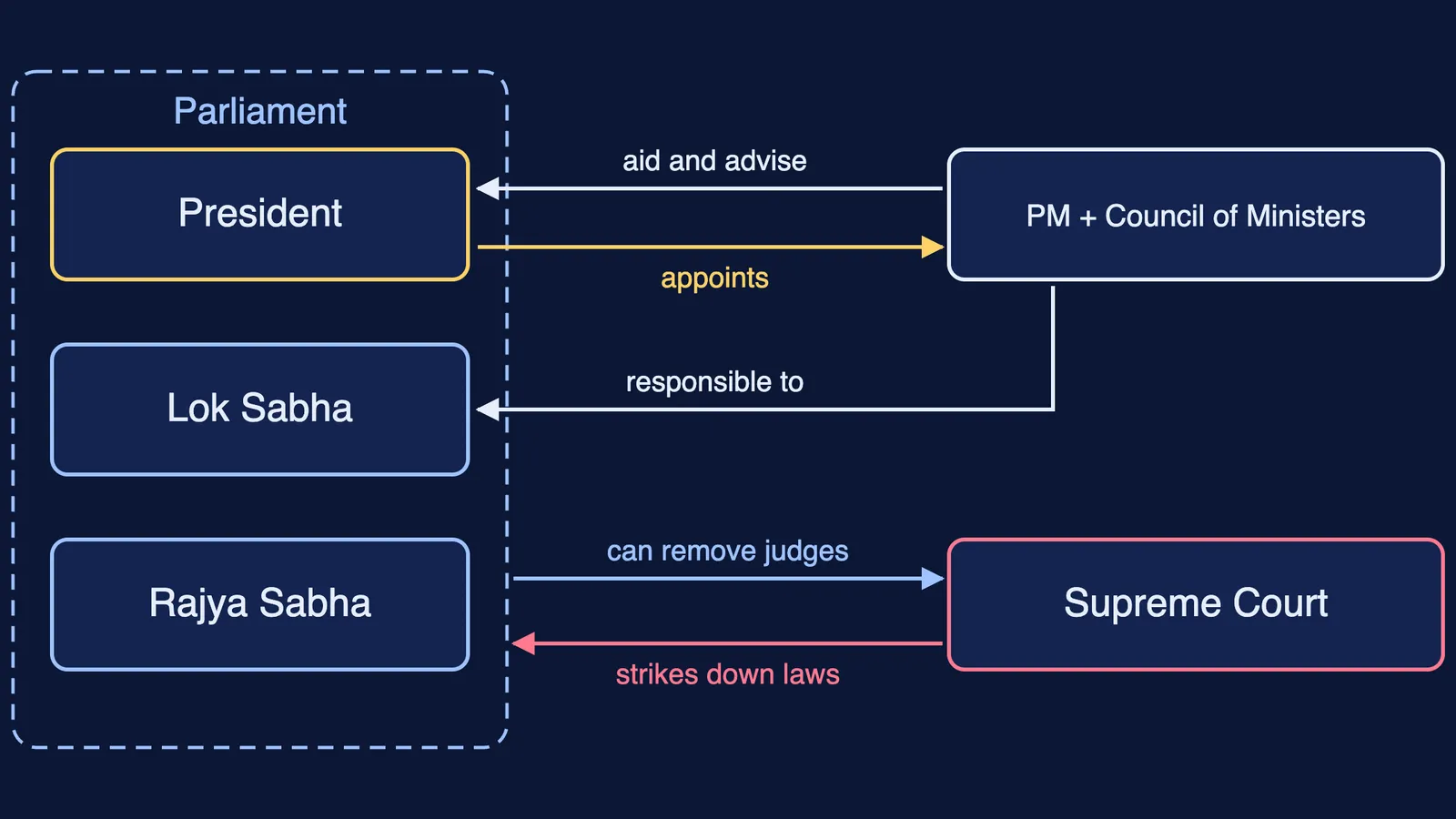
On paper, the executive power of the Union is vested in the President, according to Article 53. In practice, Article 74 creates a Council of Ministers with the Prime Minister at the head to aid and advise the President, who acts on that advice. The President may ask the Council to reconsider its advice, but must then act on the advice given after reconsideration.
Under Article 75, the President appoints the Prime Minister and appoints the other ministers on the Prime Minister's advice. Article 75(3) is the sentence to learn by heart: the Council of Ministers is collectively responsible to the Lok Sabha. Collective responsibility means the ministers stand or fall together: a government that loses the confidence of the Lok Sabha goes as a whole.
What does the judiciary do in a democracy?
Every Supreme Court judge is appointed by the President after consultation with judges, under clause (2) of Article 124. Under clause (4), a judge can be removed only for proved misbehaviour or incapacity, after each House supports removal by a majority of its total membership and two-thirds of members present and voting. That is hard by design, so judges can rule against the government without fear.
The courts can also check Parliament. Article 13(2) says the State shall not make a law that takes away fundamental rights, and such a law is void to the extent it does.
How does one decision pass through all four institutions?
Here is a made-up example to practise with. Suppose the government wants a national law capping school fees.
The Cabinet, led by the Prime Minister, approves a draft bill. (Political executive)
The bill is debated and passed by the Lok Sabha and the Rajya Sabha. (Parliament)
The President gives assent, acting on the Council of Ministers' advice. (President)
A parents' association argues in court that one clause takes away a fundamental right. The court can declare that clause void. (Judiciary)
If the Lok Sabha withdraws its confidence over the issue, the whole Council of Ministers resigns. (Accountability)
Our explainer on who runs a government school, from panchayat to Parliament shows the same chain at the local level.
How should you revise this chapter for exams?
Use a three-evening plan:
Evening 1: draw the four institutions on one page with arrows for advise, appoints, responsible to, removes and strikes down. Redraw it from memory.
Evening 2: write the five-step example for a different policy, such as a new tax.
Evening 3: answer two long questions with one frame: the institution, its power and article, the check on it, and why that check protects democracy.
If a chatbot gives you an article number, verify it first; our guide on checking AI answers against the Constitution shows how. For source-based questions, see how to answer case-based questions in CBSE exams.
If science revision keeps crowding civics out, Fermi's AI tutor can work out what you already know in a science topic and build a plan for the session, so your civics evening stays free.


