On this page
Most families find out who runs their government school only when something goes wrong: a subject with no teacher, a locked toilet, a child turned away at admission. The school, a local body, the state and the Centre each hold part of the job, and the law names where a formal complaint goes.
India had 14,71,473 schools in 2024-25, and 10,13,322 of them were government schools, according to UDISE+ figures tabulated by Education for All in India.
Who is responsible for government schools in India?
Four levels share the work.
The Centre. The Right to Education (RTE) Act, 2009 is a central law: every child aged six to fourteen has a right to free and compulsory education in a neighbourhood school until elementary education is complete (RTE Act, Section 3). The Centre also co-funds schools.
The state. The Act names an "appropriate Government" for each school: the Central Government for schools it establishes, owns or controls, and the State Government for other schools within a state (RTE Act, Section 2). For most government schools, that is your state's school education department.
The local authority. The Act defines a local authority as a Municipal Corporation, Municipal Council, Zila Parishad, Nagar Panchayat or Panchayat, including any body with administrative control over the school (Section 2). The Constitution's Eleventh Schedule lists "Education, including primary and secondary schools" among the matters a state may hand to panchayats (Eleventh Schedule, item 17). What your panchayat or municipality handles depends on state rules.
The school. The head teacher runs it day to day, with a School Management Committee of parents, teachers and local representatives.
Who pays for a government school?
Both the Centre and the state. Samagra Shiksha is the Centre's main scheme for school education, covering pre-primary to higher-secondary classes, and the Ministry of Education's school department implements it with state departments (Accountability Initiative, CPR budget brief).
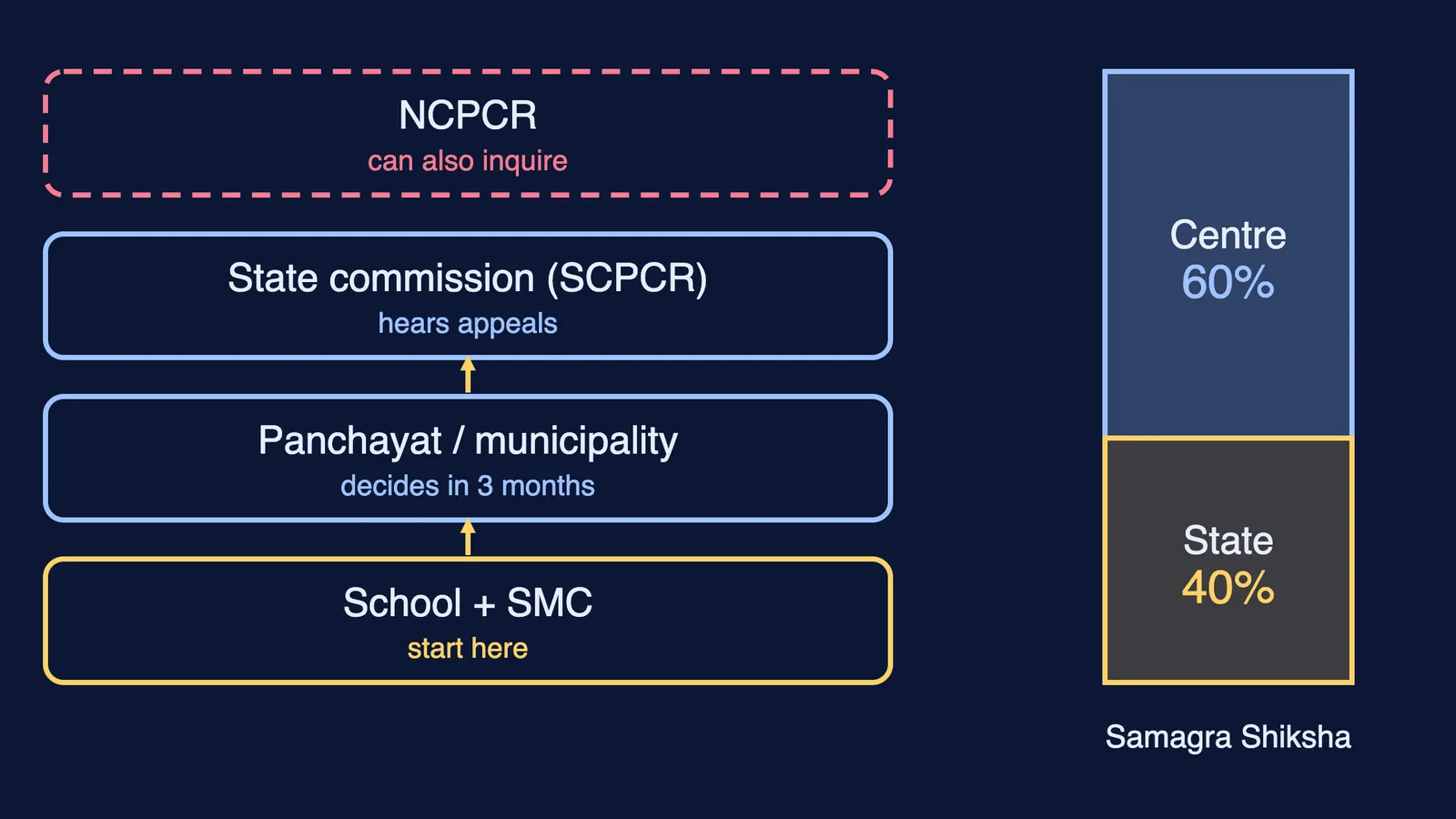
According to that 2023-24 brief, the Centre and most states share Samagra Shiksha costs 60:40; for the eight north-eastern states and the Himalayan states the ratio is 90:10, and Union Territories without a legislature are fully funded by the Centre (CPR budget brief).
For the bigger picture, see our guide to where each rupee of the Union Budget comes from and goes.
What does a School Management Committee do?
Every government school must have a School Management Committee (SMC), and at least three-fourths of its members must be parents or guardians (RTE Act, Section 21). Half the members must be women, and parents of children from disadvantaged groups and weaker sections must be represented in proportion (Section 21).
The Act names three SMC jobs: monitor the working of the school, prepare and recommend the school development plan, and monitor how grants are used. That makes it a quick place to raise most problems. Ask the head teacher who sits on it and when it next meets.
Where can a parent or student complain about a government school?
Start at the school, then use the route the RTE Act sets out.
Head teacher. Put the problem in writing, with dates and what you want done.
School Management Committee. If nothing changes in a few weeks, give the same note to an SMC parent member and ask for it on the next meeting's agenda.
Local authority. Anyone with a grievance about a child's right under the Act may make a written complaint to the local authority, which must decide within three months after hearing both sides (RTE Act, Section 32).
State child rights commission. If you disagree with that decision, you can appeal to the State Commission for Protection of Child Rights, or the authority your state has set up in its place (Section 32).
Separately, the national and state child rights commissions can inquire into complaints about the right to free and compulsory education (RTE Act, Section 31). The NCPCR website links to its online complaint portal, e-Baal Nidaan.
This route covers rights under the RTE Act, which protects children aged six to fourteen. For a problem in a higher class, ask which district education office oversees the school and write there.
Here is a note you can copy:
"To the Head Teacher, [school name]. My child, [name], studies in Class [x]. Since [date], [problem: for example, Class 8 has had no maths teacher]. I request [action] by [date]. I am sending a copy to the School Management Committee. [Your name, phone, date]."
Keep it short and factual. Updated, the same note becomes your complaint to the local authority.
A student need not wait out a vacant teacher post. The Fermi Concept Library has a lesson for every concept in physics, chemistry, biology, mathematics and computing, so you can work through topics you missed.
If your child is at a private school, see the questions parents can ask about a school fee hike. For another worked example of escalating step by step, read how to complain about loudspeaker noise during board exams.
Start with one dated note to the head teacher this week.