On this page
DigiYatra is the face-recognition system at Indian airports that lets you pass the entry gate, security and boarding without showing your ID and boarding pass at each one. By May 2026 it was running at 38 airports and had been used for over 10 crore journeys, according to the Press Information Bureau. Here is what happens to your face, and what to ask first.
How does DigiYatra work at the airport?
The rules are set out in the Ministry of Civil Aviation's Digi Yatra Biometric Boarding System policy (version 7.5, March 2021):
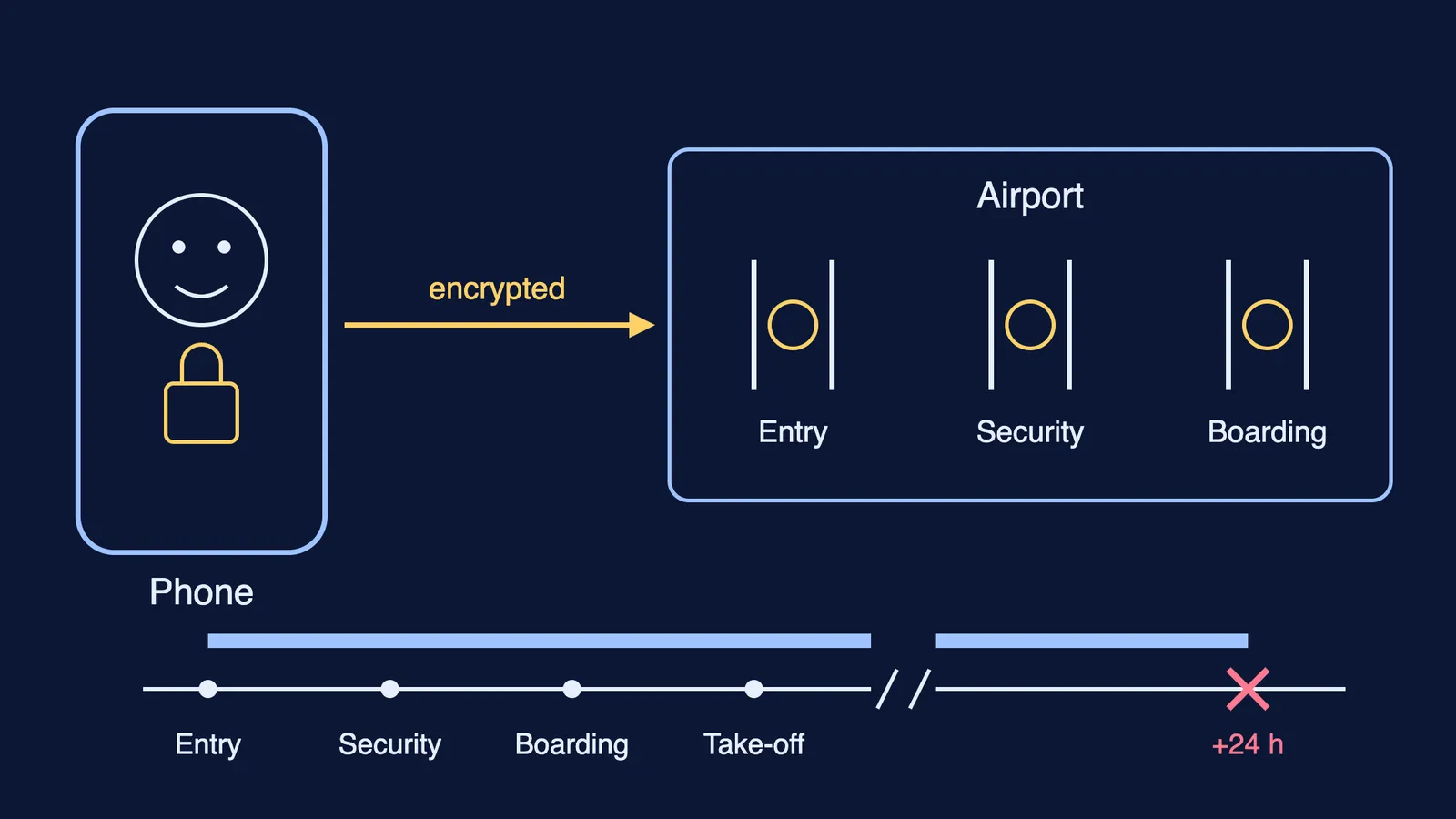
Enrol. You create a Digi Yatra ID in the app with a government ID and a selfie. Under the policy, Aadhaar and driving licences work fully in the app; other IDs, such as a passport, need a one-time check at an airport kiosk.
Share before you fly. You add your boarding pass and share your credential with the departure airport.
Face match at the entry gate. A camera captures your live face and compares it with the reference face in your credential. If they match, the e-gate opens.
One token for the rest. The airport builds a "Passenger Live Dataset" (PNR, name, flight, seat, a digital template of your face, a unique ID) that is used to identify you at the later checkpoints until boarding.
If the match fails, CISF staff check your ID by hand.
This is one-to-one matching: the system asks "is this the person on this credential?", not "who in this crowd is this?". Our explainer on how face recognition works covers the difference.
A face template is typically a list of numbers, and matching means measuring how close two such lists are. If vectors and distance still feel abstract, the Fermi Concept Library covers every concept in mathematics and computing, each with its own lesson.
Where is DigiYatra data stored?
A March 2023 PIB release says there is no central storage of passengers' personal data. It is encrypted in the wallet on your smartphone, shared only with the airport you depart from, and purged from that airport's system within 24 hours of departure.
The policy document adds three details the headline leaves out:
The airport system "shall have an ability to change the data purge settings based on security requirements on a need basis".
Travel logs without the biometric data are kept for audits "as per the mandate from Govt. of India".
"Any Security Agency, GOI or other Govt. Agency may be given access to the passenger data based on the current/ existing protocols".
ThePrint reported in November 2025 that the government's policy lets other "travel data", such as your Digi Yatra ID and travel credentials, be kept for up to 30 days. So "deleted in 24 hours" describes your face data at the airport, not every record of your trip.
Who runs DigiYatra, and why do privacy groups have questions?
The app is run by the Digi Yatra Foundation, a not-for-profit Section 8 company set up in 2019. The Airports Authority of India holds 26% and five private airport operators hold the rest, ThePrint reports. Apar Gupta, founder director of the Internet Freedom Foundation, told ThePrint that the Right to Information Act does not apply to the foundation. The foundation is also in a Delhi High Court dispute with Data Evolve Solutions, a former technology partner that claims a stake in the ownership of data shared over the app between 2021 and 2023.
Writing in The India Forum in February 2024, Disha Verma of the Internet Freedom Foundation argued that the app's privacy policy names no specific purposes for the data, that DigiYatra lacks a law of its own, and that a survey found some passengers had signed up without realising it. These are concerns, not findings of misuse. For how India's data law treats young people, see our guide to the DPDP Act and children's data.
Is DigiYatra compulsory?
No. The PIB release calls it voluntary, and the policy describes a non-biometric route: scan your boarding pass, show a physical ID to the CISF officer and walk through. You may need a manual ID check again at later checkpoints, so it can be slower, but it is your choice.
What should you ask before you scan your face?
A checklist for students and parents alike:
Is this the real app? Install it only from the official app store, not from a forwarded link.
Who gets it? Check which airport your credential goes to for this flight.
Have I said yes to extras? Opt-in "value-added services" can send your phone number or email to partners such as hotels, cab operators and lounges; the policy says you can opt out at any time.
Do I want to use it today? If not, say so at the gate and ask for the regular ID check. You do not need to give a reason.
Where does it go, how long does it stay, how do I say no: the same questions work for any app that wants your face, as our post on selfie apps and face data explains.