On this page
PM-Vidyalaxmi is a central government scheme, approved by the Union Cabinet on 6 November 2024, that lets students at top-ranked institutions borrow for college without pledging property or finding a guarantor (PIB, Cabinet decision). The loan can cover the full tuition fee and other course expenses. If your family's income is modest, the government also pays part of the interest while you study.
Between its launch and 21 July 2026, banks sanctioned 1,12,817 PM-Vidyalaxmi loans worth ₹15,634.78 crore, the Minister of State for Education told the Lok Sabha (PIB, July 2026).
Which institutions qualify for PM-Vidyalaxmi?
Eligibility depends on where you got admission, not on your marks alone. The list is built from the NIRF rankings and updated using the latest ranking (PIB explainer, July 2026). It covers:
any institution, government or private, ranked in the top 100 of the latest NIRF overall, category or subject rankings
state and UT government institutions ranked in the top 200
all other institutions run by the Government of India
As of July 2026, 1,425 institutions are covered, according to the same PIB explainer. The scheme started with 860 (PIB, Cabinet decision). Indian campuses of foreign universities, foreign campuses of Indian universities and foreign universities are not covered.
You also need merit-based admission through a competitive exam; management quota and NRI quota seats do not count. The loan can be for any degree or diploma course. You must register with Aadhaar, stay enrolled and keep up satisfactory academic performance.
Do you really need no collateral and no guarantor?
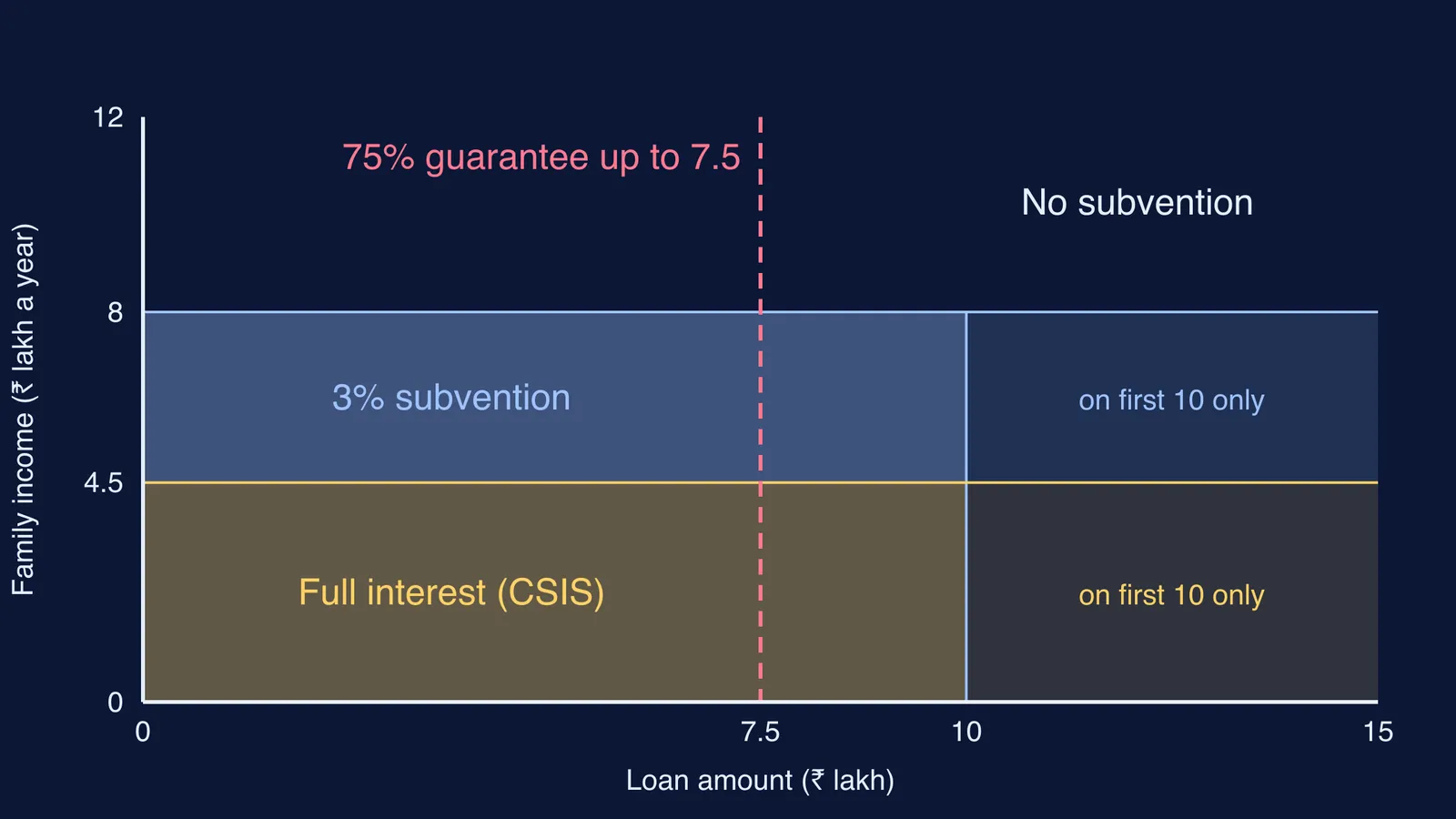
Yes. That is the core of the scheme (PIB, Cabinet decision). To make banks comfortable lending this way, the government guarantees 75% of any default on loans up to ₹7.5 lakh.
The PIB explainer lists the other terms. Interest is capped at the bank's external benchmark lending rate (EBLR) plus 0.5%. Banks may knock off up to 1% more if you pay interest during the course and moratorium. Repayment can run up to 15 years after the moratorium, which is the course length plus one year. Interest paid also qualifies for the Section 80E tax deduction.
Who gets the interest subvention, and how much?
There are two layers, and they depend on family income (PIB explainer):
Family income up to ₹4.5 lakh, technical or professional course: the older CSIS scheme pays the full interest during the moratorium on loans up to ₹10 lakh.
Family income up to ₹8 lakh, any degree or diploma: PM-Vidyalaxmi pays 3% interest subvention during the moratorium on loans up to ₹10 lakh, if you are not getting another government scholarship, fee reimbursement or interest subvention. On a bigger loan, the subvention applies to the first ₹10 lakh only.
The 3% benefit is capped at one lakh fresh students a year, with preference for students at government institutions on technical or professional courses (PIB, Cabinet decision). From the second year, it continues only with satisfactory academic progress. You can claim the subvention and guarantee only once, for one UG, PG or integrated course.
How much is the 3% subvention worth?
Say Riya's family earns ₹6 lakh a year and she joins a four-year B.Tech at a listed private college. She borrows ₹9 lakh in total.
Collateral and guarantor: none needed, because her college is on the list. The scheme sets no upper cut-off on the loan amount.
Guarantee: the 75% government guarantee covers loans up to ₹7.5 lakh, so ask the bank how it treats ₹9 lakh.
Subvention: her income is under ₹8 lakh and the loan is under ₹10 lakh, so she can apply for 3%.
Maximum value: 3% of ₹9 lakh is ₹27,000 a year. Over a five-year moratorium (four years plus one), that is at most ₹1.35 lakh.
Reality check: fees are usually released year by year, so less is outstanding early on and the real benefit will be smaller.
How do you apply for a PM-Vidyalaxmi loan?
Everything runs through the PM-Vidyalaxmi portal, live since 25 February 2025 (PIB, July 2026). Public sector, private, regional rural and cooperative banks are onboarded.
Confirm your institution is on the current list before you rely on the scheme.
Register with Aadhaar and fill the common loan application.
Choose your banks and track status online.
After the loan is sanctioned and disbursed, apply for interest subvention based on your family income.
Install the Digital Rupee App when the SMS arrives, and keep your semester results in order.
For the wider picture, read our guides to the education loan interest subsidy by family income, how much banks lend without collateral and applying for an education loan step by step.
If you are still working towards the entrance exam that decides your college, Fermi's AI tutor can work out what you already know and build a plan for each session, so the admission part of this checklist gets attention too.