
On this page
If your family earns up to ₹8 lakh a year, the government can pay some or all of the interest on your education loan while you study, according to a government press note. Two Ministry of Education schemes do this, both run through the PM-Vidyalaxmi portal. Each has its own income limit and college list.
Which education loan interest subsidy schemes exist?
The facts below come from the Press Information Bureau note on PM-Vidyalaxmi, posted on 29 July 2026.
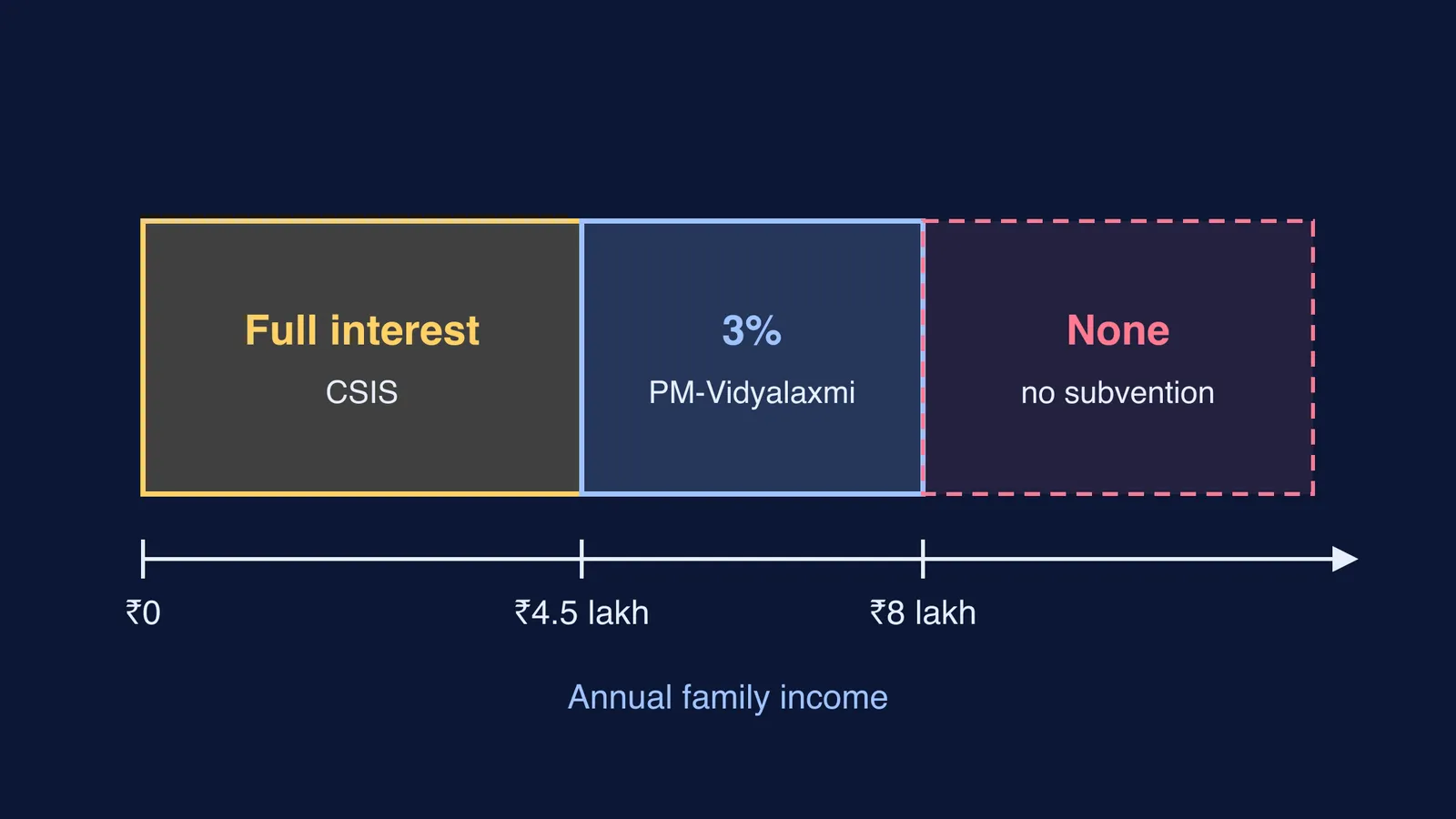
PM-USP CSIS (Central Sector Interest Subsidy) pays the full interest during the moratorium on loans up to ₹10 lakh for students with annual family income up to ₹4.5 lakh in technical or professional courses.
PM-Vidyalaxmi, approved by the Union Cabinet on 6 November 2024, gives a 3% interest subvention during the moratorium on loans up to ₹10 lakh for students with annual family income up to ₹8 lakh.
The moratorium is the course period plus one year; repayment can then run for up to 15 years. PM-Vidyalaxmi also offers collateral-free, guarantor-free loans at its listed colleges, with a 75% government credit guarantee on loans up to ₹7.5 lakh and an interest rate capped at the bank's external benchmark lending rate (EBLR) plus 0.5%.
Who qualifies for the subsidy by family income?
Find your row, using the PIB note above and Canara Bank's PM-Vidyalaxmi page:
Income up to ₹4.5 lakh, technical or professional course: full interest during the moratorium under CSIS.
Income up to ₹4.5 lakh, any other course at a PM-Vidyalaxmi college: 3% subvention.
Income ₹4.5 lakh to ₹8 lakh, any degree or diploma at a PM-Vidyalaxmi college: 3% subvention.
Income above ₹8 lakh: no subvention, though you can still apply for the collateral-free PM-Vidyalaxmi loan.
The 3% subvention is limited to one lakh fresh students a year; the PIB note says CSIS has no such limit. Both benefits are available only once, for an undergraduate, postgraduate or integrated course.
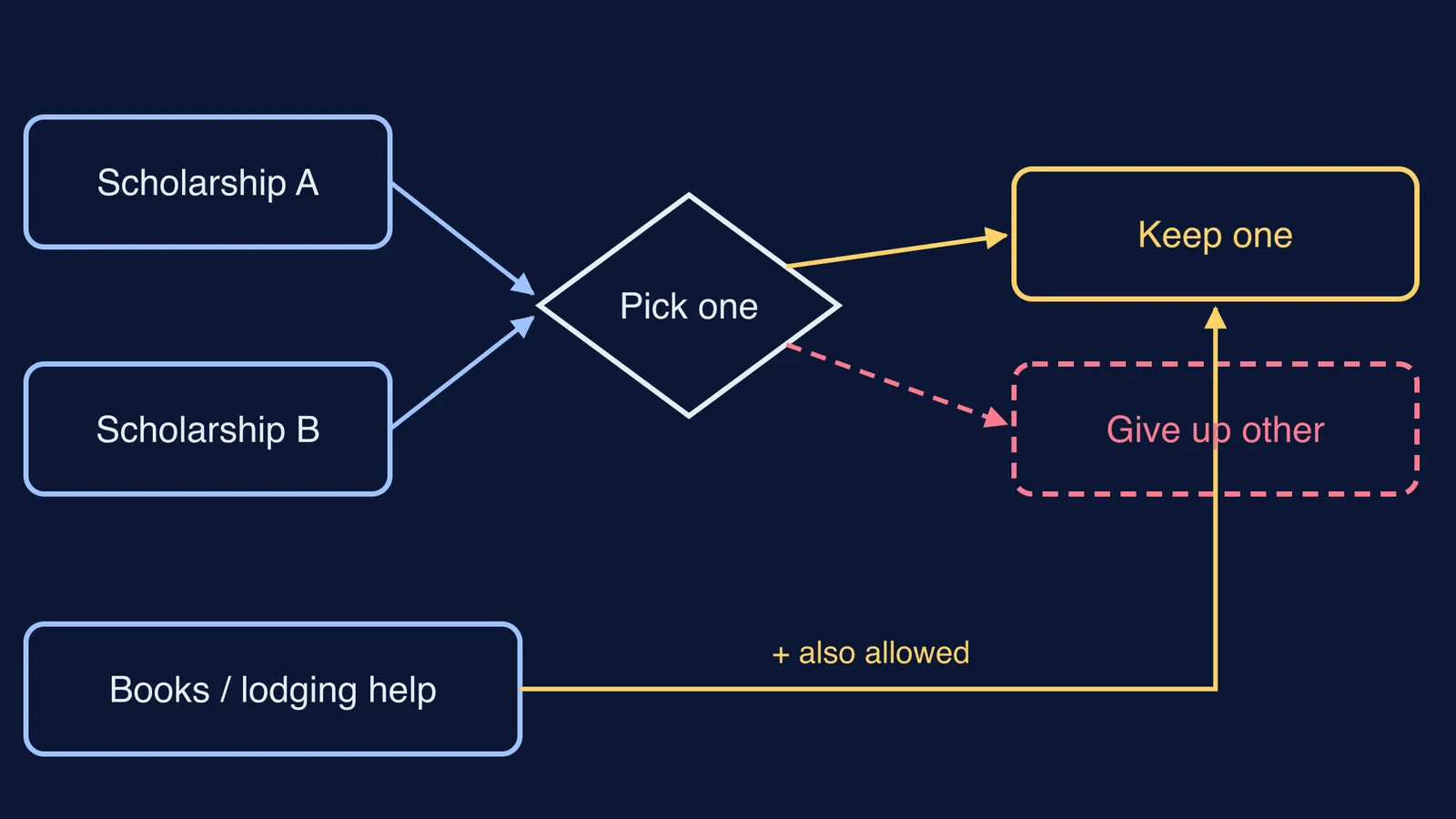
We compare the two routes in can you take a scholarship and an education loan together. If you are headed to an IIT, also read how the IIT fee waiver for low-income families works.
Which courses and colleges count?
For CSIS, Punjab National Bank's copy of the government guidelines lists professional or technical courses at NAAC-accredited institutions, NBA-accredited programmes, Institutions of National Importance and centrally funded technical institutes. The PIB note adds institutes approved by regulators such as the nursing, pharmacy, dental and bar councils.
PM-Vidyalaxmi covers all degree and diploma courses at its listed colleges: the top 100 in the overall, category or domain NIRF rankings, the top 200 state-government institutions in NIRF, and all other central-government institutions. The PIB note puts the list at 1,425 institutions. Management-quota and NRI-quota seats are not covered, and neither are foreign institutions or their campuses in India.
The subsidy stops if you drop out or are expelled; the PNB guidelines exempt documented medical breaks. From the second year, the PIB note says you must also keep up satisfactory academic performance. If a concept in physics or maths is slipping, the Fermi Concept Library has a lesson for every concept in physics, chemistry, biology, mathematics and computing, so you can fix the gap before exams.
How much does the subsidy save? A worked example
Take a four-year B.Tech, so the moratorium (course plus one year, per the PIB note) is five years. Say the bank disburses ₹1 lakh at the start of each year at an illustrative 10% simple interest.
Interest during the moratorium: ₹10,000 + ₹20,000 + ₹30,000 + ₹40,000 + ₹40,000 = ₹1,40,000.
Under CSIS (income up to ₹4.5 lakh, NBA-accredited course), the government covers all ₹1,40,000.
Under the 3% subvention (income up to ₹8 lakh), it covers about 3% of the amount disbursed each year: ₹3,000 + ₹6,000 + ₹9,000 + ₹12,000 + ₹12,000 = ₹42,000. Your family still owes about ₹98,000 in interest, which you can pay as you go or add to the loan.
What documents should you keep ready?
Canara Bank's scheme page and the PIB note list these:
Income certificate from the authorised public authority of your state government.
Aadhaar and PAN; you register on the portal through Aadhaar.
Admission letter or entrance exam result, plus the college's fee structure.
Self-attested mark sheets.
Proof of identity and address under KYC rules.
Co-borrower documents, usually a parent's or guardian's.
Also keep proof that you are still enrolled and passing, and medical papers for any break.
Once the loan is disbursed, you claim the subvention on the portal. The money goes into your PM-Vidyalaxmi Digital Rupee wallet and then into the loan account. Our guide to applying for an education loan step by step covers the bank side.
Before the admission rush, get the income certificate made and check that your college is on the PM-Vidyalaxmi list.