

On this page
Securing admission to a top university is a huge milestone, but figuring out how to pay for it can be stressful for your family. If you have been awarded a scholarship and are also applying for an education loan, you might wonder if you are allowed to keep both.
The short answer is yes. According to the Indian Banks' Association (IBA) and Reserve Bank of India guidelines, you can hold a scholarship and an education loan at the same time. Not only is it allowed, but your scholarship actually works in your favour by reducing the amount of money you have to pay from your own pocket.
How does margin money work in education loans?
When you apply for an education loan, the bank rarely covers 100% of your total expenses. The portion of the course cost that you are expected to pay yourself is known as "margin money."
According to standard RBI guidelines, the margin requirements depend on your loan amount and destination:
For loans up to ₹4 lakh, there is a 0% margin, meaning the bank covers everything.
For loans above ₹4 lakh for studies in India, there is a 5% margin.
For loans above ₹4 lakh for studies abroad, the margin is 15%.
If your total course cost is ₹10 lakh for a degree in India, the bank expects you to bring in 5%, or ₹50,000, as your margin. The bank will then disburse the remaining ₹9.5 lakh.
Can a scholarship reduce your loan amount?
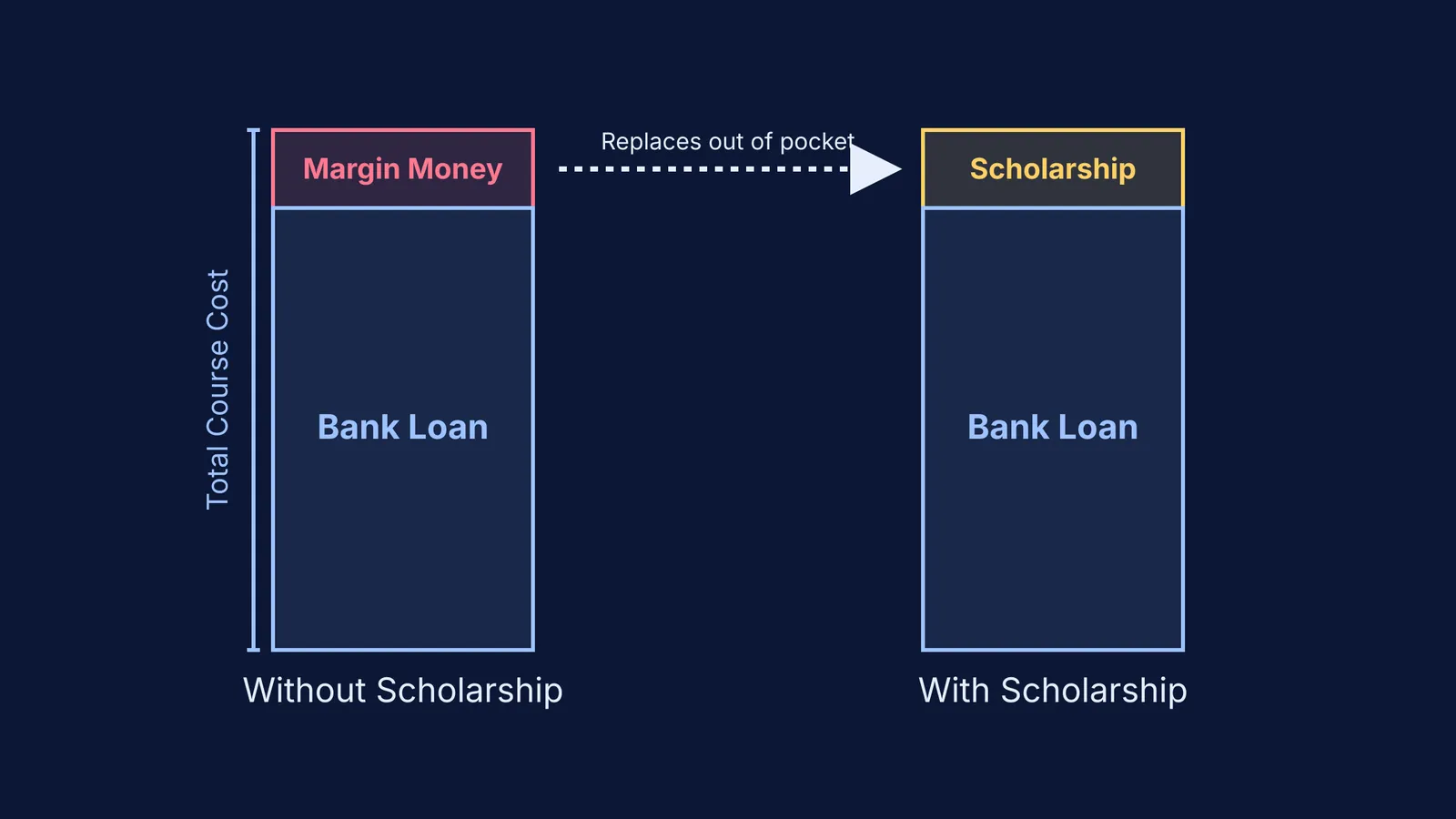
This is where your hard work pays off. The IBA scheme explicitly states that any scholarship or assistantship you receive is treated as part of your margin money.
Instead of asking your parents to arrange the ₹50,000 margin in the example above, you can show the bank your scholarship award. If your scholarship is worth ₹50,000 or more, it fully covers the margin requirement. You will not have to pay anything out of pocket, and the bank will finance the rest of your education.
Earning these merit scholarships often means clearing competitive entrance exams or maintaining top grades. If you are preparing for these exams, the Fermi Problem Library has worked problems with a step-by-step solver that explains the reasoning rather than printing an answer, helping you master the topics you need to succeed.
What if the scholarship is larger than the margin?
If you secure a major scholarship that covers your tuition entirely, you can still use an education loan to cover other essential expenses. Education loans in India cover more than just tuition fees. They can be used for hostel and mess charges, examination fees, library fees, travel expenses for studying abroad, and even the purchase of a laptop or books.
If your tuition is paid for, your loan can be directed towards these living costs. This ensures you can focus entirely on your coursework without financial stress.
Can you use multiple scholarships with an education loan?
Yes, you can combine multiple smaller scholarships. The total amount of all your scholarships will be calculated against the margin money required. If your combined scholarships exceed the margin money, the excess amount can either reduce the total loan amount you need to borrow or be used to cover additional living expenses like a laptop or travel, depending on the bank's terms. This strategy gives you more financial flexibility and reduces the principal amount you will eventually have to repay.
What is the CSIS interest subsidy scheme?
For students from families with an annual income up to ₹4.5 lakh, the Ministry of Education offers the Central Sector Interest Subsidy (CSIS) scheme. If you take a loan for a professional or technical course in India, the government pays the full interest charged by the bank during your course duration plus one year.
This means your loan remains interest-free while you study, giving you time to graduate and secure a job before the repayment burden begins. The subsidy applies to loans up to ₹7.5 lakh.
What is the checklist for combining your loan and scholarship?
Apply through Vidya Lakshmi: Most public sector banks process education loans and CSIS subsidies through the government's Vidya Lakshmi portal.
Submit proof of award: Provide your official scholarship letter to the bank to ensure it is counted toward your margin money.
Study consistently: Most scholarships require you to maintain a minimum academic standard to be renewed each year. The Fermi Concept Library has every concept in physics, chemistry, biology, mathematics and computing, each with its own lesson and its place in the map, so you can stay on top of your university coursework.
Read ahead: Whether you are reviewing how energy bands differ in conductors and insulators or solving the complex triangle inequality, keeping your grades high ensures your funding is safe.
Understand the repayment terms: Even with a scholarship and the CSIS interest subsidy, the principal loan amount remains your responsibility. Make sure you understand when the moratorium period ends and what your monthly EMI (Equated Monthly Instalment) will be. Planning ahead ensures you are ready when the repayment phase begins.


