

On this page
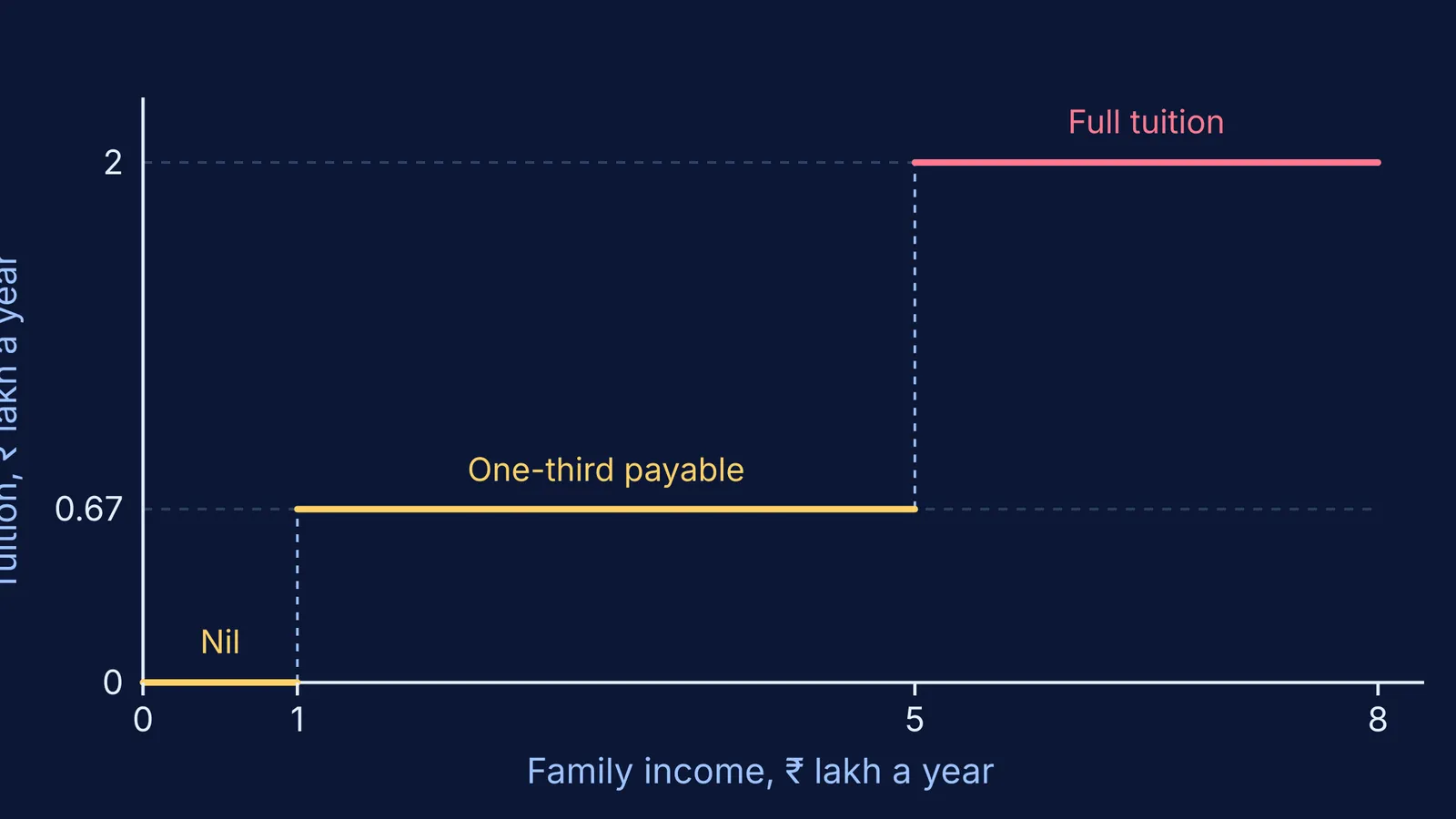
If your family earns less than ₹5 lakh a year, an IIT seat costs much less in tuition than the headline fee suggests. The rule dates from 2016, when IIT undergraduate tuition was raised from ₹90,000 to ₹2 lakh a year, with protections for socially and economically backward students written into the same decision (IIT Bhubaneswar's notice of 9 May 2016). IIT notices issued in 2026, such as IIT Guwahati's, still use the same income slabs.
Who qualifies for an IIT fee waiver on family income?
IIT Guwahati's notice of 7 April 2026 sets out three groups:
Most Economically Backward (MEB): GEN, GEN-EWS or OBC-NCL students whose annual family income from all sources is below ₹1 lakh. Tuition is fully waived.
Other Economically Backward (OEB): GEN, GEN-EWS or OBC-NCL students whose family income is between ₹1 lakh and ₹5 lakh. Two-thirds of tuition is waived.
SC, ST and PwD students: tuition is fully waived whatever the income, and they do not need to submit an income certificate or affidavit. The waiver is applied from admission data.
IIT Mandi's guidelines give the same two income slabs and say remission applies to B.Tech and B.S. students for the four years of the course.
"Family income from all sources" is broad. The affidavit format in the IIT Guwahati notice asks for salary or pension, business income, agriculture, land, bank and post office interest, shares, the other parent's income, and any income in the children's names.
How much tuition will you actually pay?
Take a family where one parent earns ₹2.4 lakh a year from a shop, the other earns ₹60,000 from tailoring, and savings earn ₹15,000 in interest. Total: ₹3.15 lakh. That falls in the ₹1-5 lakh slab of the 2016 fee rules.
Full tuition: ₹2 lakh a year.
Two-thirds waived, so one-third is payable: about ₹66,667 a year.
Over four years, if tuition stays at ₹2 lakh: about ₹2.67 lakh instead of ₹8 lakh.
IIT (ISM) Dhanbad's 2026-27 fee table for fees due at admission shows the same ratio: tuition of ₹1,00,000 for GEN, OBC-NCL and GEN-EWS students, ₹33,333 for families earning ₹1-5 lakh, and nil below ₹1 lakh.
Now a family near the line. If wages come to ₹95,000 but bank interest adds ₹10,000, the total is ₹1.05 lakh, which is the two-thirds slab, not the full waiver. Count everything. The affidavit you sign says that if the information is found false, the waiver can be recovered with penal interest and legal action taken.
Our guide on how to explain an education loan to a teenager can help you plan the rest of the budget together.
Which documents do IITs ask for to waive fees?
Formats differ between IITs, so always use your own institute's notice. These are the requirements in the IIT Guwahati 2026 notice (MEB and OEB students only):
Family income certificate in the IIT's format, from a District Magistrate, Collector, Deputy Commissioner, Sub-Divisional Magistrate, a revenue officer not below Tehsildar, or the Sub-Divisional Officer where the family lives.
Income affidavit on ₹100 non-judicial stamp paper, sworn before a first-class magistrate, SDO, BDO, Tehsildar, notary or revenue officer. Affidavits on ₹10 or ₹20 paper are not accepted.
Proof of salary such as Form 16 or an income tax return, which the affidavit form asks salaried parents to attach.
Clear PDF scans with the student's roll number visible on both documents. Hazy or unclear scans, such as those made with a smartphone, are not accepted.
Both documents are mandatory: one without the other does not count. IIT Mandi similarly asks for a certificate from the revenue department, DC, SDM or Tehsildar plus a notarised affidavit, handed to the Academic Office. If you have not applied for an income certificate before, start with our guide on how to get an income certificate.
When do you submit, and do you need fresh papers?
The certificate is tied to a financial year. IIT Guwahati wanted certificates for 1 April 2025 to 31 March 2026, issued after 1 April 2026, with uploads closing at 5 pm on 25 June 2026; late documents were not considered. Even a certificate valid for three to five years needed a fresh affidavit for the latest financial year. IIT Mandi asks for a certificate issued on or after 1 April of the current financial year.
A simple plan for a family in the slab:
April: once the financial year closes, apply at the tehsil or SDM office. Take your salary, land and bank records.
May: get the affidavit prepared on ₹100 stamp paper and sworn.
By the IIT's deadline: scan both cleanly and upload. Keep originals in one folder.
At admission, follow the document list in our JoSAA counselling guide for parents, then watch your IIT's academic notices each year.
Once the paperwork is done, first-semester maths and physics move fast. If you are unsure where to begin, Fermi's AI tutor can work out what you already know and build a plan for the session.


