

On this page
College is a significant investment. While parents usually handle the paperwork and the bank visits, the student will be the one living with the degree and the career it builds. Yet, financial conversations often happen behind closed doors.
According to the 2019 survey by the National Centre for Financial Education, only 27% of Indian adults are financially literate. It is no surprise that many students arrive at college without understanding what their education actually costs. Discussing how an education loan works before the first semester is a practical way to teach your child the value of money and set clear academic expectations. It is an ideal conversation to have after Class 12 before college starts, when the teenager is old enough to grasp the concepts but before the academic pressure begins.
How do education loans work in simple terms?
An education loan is not like a cash allowance or a blank cheque. When a bank approves the loan, it does not hand the money to the student. Instead, it pays the college directly for tuition, and sometimes covers specific expenses like hostel fees, books, or a necessary laptop.
For many families, the biggest worry is providing security for the loan. However, under the RBI and Indian Banks' Association (IBA) Model Education Loan Scheme, loans up to ₹7.5 lakhs require no collateral. The bank does not ask you to pledge your house or land; they lend the money based on the student's admission to a recognised course and their future earning potential.
In this arrangement, the student is the primary borrower. The parent joins as a co-borrower to show family commitment and provide a financial guarantee. Explaining this structure to a teenager makes it clear that the loan is an investment in their personal future, not just another household bill the family has to pay.
What is the moratorium period in an education loan?
You do not have to start paying the loan back on the day the college receives the money. Education loans come with a repayment holiday known as the moratorium period.
This period usually covers the entire duration of the course, plus one extra year. This grace period gives the student time to graduate, navigate the job market, and secure a stable income before the Equated Monthly Installments (EMIs) officially begin.
However, it is crucial for your teenager to know that the bank still calculates interest during this time. The loan is not free money sitting idle; it is actively costing the family money every month.
If you choose not to pay the interest during the moratorium, it capitalises. This means the accumulated interest is permanently added to the principal amount when the repayment holiday ends, making the final EMIs much larger and the overall debt much heavier.
How does the interest rate and repayment work?
Once the moratorium period ends, the repayment phase begins. The student and co-borrower typically have up to 15 years to repay the loan in monthly installments.
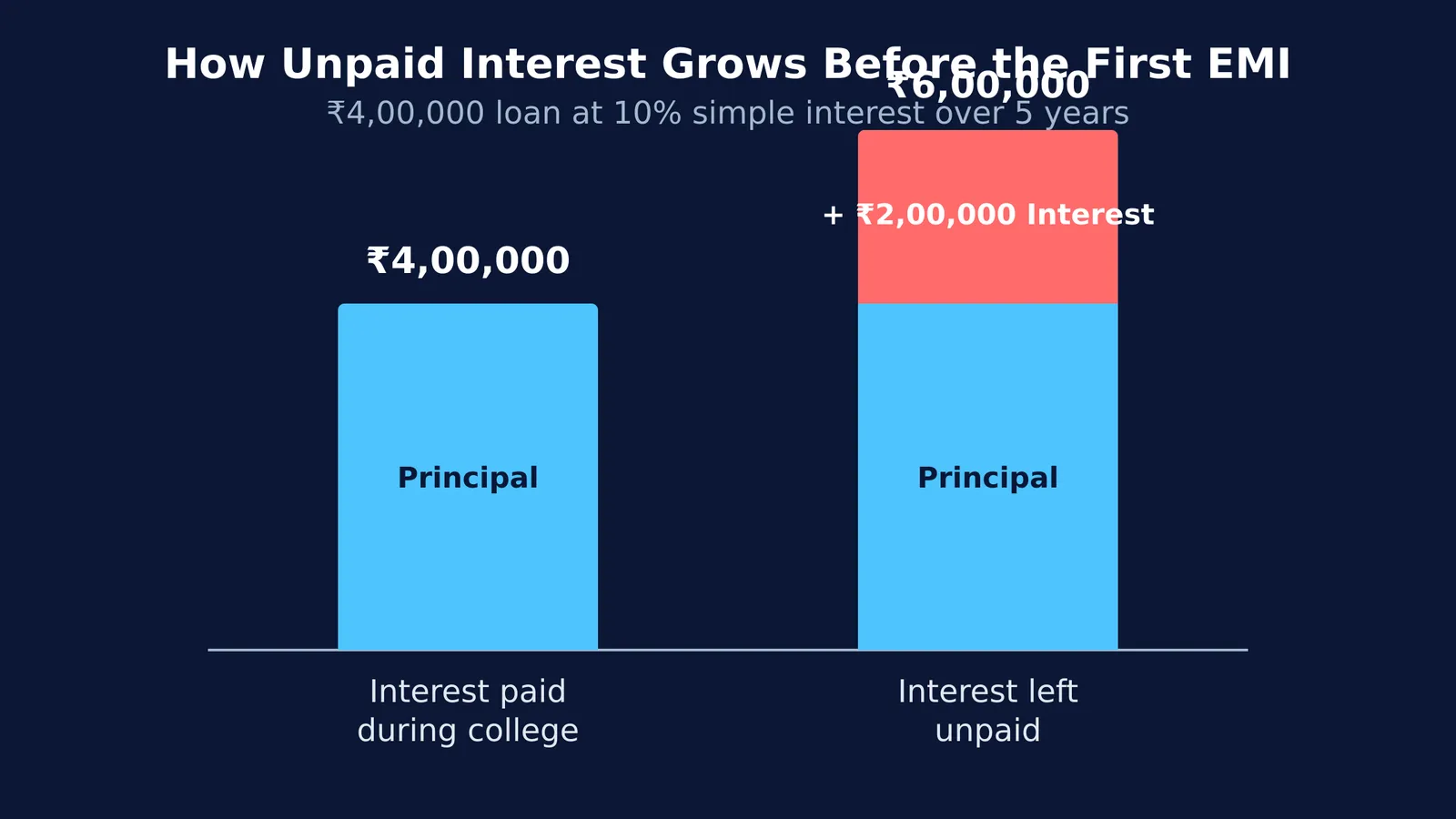
Show your teenager a simple calculation on a piece of paper. If you take a ₹4 lakh loan at a 10% interest rate for a four-year degree, the simple interest during the moratorium (the four-year course duration plus one year) is ₹40,000 per year. If that is left unpaid for those five years, the total loan balance jumps to ₹6 lakhs before the first EMI is even due.
Walking through these numbers does not mean burdening a teenager with financial anxiety. It means showing them the mechanics of interest and the real cost of a professional degree. It is as practical and necessary as explaining inflation to a teenager. You can even discuss how a future college internship or stipend could help pay down the simple interest early.
Why should a teenager understand their education loan?
When a student understands the financial weight of their education, they are more likely to take ownership of their learning.
A 2013 study published in the *American Sociological Review* found that increased parental financial support was actually associated with lower student GPAs. The research suggested that students with a complete financial safety net often dialled down their academic efforts because they lacked clear expectations from their parents. They did just enough to get by, rather than striving for excellence.
Explaining the loan acts as a safeguard against this complacency. It shows that the family is supporting them, but the support comes with the expectation of hard work and responsibility. It frames their daily study habits as part of a larger financial and professional goal.
If your child is studying engineering or science, Fermi's AI tutor can work out what they already know and build a plan for the session, so they sit down to a clear next step and get the most out of their courses.
By understanding the moratorium period and the repayment structure, your teenager learns that college is a privilege to be used well, not just a continuation of school. They will step onto campus knowing exactly what their degree is worth.


