On this page
Results are out, counselling is moving, and college starts in a few weeks or months. That stretch can vanish into refreshing allotment pages, or it can set up your first semester. Here are five things worth doing, with a plan you can copy.
Which documents should you sort out before college?
Paperwork problems show up at the worst moment: a name spelled two ways, a certificate missing on reporting day. Fix them now.
DigiLocker's own answers to common questions make two points worth knowing. A document can only be fetched from DigiLocker if the name on it matches the name on your Aadhaar. And if your Class 12 marksheet is missing there, only the authorised board or university can upload it, so ask your board to make it available rather than waiting on your college.
Work through this checklist:
Class 10 and Class 12 marksheets and passing certificates, downloaded and saved
Aadhaar, with your name spelled exactly as on your marksheets
Category, income or domicile certificates if you are claiming a reservation or state quota, checked for validity dates
Transfer or migration certificate, if your college asks for one
An APAAR ID, if your college asks for it
Passport-size photos, plus scans of everything in one phone folder and one backup
If you are going through engineering counselling, our guide to JoSAA rounds, choices and documents lists what is checked at each stage.
Should you study maths before college starts?
Yes, a little, several times a week. A 1996 review of 39 studies in Review of Educational Research found that achievement test scores fall over the summer holiday. Its meta-analysis of the 13 most recent studies put the loss at about one month on a grade-level scale, and maths, especially computation, fell more than reading. Those studies were of school pupils, so treat this as a reason to keep practising, not a forecast for you. Our piece on summer learning loss and simple fixes has more on that research.
First-year science and engineering courses usually build on this base. Review in this order:
Algebra: factorising, fractions, logarithms, inequalities
Functions and their graphs
Trigonometric identities
Differentiation and integration rules
Vectors and basic probability
Worked example of one week: on Monday, do 10 differentiation problems from your Class 12 textbook exercises in 40 minutes and mark the ones you got wrong. On Thursday, redo only the wrong ones without looking at your old working. On Saturday, mix in 5 integration problems. That is about two hours a week, and you learn which topics still wobble.
If a topic never really made sense (you could differentiate, but never knew what a derivative meant), the Fermi Concept Library has a lesson for every concept in mathematics, so you can fill that gap before lectures assume it.
Which skill is worth learning in the gap?
Pick one skill, not five, and choose one you will use in your first year: touch typing, spreadsheets, a first programming language such as Python, or hostel skills like cooking simple meals and keeping a budget.
Practise for 30 minutes most days and finish one small thing by the end, such as a spreadsheet of your first month's expenses or a short program that solves a problem you care about.
How much should you rest and read?
After a year of boards and entrance tests, rest is part of the plan. The US Centers for Disease Control and Prevention recommends 8 to 10 hours of sleep per 24 hours for teens aged 13 to 17, and 7 or more hours for adults aged 18 to 60. Fix a wake-up time now; your 8 am lectures will thank you.
Read for pleasure: one book every two weeks, anything you enjoy, plus one readable book about the field you are entering.
Waiting for results or a disappointing rank can leave you low for a while. If that feeling lasts, talk to someone you trust. Tele MANAS, the national mental-health helpline, is free and open 24x7 on 14416 or 1800-891-4416.
What does a good 8-week plan look like?
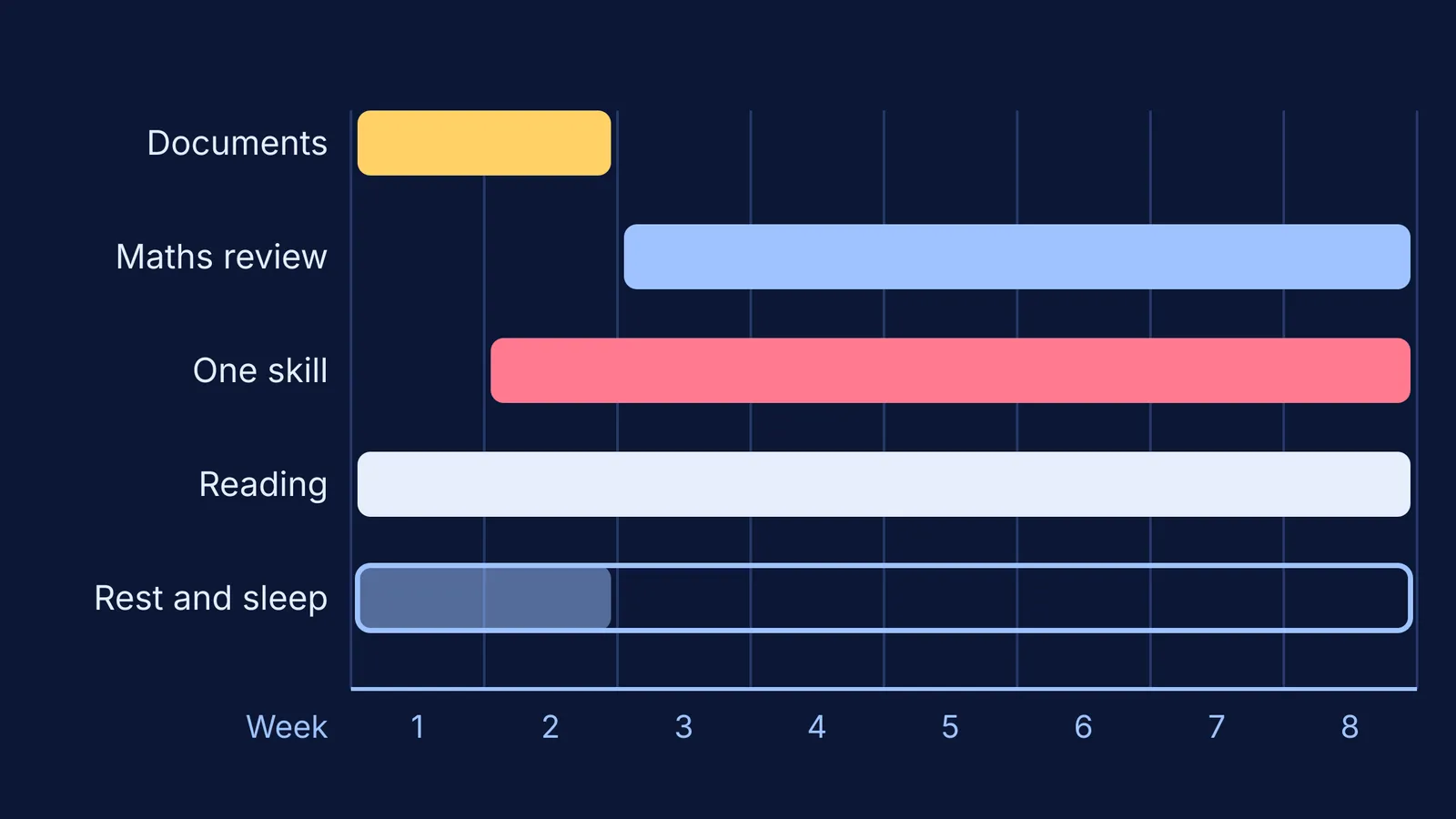
Weeks 1 and 2: sleep, rest and reading. Sort every document on the checklist.
Week 2 onwards: start your one skill, 30 minutes a day.
Weeks 3 to 8: maths review, three sessions a week like the worked example above, in the order above.
Every week: one afternoon fully off, and one check that counselling deadlines have not moved.
If you would rather not plan the maths review yourself, Fermi's AI tutor works out what you already know and builds a plan for the session, so you sit down to a clear next step.
When the plan is done, read about what changes in your first semester at college.