

On this page
Teaching children the value of money is not a single conversation. It is a slow transfer of responsibility that shifts from physical coins to invisible digital transactions. The habits children build when they are young often become the default behaviors they rely on as adults. Knowing when to introduce a piggy bank versus a budget is critical to developing their financial independence.
When should you start teaching kids about money?
Children are capable of grasping financial basics far earlier than most parents realize. A 2013 University of Cambridge study authored by David Whitebread and Sue Bingham found that children's core money habits and financial behaviors are largely formed by age seven (University of Cambridge / MAS report). By this age, children can understand the concepts of delayed gratification and the irreversibility of spending.
Between ages 3 and 5, children are concrete thinkers. The concept of a digital balance is too abstract, so they need to see money physically change hands.
Use a clear jar: Replace the traditional opaque piggy bank with a clear plastic jar. Seeing the level of coins rise gives them a visual representation of accumulation.
Play "store" at home: Use real coins to buy and sell toys in the living room so they experience the exchange of value.
The script: When shopping, narrate your choices out loud. Say, "We are buying the milk because we need it for breakfast, but we are leaving the candy because we are saving our money for the weekend trip."
How do you teach a 7 to 12-year-old about budgeting?
As children enter primary school and develop better math skills, they are ready for the responsibility of a regular allowance. This is the window to teach them that money is a tool with multiple uses.
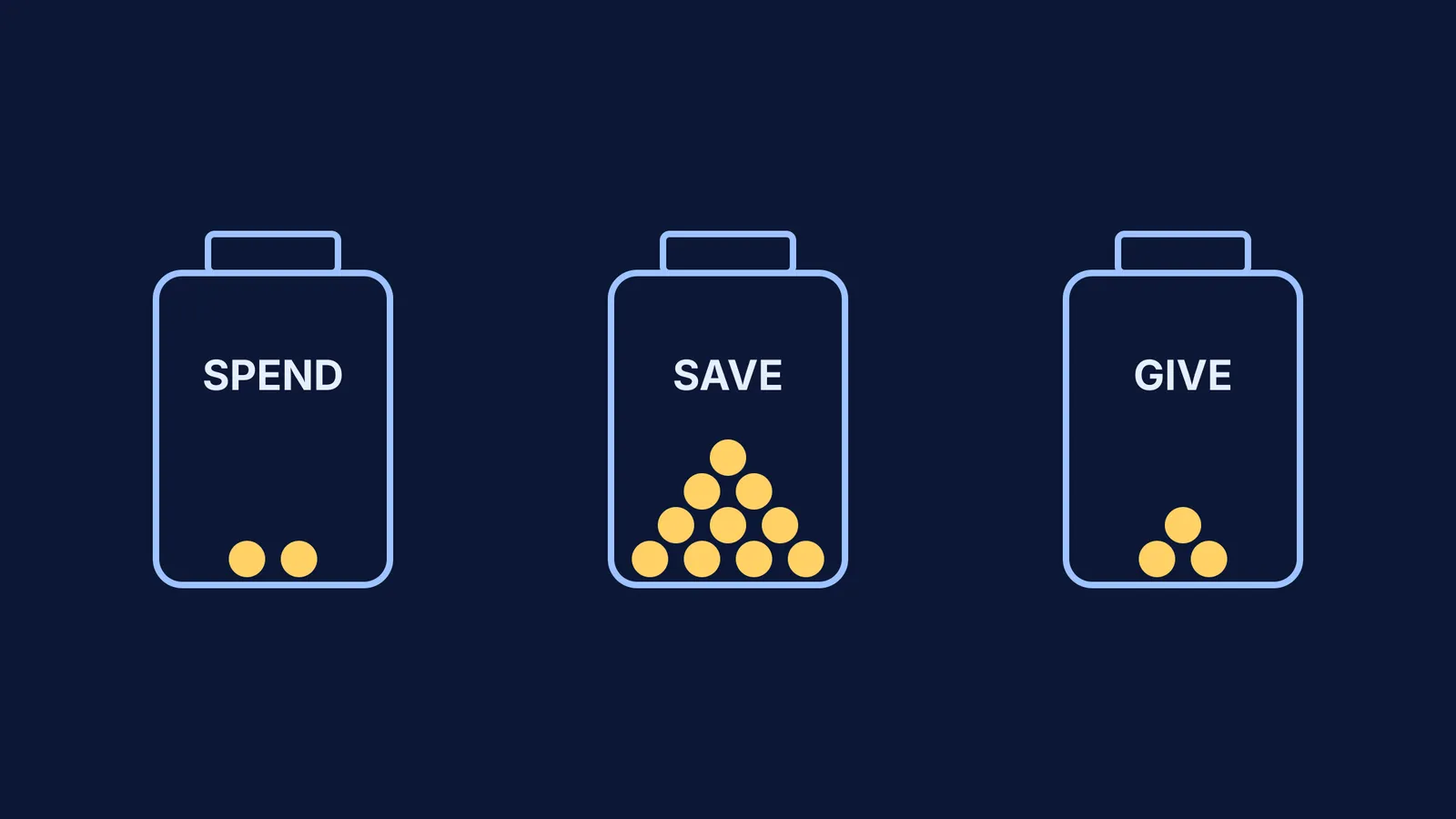
The most effective framework for this age is the Three-Jar System:
Spend: A small portion they can use on immediate wants, like a snack or a small toy.
Save: A larger portion dedicated to a specific, medium-term goal.
Give: A small portion set aside for philanthropy, teaching them that money can help others.
This is also an ideal time to build their structured problem-solving skills. Just as they learn to break down a long division problem, they need to break down the steps to reach a saving goal. Fermi's AI tutor teaches rather than answers: it holds a line of reasoning across a whole session, works out what the student already knows and builds a plan for the session, so they sit down to a clear next step. You can apply the exact same approach to financial goals: sit down with your child and map out exactly how many weeks of allowance it will take to afford the item they want.
What financial skills does a 15-year-old need?
Teenagers face a completely different financial landscape dominated by digital spending. They are active in the economy, but their theoretical understanding often lags behind their behavior. According to the 2022 OECD PISA financial literacy assessment, over 85% of 15-year-old students across participating countries had made an online purchase in the previous 12 months, yet 18% of them fell below the baseline level of financial proficiency, struggling to read a simple bill (OECD PISA Volume IV).
To bridge this gap, parents must transition from directing to coaching:
Introduce digital banking: Move their allowance to a debit card or a teen banking app. They need to learn that a card swipe is real money leaving a bank account.
Explain compound interest: Teenagers need to understand both the danger of credit card debt and the power of early investing. The mathematics of compound interest is identical to the biology equations for arithmetic vs geometric growth in plants.
Transfer real expenses: Instead of buying their clothes or movie tickets directly, increase their allowance and make them responsible for those specific categories.
By giving teenagers control over a portion of their expenses, you force them to prioritize their spending. If they exhaust their budget on entertainment, they may have to wait to buy a new jacket. When students struggle with the mathematical trade-offs required to calculate discounts and percentages—and research shows that fractions and division predict later maths—the Fermi Problem Library has worked problems with a step-by-step solver that explains the reasoning rather than printing an answer.
Teaching the value of money is ultimately about teaching choices. By adapting your lessons to their age, you give them the tools to make those choices wisely.


