On this page
You have just heard that your state post-matric scholarship is approved. A week later, a central merit scholarship comes through too. Can you keep both? For many government scholarships in India, no: you pick one. But there are exceptions, and private or college awards follow their own terms. Here is how to tell them apart and declare everything honestly.
Can I get two scholarships at the same time on NSP?
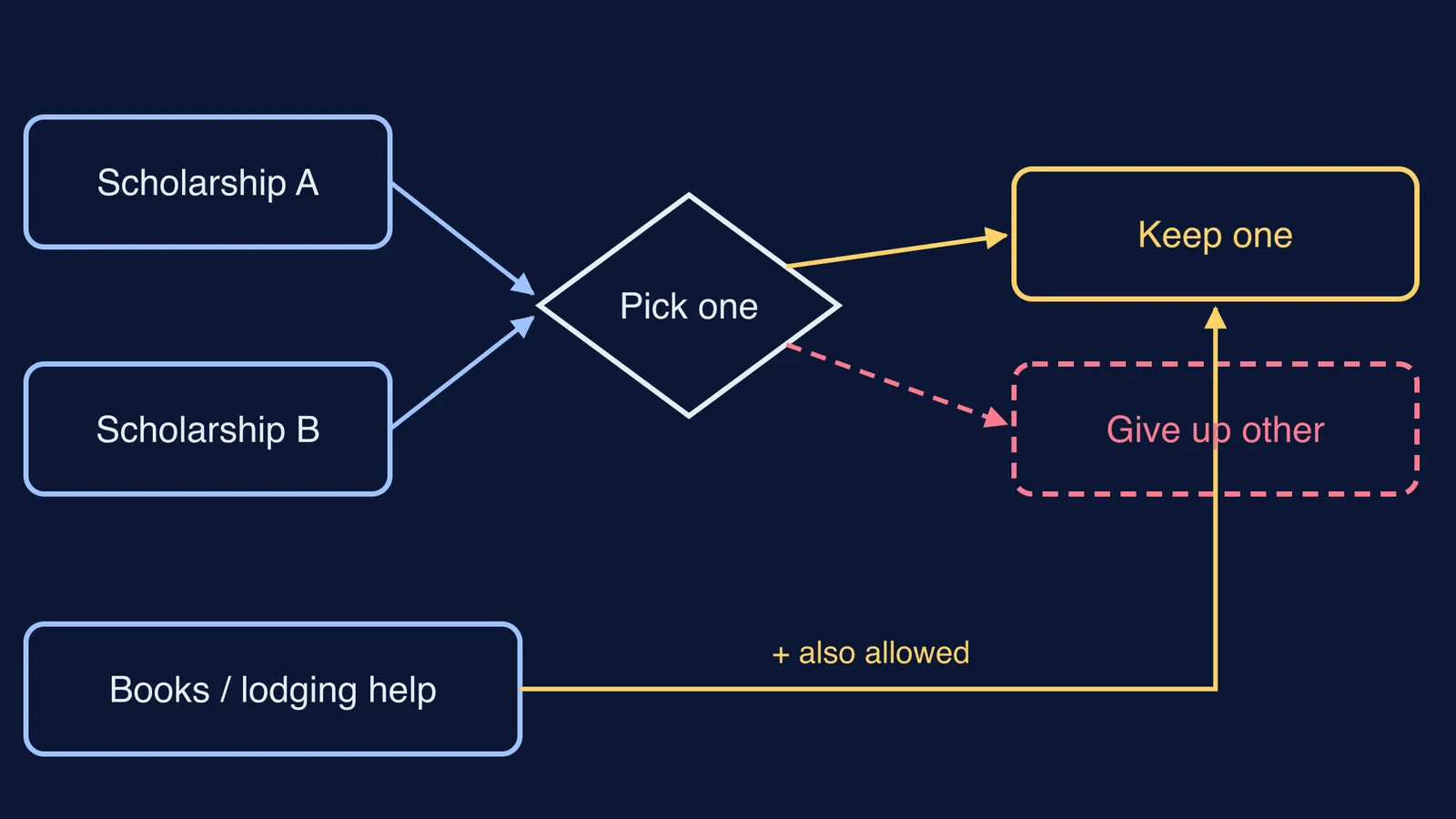
Not two government scholarships, in many cases. In the Ministry of Social Justice and Empowerment's post-matric scholarship guidelines for EBC students, clause III(xi) says a scholarship holder “will not hold any other scholarship/stipend.” If you are awarded a second one, you choose whichever is “more beneficial” and inform the awarding authority through the Head of your Institution. No scholarship is paid under that scheme from the date you accept the other.
Merit schemes carry a similar condition. The Department of Higher Education's May 2018 guidelines for the Central Sector Scheme of Scholarship make it open only to students “not availing benefit of any other scholarship scheme including State run scholarship schemes/Fee waiver and reimbursement scheme.”
The portal makes doubling up hard to hide. According to the NSP's One-Time Registration FAQ, each student gets a single OTR number after e-KYC, all of a student's applications are linked to that one number, and OTR is used to “ensure de-duplication.”
What can you combine with a government scholarship?
The same clause in the EBC post-matric guidelines lists what you may take on top. From the State Government “or any other source,” you can accept:
free lodging
a grant or one-off money for books or equipment
help with board and lodging expenses
Everything else needs a closer look:
Fee waivers. Under some schemes, a fee waiver or reimbursement can count against you. The Central Sector Scheme wording above names fee waiver and reimbursement schemes specifically. Our guide to which engineering college fee concessions and scholarships stack walks through common cases.
Private and trust scholarships. The phrase “any other scholarship/stipend” does not carve out private awards, and private donors write their own rules. Ask both sides and get the answer in writing.
What happens if you keep both and say nothing?
If a student is found to have obtained a scholarship “by false statement,” clause IX(ii) of the EBC post-matric guidelines says it will be cancelled, the amount paid may be recovered at the State Government's discretion, and the student will be “blacklisted and debarred for scholarship in any scheme for ever.” A false declaration about another award can shut you out of future schemes.
Worked example: how do you choose between two offers?
Say Ananya, a first-year B.Sc. student, is offered a state post-matric scholarship and the Central Sector Scheme. Compare three things:
Total value over the course. Yearly amount times the years it can run, counting fee reimbursement as well as cash.
Renewal conditions. The 2018 Central Sector Scheme guidelines make renewal depend on scoring 50% or more in the preceding exam and 75% attendance. A scheme you might lose in second year is worth less than its first instalment suggests.
What it blocks. If a scheme bars fee waivers and your college already gave you one, it may cost more than it pays.
Ananya picks the offer that comes out ahead on these three, writes to the principal, and keeps a copy. If staying above a renewal mark is the worry, Fermi's AI tutor can work out what you already know and build a plan for the session, so revision starts from your gaps. For the yearly paperwork, see how to renew your NSP scholarship every year.
Checklist: how to declare every award honestly
List every award: who pays, what it covers, and for how many years.
Find the “other scholarship” clause in each scheme's official guidelines on scholarships.gov.in.
If two clash, choose the more beneficial one and tell the awarding authority through your Head of Institution, in writing.
Tell any private donor about your government award, and your college scholarship cell about any private one.
Answer every “Are you receiving any other scholarship?” question on a form truthfully.
Keep one OTR. Never register a second time to apply again.
If money arrives from a scheme you gave up, report it and ask how to return it.
Ignore anyone offering, for a fee, to help you hold two awards quietly. See our five-step check for fake scholarship offers.
A note to your principal can be this simple:
“I have been selected for [Scheme A] and [Scheme B] for [academic year]. Under the scheme rules I can hold only one, so I choose [Scheme A] and give up [Scheme B]. Please forward my choice to the awarding authority. My application IDs are [IDs].”
Once you have chosen, note your renewal dates and keep a copy of every letter.