On this page
A message lands in your class WhatsApp group: a government logo, a crisp poster, perhaps a short video of an official at a podium, and a Rs 50,000 scholarship that needs only a small "registration fee" today. AI now writes these cleanly, so the polish tells you nothing. Here is how these offers work in India, and a five-step check that uses only official portals.
How do AI-made scholarship scams look so real?
The FBI's December 2024 public service alert on how criminals use generative AI for fraud says criminals use these tools to limit the grammar and spelling errors that once gave them away, to create believable images and fake identification documents, and to generate videos of executives, police or other authority figures. The alert sums it up in one line: generative AI "reduces the time and effort criminals must expend to deceive their targets."
India has its own examples. On 16 September 2026, PIB Fact Check called a viral "National Sports Scholarship 2026-27" advertisement fake, saying neither the ministry nor the Sports Authority of India had announced such a scholarship, as CareerIndia reported. PIB also flagged an AI-generated video spreading the claim. The same report lists common red flags in fake scholarship posts: link shorteners, WhatsApp-only helplines, Gmail IDs and prefilled forms asking for Aadhaar scans.
Do real government scholarships ask for a fee?
Most central government scholarships run through the National Scholarship Portal (NSP). The portal gives each student a One Time Registration (OTR) number, a 14-digit number based on Aadhaar that lasts for the student's whole academic career.
If you get help at a Common Service Centre, the NSP home page fixes the total charge for the whole job (reference number, biometric check, OTR and filing the complete application) at Rs 30, including taxes.
So a Rs 499 "processing fee", a "GST charge" or a refundable "security deposit" sent to someone's UPI ID is not how a government scholarship works.
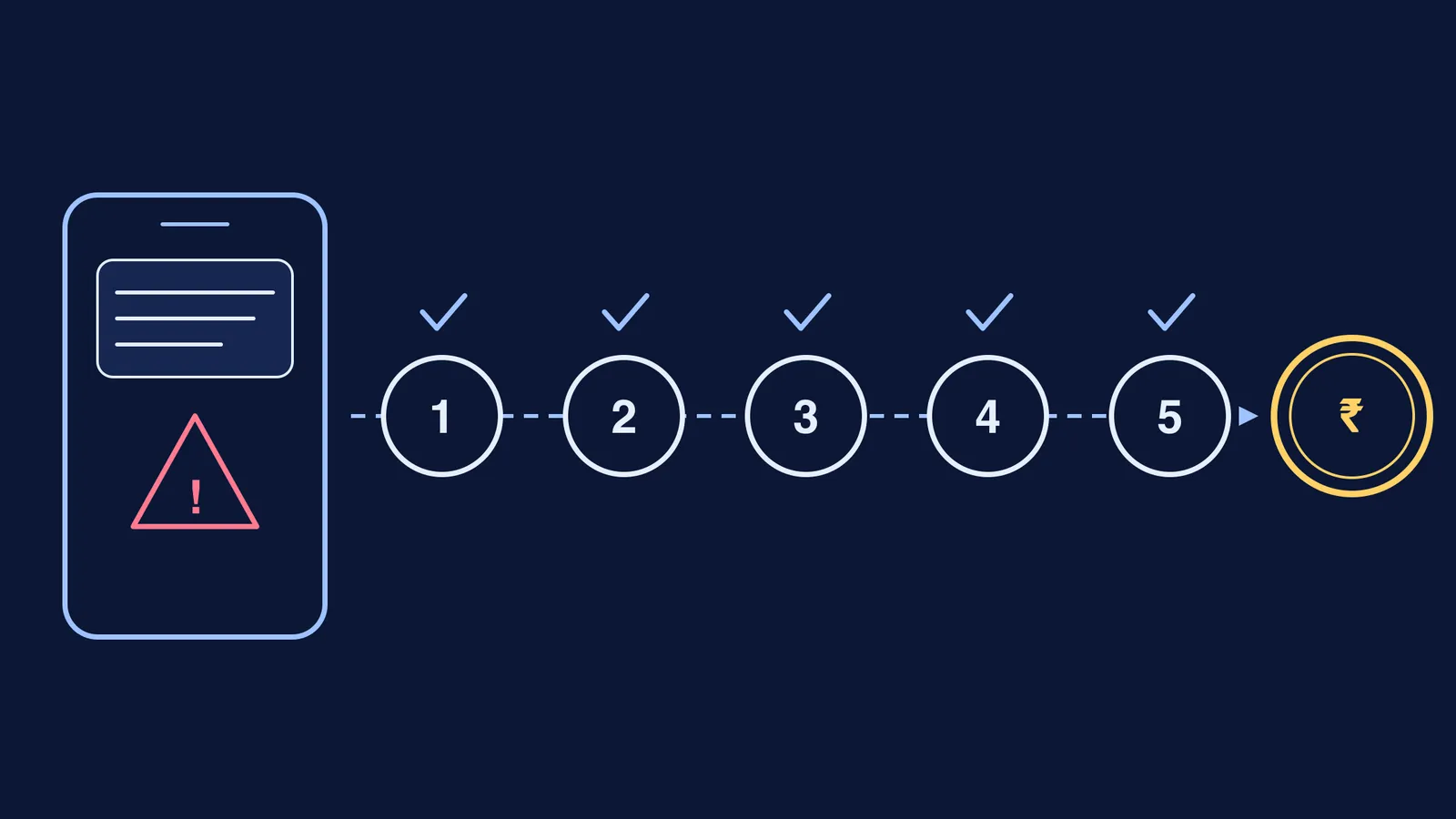
The five-step check before you pay anything
Find it yourself. Do not tap the link. Type scholarships.gov.in or the ministry's own address into your browser and search for the scheme's exact name. If it is not there, stop.
Check the channel. Central government portals such as scholarships.gov.in and cybercrime.gov.in sit on the gov.in domain. A Gmail address, a Telegram helpline, a Google Form or a shortened link is a warning sign.
Follow the money. No fee to a person's UPI ID or bank account, no OTP read out to anyone, no Aadhaar scan sent on WhatsApp.
Ask your institute. Your school's or college's scholarship cell can tell you whether a scheme is real and open this year.
Ask PIB Fact Check. Forward the message to PIB Fact Check on WhatsApp at +91-8799711259, or email socialmedia@pib.gov.in.
If any of steps 1 to 3 fails, you do not need steps 4 and 5. Delete it and report it.
What does the check look like on a real message?
Say Riya, in Class 12, receives this made-up but typical message: "PM Merit Scholarship 2026. Rs 50,000 for students above 85%. Register before midnight, Rs 499 fee. Apply at bit.ly/...", with a smooth video of a man in a suit.
Step 1: she searches the NSP for that exact name and finds nothing.
Step 2: the link is shortened and the helpline is a Telegram account.
Step 3: the fee goes to a personal UPI ID.
Three fails, so she stops and forwards it to PIB Fact Check. The video never mattered: no check asks whether something looks real.
If someone calls you instead, use this script: "I only apply through the official portal. Send me the scheme's gov.in page and I will check it with my college." Then end the call.
Parents, the deadline is the hook; agree at home that nobody pays the day they hear of an offer. For more warning signs, read how to identify fake scholarship offers; for the real process, see how to apply on the National Scholarship Portal, step by step; and to build the habit widely, read how to teach your teen to spot fake news and AI images.
What should you do if you already paid?
Act fast. The Indian Cybercrime Coordination Centre lists two ways to report online financial fraud: the helpline 1930 and the portal cybercrime.gov.in.
Call 1930 and report the payment.
Call your bank to block further debits.
Keep screenshots, the UPI transaction ID, the phone number and the link.
Ignore anyone who offers to recover your money for a fee.
AI can be used to teach as well as to fake. Fermi's AI tutor teaches rather than answers: it works out what you already know and builds a plan for the session, so the time you save on fake offers goes into real preparation.