On this page
Working backwards means testing the answer choices in the question instead of building the answer from the data. In the right question it turns a long solve into a quick check. In the wrong one it wastes time, or crosses out the right answer.
When is plugging in the options faster than solving?
Use it when checking an option is cheaper than finding the answer:
The options are values that should satisfy an equation: roots, solutions, a value of x.
The options are formulas. Test each with a special value (μ = 0, θ = 90°, n = 1), as in checking an AI formula with special values, or with dimensional analysis.
The options are ranges. Pick a point inside some ranges but not others, and test it.
Skip it when every option needs the same long computation, when the options are too close for a quick check to separate, and in numerical-value questions, where you enter a number on an on-screen keypad and there is nothing to plug back.
A worked example: which roots fit the cubic?
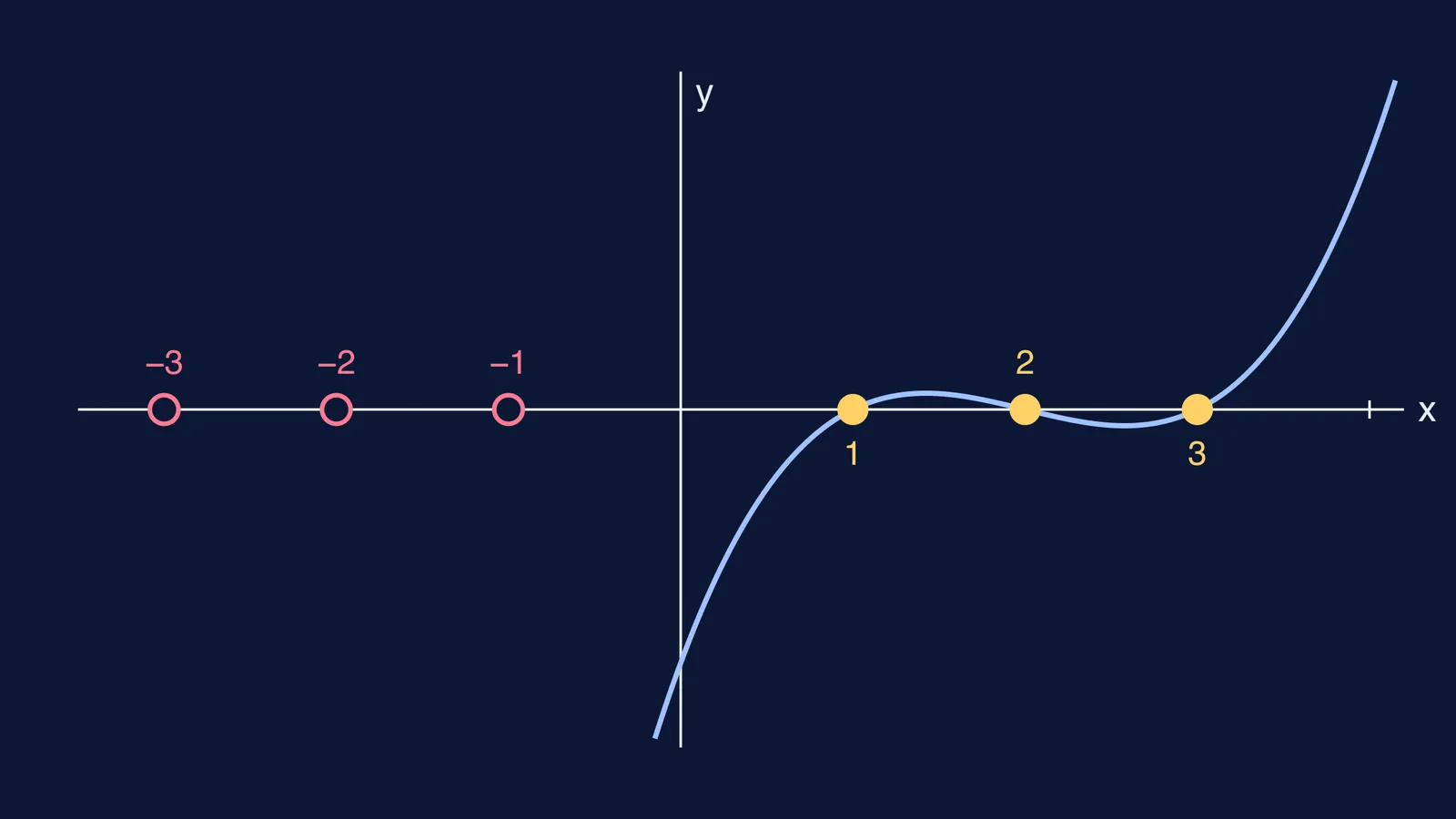
Question: the roots of x³ − 6x² + 11x − 6 = 0 are (A) 1, 2, 3 (B) −1, 2, 3 (C) 1, −2, 3 (D) 1, 2, −3.
Instead of factorising, test only the value that makes each option different:
x = −1 gives −24, not zero. B goes.
x = −2 gives −60. C goes.
x = −3 gives −120. D goes.
Confirm A rather than trusting it: x = 1, 2 and 3 each give 0.
A second check: the roots must add up to 6, the negative of the x² coefficient, and only A does.
When is an elimination not valid?
The risk is a test that looks fair but is not. A block slides down a rough incline at angle θ with friction coefficient μ. Its acceleration is (A) g(sin θ − μ cos θ) (B) g(sin θ + μ cos θ) (C) g(μ sin θ − cos θ) (D) g sin θ.
Valid eliminations:
Put μ = 0: the answer must become g sin θ. C gives −g cos θ, so C goes.
Friction opposes sliding, so the acceleration must be less than g sin θ. B goes, and D, which ignores friction, goes too.
An invalid one: a student puts θ = 0 into A, gets −μg, decides negative acceleration is impossible and crosses out A, the correct answer. On a flat floor the block does not slide, so a formula for a sliding block says nothing there. A special value must keep the situation the formula describes: with μ = 0 the block still slides, with θ = 0 it does not.
Why does a wrong elimination cost so much in JEE Main?
The JEE (Main) 2027 Information Bulletin gives four marks for a correct answer and minus one for an incorrect one, in both the multiple-choice Section A and the numerical-value Section B. In Paper 1, each subject has 20 multiple-choice and 5 numerical-value questions, per the same bulletin.
For a four-option question, here is the average result of answering, worked out from that marking scheme:
Pure guess: one chance in four of +4, three in four of −1, so +0.25 marks on average.
Two wrong options validly eliminated: half and half, so +1.5 marks.
The right option wrongly eliminated: −1 every time.
What does research say about reasoning through wrong options?
In two experiments, Little, Bjork, Bjork and Angello (2012) found that multiple-choice tests with plausible wrong options helped students later recall information about those incorrect alternatives, which cued-recall tests did not. There is a catch: Roediger and Marsh (2005) found that reading more multiple-choice lures shrank the benefit of testing and made students more likely to give those lures as wrong answers later. Working out why each option is wrong is good practice, as long as the reasoning gets checked.
A prompt to have AI judge your elimination
After a mock, pick three questions where you crossed out options and paste this into an AI chat:
“Here is a JEE question and its options: [paste]. I eliminated these options for these reasons: [option and one-sentence reason, for each]. Do not tell me the answer. Say whether each reason is valid. If not, name the flaw: tested a case the question rules out, arithmetic slip, wrong formula, or assumed the answer must look a certain way. Then ask me one question that helps me fix it.”
Then:
Fix any invalid reason yourself before asking for the answer.
Check the AI's verdict against the official answer key or your textbook; AI can be wrong too.
Log the flaw type. If one keeps coming back, practise that.
To catch a bad approach before you solve, try writing a three-line plan and asking AI to critique it. The Fermi Problem Library has worked problems with a step-by-step solver that explains the reasoning, so you can compare your route with a full one.
To see how Fermi's AI tutor works through problems alongside you, take the tour.