

On this page
Every admission cycle brings an influx of scholarship notices promising full tuition coverage, laptop grants, and monthly stipends. Alongside genuine financial assistance, however, cyber criminals deploy sophisticated phishing messages, clone websites, and fraudulent advertisements designed to siphon money from students and parents. Knowing how to tell an authentic grant from an imposter scam protects both your family's savings and your confidential academic documents.
What are the most common scholarship scam red flags?
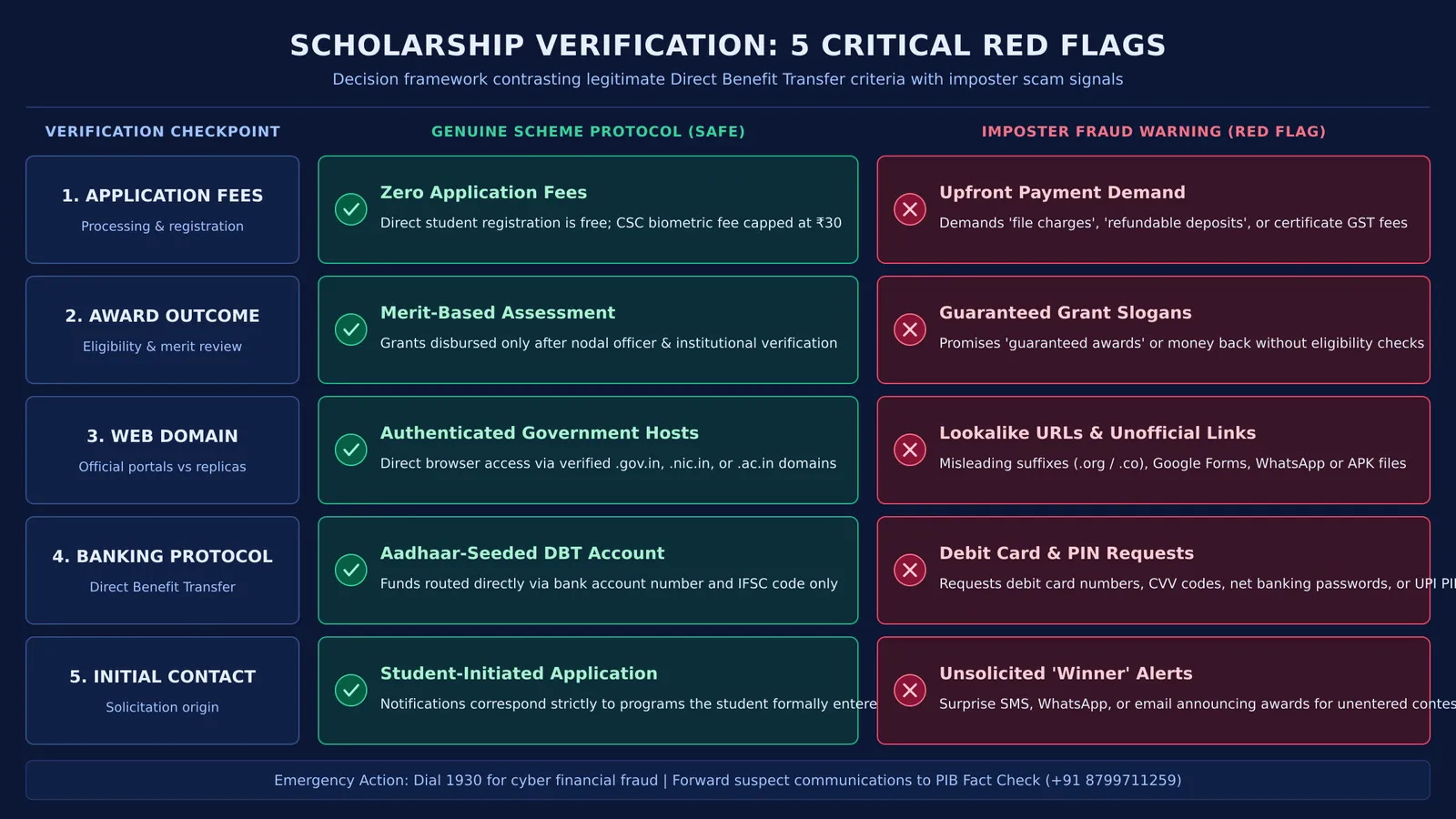
The clearest warning sign of a fake scholarship is any demand for upfront payment. According to consumer guidance from the Federal Trade Commission, legitimate scholarships exist to award money, never to charge students for the privilege of receiving it. Fraudulent schemes often disguise these charges under convincing labels:
A mandatory "file processing fee" or "document verification charge"
A "refundable security deposit" to hold your grant allocation
An administrative charge to pay "GST" or courier costs for award certificates
A service fee claiming that their agency will "do all the application work" for you
Unsolicited notifications represent another major danger signal. If an email, SMS, or WhatsApp message announces that you have been selected as a finalist or winner for an award you never applied for, it is almost certainly a scam. Fraudsters also promise guaranteed outcomes, using slogans such as "the award is guaranteed or your money back." In reality, no authentic scholarship committee guarantees an award before reviewing merit and eligibility.
The scale of impersonation fraud is extensive. In 2024, consumers reported losing over $12.5 billion to fraud according to the FTC Consumer Sentinel Network data. Among consumers aged 20 to 29—an age group heavily populated by students—44% of those who filed fraud reports experienced actual financial losses, the highest frequency of any demographic group.
How do lookalike websites and viral messages deceive students?
Scammers frequently build replica portals that mimic government bodies and well-known trusts. In India, central government financial aid is administered through the National Scholarship Portal (NSP). On the official portal, direct student registration and One-Time Registration (OTR) are completely free. Even when students visit an authorized Common Service Centre for biometric authentication or form submission, the government has capped the total service charge at ₹30 inclusive of all taxes. Any portal or individual demanding hundreds or thousands of rupees is operating outside the law.
Pay close attention to domain extensions. Authentic central and state government portals in India strictly end with `.gov.in` or `.nic.in`. Scammers register misleading domain variations such as `scholarships-gov.in`, `nsp-scholarship.org`, or `indiascholarships.co` to deceive search engines and users.
Viral social media messages frequently fabricate non-existent government programmes. For instance, in September 2026, the PIB Fact Check unit issued a formal alert debunking a viral WhatsApp campaign for a fake "National Sports Scholarship Scheme 2026–27" under the name KheloGram. PIB also clarified that claims of a flat ₹10,000 NSP grant distributed to all college students without criteria were entirely false. Before trusting an unfamiliar scheme, compare it with vetted opportunities described in our guide to central and state scholarships for science students.
How should families verify an educational offer before applying?
Evaluating an educational offer requires a disciplined verification protocol, similar to evaluating coaching institute fees before enrolling. Before entering personal data or sending documents, run through this four-step check:
Verify the domain in the address bar: Never click links inside unsolicited text messages. Type the official URL directly. Genuine portals use `.gov.in`, `.nic.in`, or recognized university domains like `.ac.in` or `.edu`.
Confirm Direct Benefit Transfer protocols: Genuine public scholarships disburse funds through Direct Benefit Transfer (DBT) directly into your Aadhaar-seeded bank account. They require only your bank account number and IFSC code for disbursement. They never require debit card numbers, CVV codes, net banking passwords, or UPI PINs.
Cross-reference with your institution: Ask your school principal, college financial aid office, or scholarship nodal officer to verify whether the award notification corresponds to an approved institutional scheme.
Search fact-checking registries: Search the scheme's name alongside "PIB Fact Check" or check the suspect repository on national cybercrime portals.
While completing secondary school and preparing for your first semester at college, students can avoid application anxiety by focusing on verified academic resources. The Fermi Concept Library provides structured lessons covering every concept in physics, chemistry, biology, mathematics and computing, each with its own lesson and its place in the map. For exam numericals and competitive problem solving, the Fermi Problem Library offers worked problems with a step-by-step solver that explains the reasoning rather than printing an answer.
What should you do if you shared sensitive details or sent money?
If you suspect you have engaged with a fraudulent scholarship or transferred funds, rapid action is essential to limit damage.
Take these corrective steps immediately:
Contact your bank: Request an immediate block on compromised debit cards, credit cards, or net banking access. If you authorized a UPI transfer, file an immediate fraud dispute.
Call the cybercrime helpline: Dial 1930 in India to register a complaint under the Citizen Financial Cyber Fraud Reporting system, or file a detailed report at the National Cyber Crime Reporting Portal.
Report the communication: Forward suspicious WhatsApp messages or SMS alerts to the PIB Fact Check helpline at +91 8799711259, or submit the fraudulent number to the Department of Telecommunications Chakshu portal on Sanchar Saathi.
Staying skeptical of unverified promises ensures your academic journey remains funded safely and securely.


