On this page
Both GNM and BSc Nursing lead to the same licence: registration as a nurse and midwife. They differ in how long you study, which Class 12 subjects you need, what you pay in total and how easily you can move up later. Here is how they compare under Indian Nursing Council (INC) rules, with a five-question check you can do as a family.
What is the difference between GNM and BSc Nursing?
GNM (General Nursing and Midwifery) is a three-year diploma taught in schools of nursing. According to the INC's frequently asked questions document, GNM was cut from three and a half years to three from 2015-16, with the internship built in.
BSc Nursing is a four-year, eight-semester degree taught in colleges of nursing, according to the INC's revised BSc Nursing regulations%20(Program)%20Regulations,2020..pdf), published in the Gazette on 5 July 2021. The eighth semester is a hospital internship.
GNM admissions are still running. For example, West Bengal held a common entrance test for its three-year GNM course for the 2026-27 session (WBJEEB).
How do GNM and BSc Nursing compare at a glance?
These points come from the INC eligibility criteria, FAQ and the BSc Nursing regulations%20(Program)%20Regulations,2020..pdf).
Length: GNM takes 3 years. BSc Nursing takes 4 years over 8 semesters.
Class 12 stream: GNM accepts any stream with English, though the INC adds "Science is preferable." BSc Nursing needs Physics, Chemistry and Biology plus English.
Minimum marks: GNM needs 40% in the qualifying exam and in English. BSc Nursing needs 45% in PCB taken together, or 40% for SC, ST and OBC candidates, and a pass in English.
Selection: BSc seats go by merit in an entrance test run by the university or state government. GNM selection varies; West Bengal uses the test above.
Licence: Both lead to registration as a Registered Nurse and Registered Midwife (RN&RM) with your State Nursing Registration Council.
Next degree: A BSc graduate can apply for MSc after a year of work. A GNM nurse needs a Post Basic BSc first.
Who is eligible for the BSc Nursing entrance test?
The BSc regulations%20(Program)%20Regulations,2020..pdf) set the minimum age at 17 on 31 December of the admission year and the upper limit at 35. The test has five sections (nursing aptitude, physics, chemistry, biology and English), each worth 20 marks, and you need at least 50% to qualify.
If you took commerce or humanities, GNM is your direct route in. If you took PCB, both routes are open, and three of the five test sections are Class 12 science. If some biology or chemistry topics feel shaky, the Fermi Concept Library has a lesson for every concept in physics, chemistry and biology, so you can fix gaps one topic at a time. For the steps after the test, read how BSc Nursing admission works.
Which costs more, GNM or BSc Nursing?
Fees vary too much across states and colleges for one figure to help. Count the years you pay fees instead. GNM means three years of fees and BSc Nursing means four. But the INC FAQ says Post Basic BSc takes 2 years full-time or 3 by distance. That makes GNM followed by a degree five fee years, against four for BSc Nursing.
Which is better for career growth?
At the start, both lead to the same registration, handled by your State Nursing Registration Council, says the INC FAQ. The BSc regulations%20(Program)%20Regulations,2020..pdf) add that registered nurses must complete Continuing Nursing Education to renew registration every 5 years.
The gap opens later. The INC's MSc Nursing regulations describe a two-year course. To get in, you need a BSc or Post Basic BSc in Nursing with 55% aggregate, RN&RM registration and at least one year of work experience. Under the BSc regulations, every college teaching post from assistant professor up requires an MSc in Nursing.
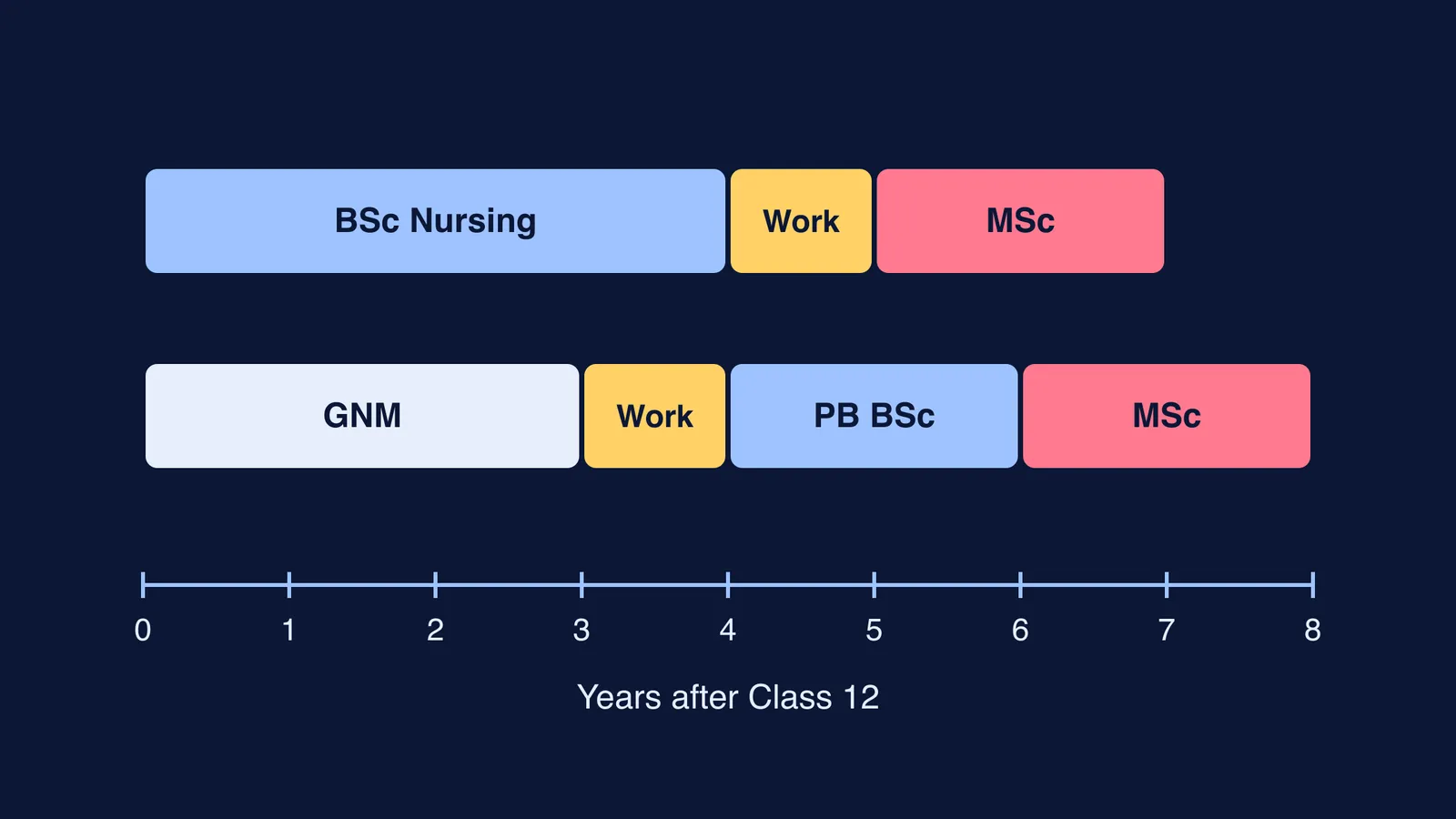
Our worked example of the quickest full-time route from Class 12 to MSc, using those INC durations:
BSc route: 4 years of BSc + 1 year of work + 2 years of MSc = 7 years.
GNM route: 3 years of GNM + 1 year of work + 2 years of Post Basic BSc + 2 years of MSc = 8 years.
To see where a degree can lead, read about nursing specialisation routes after graduation. Parents comparing nursing with other health courses can also read BSc Nursing and allied health paths.
GNM or BSc Nursing: which should you choose?
Answer these together:
Did you study PCB and score at least 45% in it together (40% for SC, ST or OBC, under the BSc regulations%20(Program)%20Regulations,2020..pdf))?
Can the family pay for four years now, or is studying for three and earning sooner more realistic?
Do you hope to teach, manage or specialise later?
Is the institution recognised by the INC and your state council? Check before paying anything.
Is there a hospital attached where you will actually train?
Before you apply, read your state's current admission notice and the INC eligibility page.